Automakers Turn Vehicles into Home Power Backup Systems Amid Grid Concerns and EV Market Shifts
As extreme weather events continuously test regional electrical infrastructure, major automakers are pivoting beyond transportation to turn passenger vehicles into emergency residential power stations. The strategy allows car companies to extract new value from multi-billion-dollar battery investments while giving homeowners an alternative to traditional backup generators.
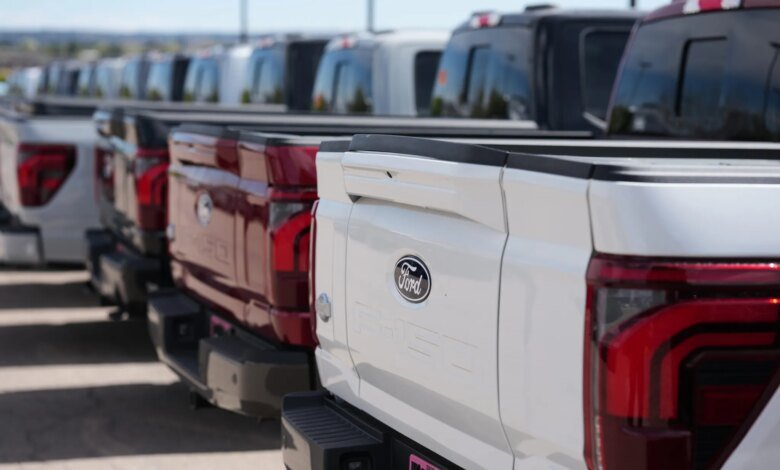
Ford Motor Company recently introduced a direct meter connection setup designed for roughly 200,000 compatible trucks, including the all-electric F-150 Lightning and the F-150 PowerBoost hybrid. Developed alongside Global Power Products, the system utilizes a one-foot adapter plugged into an onboard 240-volt socket, connecting via high-capacity cable to a transfer switch mounted directly at the household electric meter. By allowing homeowners to manually select critical circuits on their main breaker panel, the configuration turns standing vehicles into immediate electricity sources.
The system presents significant cost advantages over conventional backup generation. While whole-home standby systems or stationary diesel units frequently require heavy capital outlays running into several thousands of dollars, Ford’s hardware package starts at around $1,100, excluding professional meter installation. Depending on household demand, an F-150 Lightning can supply home electricity for two to three days, while the hybrid PowerBoost can run up to five days on a single gas tank.
“The way we think about it, especially for customers who already have a compatible vehicle is, you already own the power source, it’s in your driveway,” said Amanda Roraff, lead for grid and energy services business acceleration at Ford.
Consumer interest in off-grid power resilience has spiked following catastrophic grid failures across the country. In Texas, memory of the devastating multiday blackout caused by Winter Storm Uri in February 2021—which paralyzed local infrastructure and left millions without heat—continues to drive adoption. Kenneth Kovar, 64, a resident of New Braunfels, Texas, purchased an F-150 last fall specifically to secure residential energy autonomy after relying on pool water to flush toilets during Uri when his independent septic system lost power.
The movement toward integrated home energy ecosystem development extends across the automotive landscape. Over 630,000 vehicles on American roads currently possess vehicle-to-home capabilities, according to industry estimates, with carmakers racing to establish full vehicle-to-grid compatibility. General Motors recently partnered with energy software firm WeaveGrid, enabling drivers to participate in utility reliability initiatives where GM’s vehicle-to-home technology automatically isolates a dwelling from the main grid during an outage to begin discharging vehicle energy.
“If you can imagine the future as we go forward, it’s having the ability — now that we have this single platform — that allows our customer to experience our system,” noted Wade Sheffer, vice president of GM Energy, adding that users gain “full control of the energy.”
Meanwhile, Tesla offers vehicle-to-home integration through custom hardware for its Cybertruck, while South Korean manufacturer Kia has joined forces with charging station maker Wallbox to facilitate home backup and power feed-back onto the grid during peak usage hours. As electricity demands rise and localized blackouts grow more frequent—a trend documented by the U.S. Energy Information Administration—automakers view these utility offerings as vital secondary business lines.
The commercial pivot comes at a critical juncture for the automotive sector. Pure electric vehicle sales in the United States plunged 23.8% year-over-year during the first half of 2026, according to a July study by Cox Automotive. Facing policy shifts and slower retail demand for pure EVs, car companies are attempting to monetize their battery architecture across adjacent sectors.
“They’re trying to look for other businesses that they might sell into,” explained Parth Vaishnav, assistant professor of sustainable systems at the University of Michigan.
Expanding vehicle-to-home architecture remains fraught with regulatory and technical hurdles. Systems must undergo third-party safety certifications and ensure seamless software communication between vehicle and charger. Crucially, connecting home systems directly to public power grids requires formal utility interconnect agreements, a bureaucratic permitting process that can stretch across years in some jurisdictions.
Despite those bottlenecks, academic experts anticipate rapid adoption as consumers seek personal energy security against fragile public utilities. “We already know during an outage, its impact, providing electricity to the home,” said Scott Samuelsen, engineering professor emeritus at the University of California, Irvine. “This is going to become very, very popular.”