European Imports of Russian Yamal LNG Hit Record High Ahead of Planned Ban
EU purchases of Siberian gas rise 18% in the first half of 2026 despite looming sanctions deadlines.
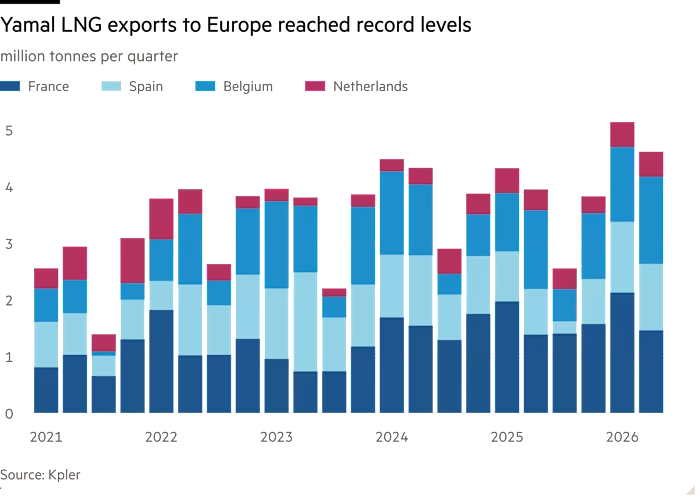
Europe imported record volumes of liquefied natural gas from Russia’s flagship Yamal LNG project in the first half of 2026, absorbing nearly all of the Siberian facility’s output just months before a European Union ban on Russian gas imports is scheduled to take effect.
EU purchases from the Yamal LNG facility, which is controlled by Russia’s privately owned Novatek, reached a record 9.89mn tonnes during the first six months of the year. This represents an 18 per cent increase compared to the same period last year, according to data from analytics company Kpler.
The figures highlight the ongoing role Europe plays in sustaining Russia’s primary energy facility as Moscow’s war against Ukraine continues through its fifth year. Estimates from Urgewald, a non-governmental organization, suggest European buyers may have paid up to €6bn for these shipments.
France, Belgium, and Spain emerged as the primary European destinations. Kpler data shows France imported 3.6mn tonnes, Belgium took 2.9mn tonnes, and Spain received 2.7mn tonnes from Yamal in the first half of 2026.
Sebastian Rötters, a sanctions campaigner at Urgewald, described the import volumes as “stark.” Rötters pointed out that these purchases did not occur in a vacuum, noting they coincided with a period in which Russia intensified its assault on Ukrainian civilian sites and energy infrastructure.
Regulatory and Logistical Hurdles
Current EU regulations prohibit the purchase of Russian LNG under short-term contracts. Consequently, every cargo arriving in Europe from the project requires the importing nation’s customs authority to verify that the transaction occurred under a long-term contract.
A broader EU ban on long-term Russian LNG imports is set to take effect on January 1 2027, which will compel Russia to find alternative routes. A ban on pipeline gas imports will follow later that year.
Europe’s willingness to accept these shipments has been vital for the Siberian project. Located in the deep Russian Arctic, the facility relies on a specialized, limited fleet of Arc7 ice-class tankers. The project’s export capacity is highly dependent on the rapid turnaround of these vessels at European ports.
In contrast, shipping gas via the Northern Sea Route to Asia is a longer and riskier alternative. In the first half of the year, Yamal shipments to Asia fell by 74 per cent to just over 510,000 tonnes. While Asia-bound shipments typically rise during the summer months, volumes have remained low so far this year. Sources familiar with the matter indicated that some international shipping companies, insurers, and financial institutions are hesitant due to potential exposure to EU sanctions.
The specialized ice-class vessels also require maintenance services from European shipyards. This includes repairs at Damen’s yard in Brest, France, and Fayard A/S in Denmark.
“Yamal LNG depends on a small, specialised fleet, European ports and European services to keep exports flowing. Europe continues to provide all three,” Rötters said.
Ownership and Corporate Stances
Inaugurated by Russian President Vladimir Putin in 2017, Yamal remains the country’s largest producer of liquefied gas, with an official design capacity of 17.4mn tonnes annually, though actual output frequently exceeds this figure. Novatek holds the majority stake, while France’s TotalEnergies and China’s CNPC also hold ownership interests.
In February, TotalEnergies chief executive Patrick Pouyanné stated that the company, which holds long-term export contracts with the project, might be forced to halt exports entirely—not just to the EU but from the project as a whole—due to “ambiguities” in the upcoming EU ban.
Technical Overview
Liquefied natural gas is natural gas that has been cooled to approximately -162 degrees Celsius (-260 degrees Fahrenheit), reducing its volume by about 600 times to facilitate transport via specialized tankers.
The Yamal Peninsula is located in northwest Siberia, extending into the Kara Sea. The region experiences extreme Arctic temperatures, meaning the surrounding waters are covered in thick ice for much of the year. To navigate these conditions without dedicated icebreaker escorts, projects like Yamal rely on specialized ice-class vessels. These ships feature reinforced hulls and unique propulsion systems designed to break through ice up to 2.1 meters thick.
The Northern Sea Route runs along Russia’s Arctic coast from the Kara Sea to the Bering Strait. While it offers a significantly shorter geographic route to Asian markets compared to the traditional southern route through the Suez Canal, its viability is limited by seasonal ice cover, unpredictable weather, and a lack of deep-water ports and search-and-rescue infrastructure.