U.S.-Russian Space Crew Docks at ISS as Rare High-Level Diplomacy Preserves Orbital Partnership
NASA Administrator Jared Isaacman's historic visit to Baikonur underscores the fragile but enduring space alliance amid deep geopolitical tensions.
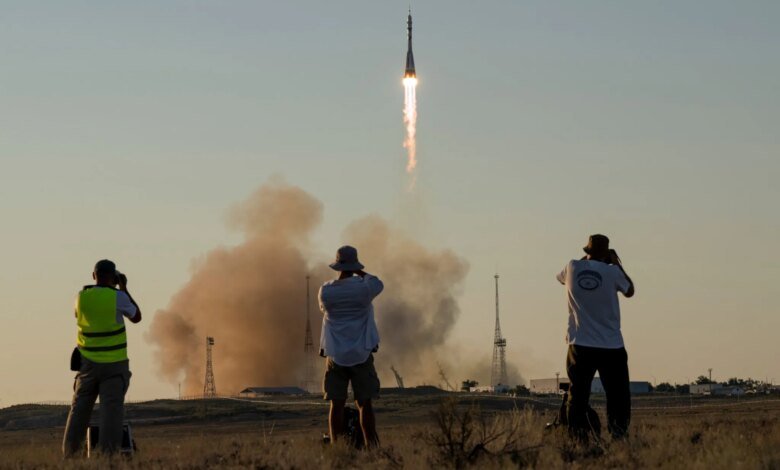
The International Space Station welcomed a new trio of residents on Tuesday, marking a successful orbital rendezvous that highlights the resilient, if increasingly isolated, scientific partnership between Washington and Moscow.
A three-person U.S.-Russian crew arrived safely at the station after launching from the Russia-leased Baikonur cosmodrome in Kazakhstan. The spacecraft, a Roscosmos Soyuz MS-29, lifted off precisely on schedule at 7:47 p.m. local time (10:47 a.m. EDT, 1447 GMT) on Tuesday, embarking on an eight-month stint aboard the orbiting outpost. Following a brief and highly efficient transit, the capsule docked smoothly in automatic mode approximately three hours after leaving the launchpad.
On board the spacecraft were NASA astronaut Anil Menon, making his first journey into space, alongside veteran Russian crewmates Pyotr Dubrov and Anna Kikina, both embarking on their second spaceflights.
The launch was notable not just for its flawless execution, but for the high-level diplomatic presence on the ground. NASA Administrator Jared Isaacman traveled to Kazakhstan to witness the liftoff firsthand. The trip marked the first visit to the Baikonur cosmodrome by a NASA chief in eight years, underscoring the delicate efforts by both nations to preserve their orbital collaboration even as relations on Earth remain severely strained by Russia’s ongoing military actions in Ukraine.
Prior to the launch, Isaacman engaged in direct talks with Dmitry Bakanov, the head of Russia’s state space corporation, Roscosmos. During a meeting with the crew on Monday, Isaacman expressed deep appreciation for the bilateral coordination required to pull off the mission. He noted that “the integrated work performed over the past several months reflects the professionalism and dedication of everyone involved.”
In addition to his discussions with Dmitry Bakanov, the NASA chief met with Russia’s Deputy Prime Minister Denis Manturov. According to Manturov’s office, the two officials discussed prospective cooperation on the International Space Station as well as other potential space initiatives.
Upon entering the space station, Menon, Dubrov, and Kikina were greeted by the current multinational crew. The orbiting outpost is currently home to NASA astronauts Jessica Meir, Jack Hathaway, and Chris Williams, European Space Agency astronaut Sophie Adenot, and Roscosmos cosmonauts Sergei Kud-Sverchkov, Sergei Mikaev, and Andrei Fedyaev.
The ongoing partnership represents a remarkable survival of Cold War-era scientific diplomacy. Once bitter rivals in the 20th-century space race, the United States and Russia transitioned into close collaborators on the ISS, creating a complex, interdependent orbital laboratory where neither side can operate without the other. While this relationship has been deeply tested by geopolitical fallout—particularly after Moscow sent troops into Ukraine in 2022—the practical realities of space flight have forced Washington and Moscow to maintain their joint operations. This includes continuing the “cross-flight” program, where American astronauts and Russian cosmonauts share rides on each other’s spacecraft to guarantee a continuous presence of both nations on board.
However, the limits of this cooperation are becoming increasingly clear. While the ISS remains protected from the worst of the geopolitical storm, broader plans for deep-space exploration have fractured. Ambitious proposals for Russian participation in NASA’s Artemis program—the U.S.-led initiative aimed at returning humans to the Moon and establishing a sustainable lunar base—have completely fallen apart.
Instead, as Western economic sanctions have intensified, Russia has found itself increasingly reliant on China for critical technology imports and energy exports. This economic pivot has mirrored a strategic realignment in space. With Western partnerships freezing over, Roscosmos has turned its sights eastward, formalizing cooperation with China on its own prospective lunar mission. For now, the ISS remains a rare, floating island of cooperation, but the shifting alliances below suggest that the future of space exploration may look vastly different once this station is eventually decommissioned.