AI Infrastructure Surge Squeezes Alibaba Profits Despite Accelerating Cloud Revenue
Cloud growth hits three-year high while capital expenditure surges to $10 billion

A surging artificial intelligence expansion lifted Alibaba’s revenue past Wall Street estimates to 268.95 billion yuan ($40 billion) in its fiscal first quarter, a 9% year-over-year increase that narrowly beat the 268.88 billion yuan anticipated by analysts.
The performance marks the Chinese tech firm’s fastest quarterly growth rate in nearly three years, with nearly the entire expansion driven by its cloud and AI units.
The company’s cloud division served as the primary growth engine, where Alibaba Cloud’s external revenue growth accelerated to 45%. Meanwhile, AI-related product revenue reached 12.38 billion yuan ($1.82 billion), marking its 12th consecutive quarter of triple-digit year-over-year growth. In Alibaba’s earnings statement, CEO Eddie Wu cited improved commercialization across the firm’s full-stack AI portfolio as the key driver of the quarter’s momentum.
Maintaining that technological push required substantial spending. Capital expenditure surged 75% to 67.7 billion yuan ($10 billion), driven mainly by rising chip prices and the expansion of compute capacity as AI demand outpaced supply. The aggressive spending caused free cash flow to swing to an outflow of more than $6.6 billion for the quarter, according to Bloomberg data, while net income dropped 75% to RMB 10.44 billion ($1.6 billion).
The intense capital outlay underscores how major technology vendors are sacrificing short-term profitability to secure specialized hardware and compute capacity, positioning themselves to capture market share in cloud infrastructure before broader software monetization fully takes hold.
Wall Street reacted sharply to the cost pressures. Shares of Alibaba trading in the U.S. slid roughly 5% shortly after the opening bell before paring losses to hover down about 3.5% by midday.
The AI monetization play
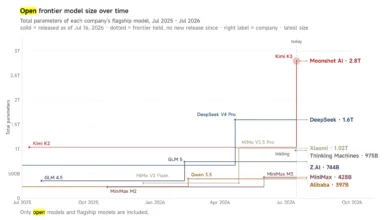
Alibaba’s cloud gains coincide with a strategic pivot toward aggressive distribution of its Qwen models alongside pure research and development. Earlier this month, Alibaba released Qwen 3.8-Max—its most capable model—as open weights for the first time at that scale, following an April decision to end the free tier for its Qwen Code coding agent.
The company is simultaneously building its presence beyond the domestic Chinese market. Apple is pairing its in-house software with Alibaba’s Qwen model to deliver Apple Intelligence on Chinese iPhones, a strategic partnership that could position Apple as the first foreign firm authorized to operate a proprietary AI model inside China.
The impact of that distribution strategy is already reflected in open platform adoption metrics. Tokens generated by Chinese open-weight models on OpenRouter climbed from under 2% in late 2024 to approximately 61% by mid-2026, establishing a dominant developer footprint even as Alibaba’s quarterly net income shrank by three-quarters.