Bond Market Tests Fed Chair Warsh as 30-Year Treasury Yields Reach 5.3%
30-year Treasuries hit 5.3% as Fed drops forward guidance
U.S. Treasury yields have reached their highest levels since 2007, with 30-year yields sitting near 5.3% as the bond market tests Federal Reserve Chair Kevin Warsh following his decision to eliminate forward guidance.
The yield increase accelerated after recent meetings of the Federal Open Market Committee, where Warsh declined to provide forward guidance on future interest rate moves. In July, financial markets formed the impression that tightening financial conditions through higher yields were performing policy work for the central bank, leaving investors uncertain over whether officials would proceed with rate hikes despite softer inflation and labor data.
“It is too early to draw firm conclusions, but the rise in the term premium and bear steepening of the curve following Warsh’s first two [Federal Open Market Committee] FOMC meetings could indicate that the Fed’s credibility is being tested,” said Bassam Nawfal, chief asset allocation strategist at Alpine Macro in a report yesterday.
The shift in the term premium—the extra compensation investors require to hold long-term debt rather than rolling over short-term bills—follows increased uncertainty over the central bank’s rate trajectory. Data from the Federal Reserve Bank of New York shows term premia rising alongside a bear steepening of the yield curve, where long-term yields climb faster than short-term rates.
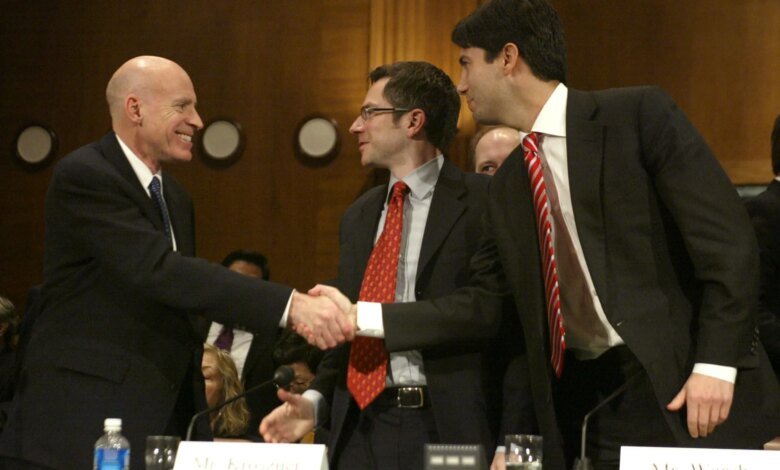
“There’s a teething process whenever there is a new Fed chair … there were concerns about Jay Powell when he first came in,” Prof. Kroszner told Fortune—speaking last week, ahead of the latest yield jump. “Kevin is very clear that he wants to change the communication strategy, and people … in the press as well as in the markets don’t like change, [they think]: ‘I’m used to this, I know how everything works, and now I don’t know how everything works and I’m frustrated.‘”
Randall Kroszner, a professor of economics at the University of Chicago Booth School of Business who was confirmed to the Fed’s Board of Governors alongside Warsh in 2006, noted that Warsh intends to focus on broader inflation objectives rather than reacting to incremental economic data. At his inaugural post-FOMC press conference in June, Warsh stated: “I’ve said for years inflation is a choice. You bet it is. And today I’m announcing that this Committee, unambiguously and unanimously, have decided we are going to deliver on that.” The statement came despite demands from President Trump that his Fed nominee be willing to cut the base rate.
Economists remain divided over Warsh’s communication policy. Former Federal Reserve economist Claudia Sahm stated that Warsh is “long on symptoms and short on solutions.” Jeremy Siegel, emeritus professor of finance at the Wharton School of the University of Pennsylvania, wrote for WisdomTree that central bankers have an “obligation to explain the economic framework behind their decisions” and argued that Warsh fell short during his recent public appearances.
Kroszner indicated that Warsh remains aware of market reactions while establishing internal task forces to review current Fed practices. While noting that central bankers should avoid being “a slave to what’s happening in the markets,” Kroszner said Warsh remains sensitive to financial market developments as those task forces examine operational questions.