Bitcoin Holds $64.5K as Tech Rebound and PCE Inflation Cooling Ease Market Pressure
Crypto markets stabilize as US PCE inflation moderates to 3.7% and tech stocks rally following early-week volatility.
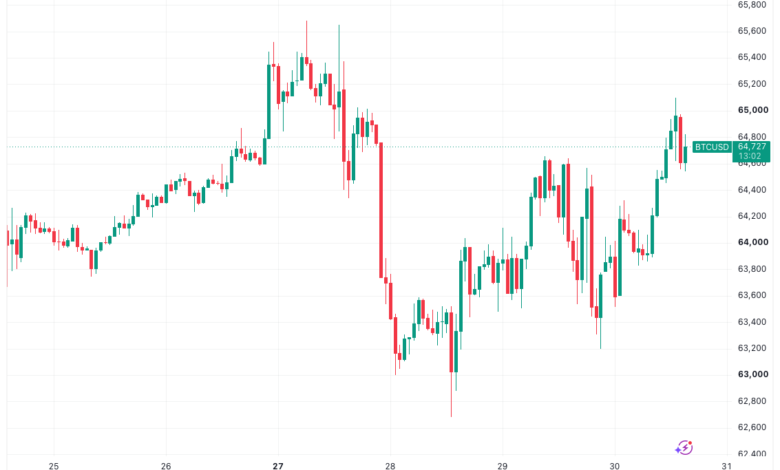
Bitcoin held steady near $64,500 on Thursday, decoupling from early-week market jitters as Wall Street mounted a solid recovery driven by technology stocks and macroeconomic data that matched expectations.
Broad equity benchmarks advanced significantly during the US trading session, with the Nasdaq Composite climbing 2.3% and the S&P 500 adding 1%. The gains followed a stabilization in semiconductor equities, whose sharp early-week sell-off had briefly dragged down digital assets and wider risk markets.
Clarifying the economic environment, fresh data from the US Bureau of Economic Analysis showed the June Personal Consumption Expenditures index rose 3.7% year-on-year. The reading matched market consensus and marked a noticeable slowdown from May’s 4.1% print, which had represented a three-year high. June also recorded the first month-over-month decrease in the PCE figure since 2020.
The US Bureau of Economic Analysis noted that June’s personal income gains were primarily driven by higher compensation, personal income receipts on assets, and government social benefits, which were partially offset by a decline in farm proprietors’ income.

Preferred by the Federal Reserve over the Consumer Price Index for its ability to adapt quickly to changing consumer substitution patterns, the PCE index serves as the primary benchmark for central bank policy. Despite the moderation in June, analysts cautioned that price increases remain sticky. Financial commentary firm The Kobeissi Letter noted that 3.7% is still the second-highest print since October 2024, emphasizing that inflation continues to run nearly double the Federal Reserve’s 2.0% target. Johns Hopkins University economist Steve Hanke also highlighted that central bankers have yet to bring consumer price increases fully under control.
The inflation print followed Wednesday’s Federal Reserve decision to leave interest rates unchanged, an event that highlighted a growing policy split among members of the Federal Open Market Committee.
Amid shifting macroeconomic expectations, institutional analysts suggest Bitcoin may be growing less sensitive to central bank interest rate decisions. Matt Hougan, Chief Investment Officer at asset manager Bitwise, stated that future Federal Reserve interest rate announcements are likely to exert far less influence over Bitcoin price movements than in past monetary cycles.
Hougan explained that earlier crypto cycles were defined by aggressive interest rate swings between 0% and 5%. By contrast, expectations derived from CME Group’s FedWatch Tool point to much tighter policy adjustments ahead, anticipating roughly 50 basis points of rate increases over the next year.
According to Hougan, incoming Federal Reserve Chair Kevin Warsh is expected to emulate the modest, incremental rate adjustments associated with former Fed Chair Alan Greenspan rather than the broader swings overseen by Jerome Powell. President Donald Trump has previously signaled expectations that Warsh would maintain a dovish stance, an outlook traditionally supportive of risk-heavy financial markets.