Injective Moves Toward Regulated Finance with SEC Transfer Agent Filing
The DeFi-focused blockchain aims to bridge the gap between decentralized ledgers and regulated securities record-keeping.
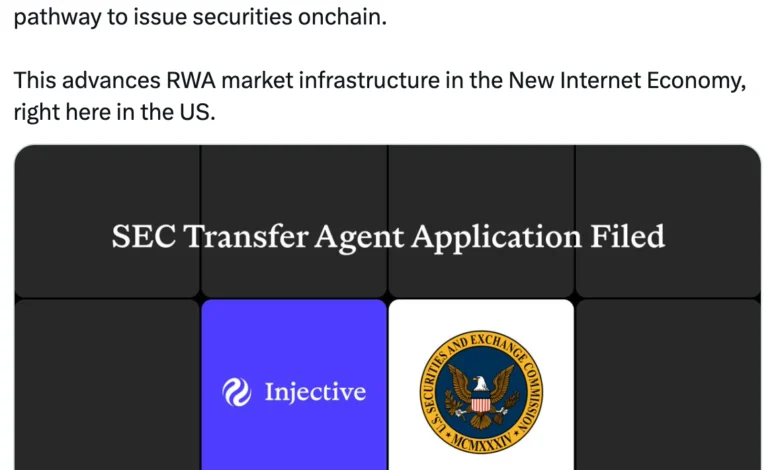
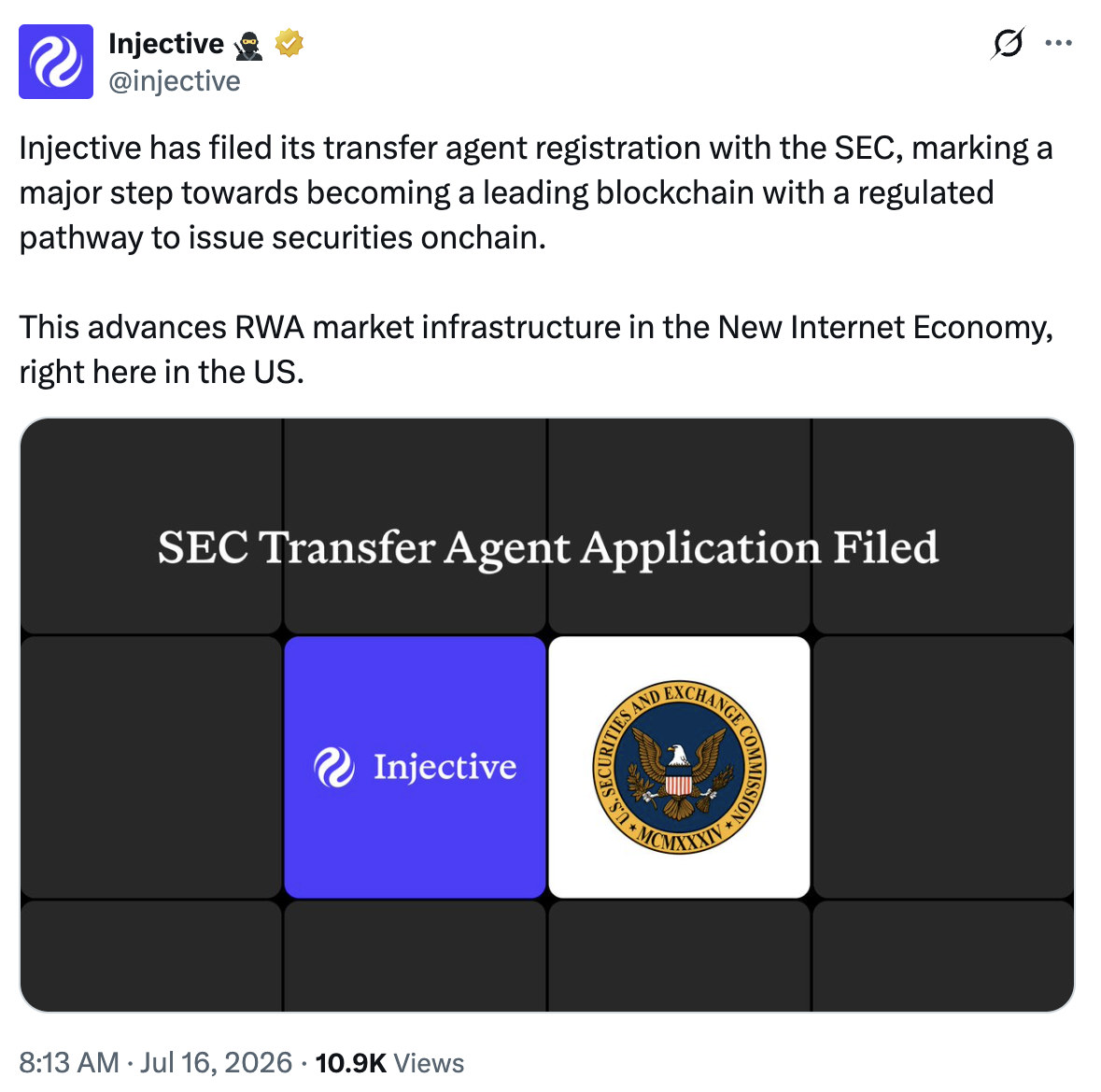
Injective, a prominent layer-1 blockchain designed for decentralized finance, is making a strategic push into the heart of regulated US financial markets. The project announced Thursday that it has filed a transfer agent registration with the SEC, a move intended to bridge the gap between decentralized ledgers and the rigorous record-keeping requirements of traditional securities.
By seeking this status, Injective aims to bring one of the most critical, yet often invisible, functions of the financial system onto its blockchain infrastructure. In the traditional world, a transfer agent acts as the official record-keeper for a company’s securities. They are responsible for maintaining an accurate ledger of who owns what, tracking changes in ownership, and managing investor communications and dividend payments. By migrating this role to a blockchain, Injective believes it can create a more transparent and efficient regulated pathway for issuing and managing tokenized real-world assets (RWAs).
Source: Injective
The current landscape of capital markets infrastructure often relies on a complex web of intermediaries, leading to settlement delays and the need for constant reconciliation between different ledgers. If the SEC approves the registration, Injective would move beyond being just a technical platform for tokenization; it would become a part of the regulated systems that determine the legal ownership of a security. This integration could significantly reduce the friction inherent in modern trading, where it can still take days for a transaction to fully settle.
“Tokenized securities and RWAs need compliant ownership records on infrastructure that settles in less than a second,” Injective stated in a post on X, emphasizing its goal to offer this high-speed, regulated capability at scale within the United States. The emphasis on sub-second settlement highlights a major selling point of blockchain technology: the ability to achieve near-instant finality, which contrasts sharply with the T+1 or T+2 settlement cycles common in legacy finance.
However, some details regarding the filing remain opaque. Injective did not specify which legal entity is behind the application, nor did it provide a direct link to a public SEC filing. At the time of publication, the submission could not be independently verified through public regulatory databases.
This move comes as traditional financial institutions increasingly look to blockchain to overhaul their aging back-end systems. It is no longer just about creating digital versions of assets; it is about the plumbing of the markets—data distribution, issuance, and post-trade settlement. The industry is seeing a wave of heavyweights entering the space to build this next-generation capital markets infrastructure.
Nasdaq, for instance, has been particularly aggressive in its blockchain integration. The exchange recently partnered with the Pyth network to distribute its TotalView market data onchain. Furthermore, Nasdaq has teamed up with the crypto exchange Kraken and the tokenization firm Backed to bridge traditional equities with blockchain networks. Similarly, the Intercontinental Exchange (ICE), which owns the New York Stock Exchange, is working with Securitize to develop infrastructure that would support 24/7 trading and instant settlement for onchain stocks and ETFs.
Even the Depository Trust & Clearing Corporation (DTCC), the primary clearinghouse for the US financial markets, is evolving. The DTCC is preparing to launch its tokenized Collateral AppChain platform, which is designed to automate settlement and collateral management across various financial markets. By filing for transfer agent status, Injective is positioning itself to compete or collaborate within this rapidly maturing ecosystem, where the line between traditional finance and decentralized technology continues to blur.