Bitcoin Cycle Peak Buyers Signal Potential Macro Bottom as Realized Losses Cool Down
Glassnode data reveals cooling realized losses among 1-2 year holders as bulls eye a critical showdown at the $69,000 level.
The cyclical nature of Bitcoin is often defined by the psychological transition of its investors from peak euphoria to deep capitulation. Currently, a specific cohort of market participants—the “cycle peak buyers” who acquired their assets during the height of the previous market expansion—may be quietly signaling that the worst of the current downturn is drawing to a close.
According to recent data from onchain analytics platform Glassnode, the selling pressure from medium-term investors is beginning to cool off. Historically, this cooling-off period has paved the way for macro market bottoms once the trend officially reverses.
The Psychology of 1-2 Year Holders
On Friday, Cryptovizart, the pseudonymous lead research analyst at Glassnode, highlighted a classic capitulation signal that appears to be repeating. The metric in focus tracks the behavior of investors who acquired their Bitcoin one to two years ago, placing their purchase window between July 2024 and July 2025.
During this period, Bitcoin’s price climbed from approximately $62,800 to a peak of $107,000. With the market subsequently correcting, a significant portion of these buyers found themselves holding underwater positions.
“One of the metrics I watch most closely when trying to gauge a bear market’s end is, Realized Loss volume (in USD) by the 1-2 year holders,” Cryptovizart explained in an X post.
In onchain analysis, “realized loss” occurs when coins are moved or spent at a lower price than when they were originally acquired. This metric serves as a direct gauge of investor pain and capitulation.
“As frustration builds with sustained price underperformance, this cohort tends to progressively increase loss realization,” Cryptovizart added.
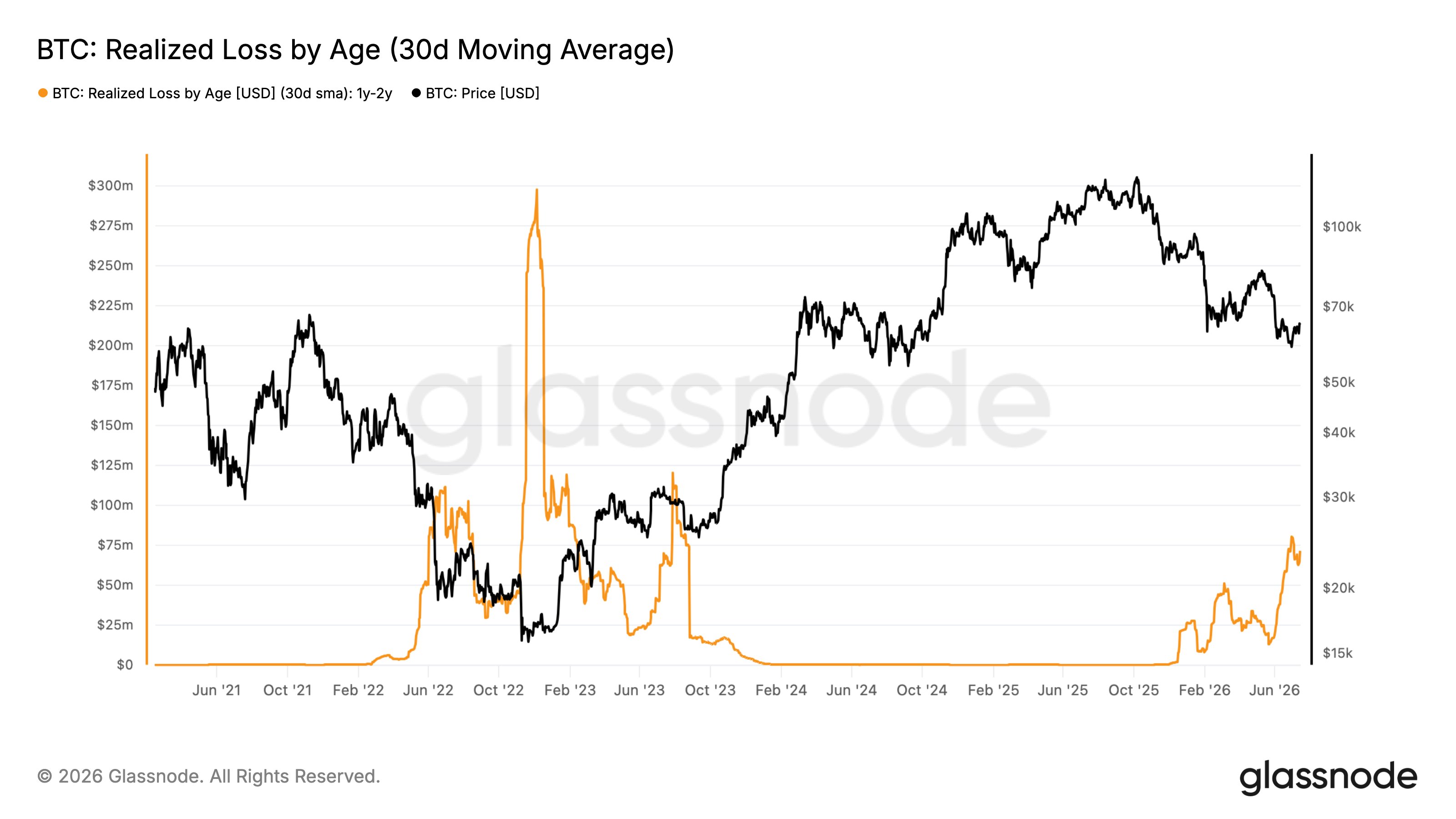
Bitcoin realized losses for 1-2 year hodlers (30-day moving average). Source: Cryptovizart/X
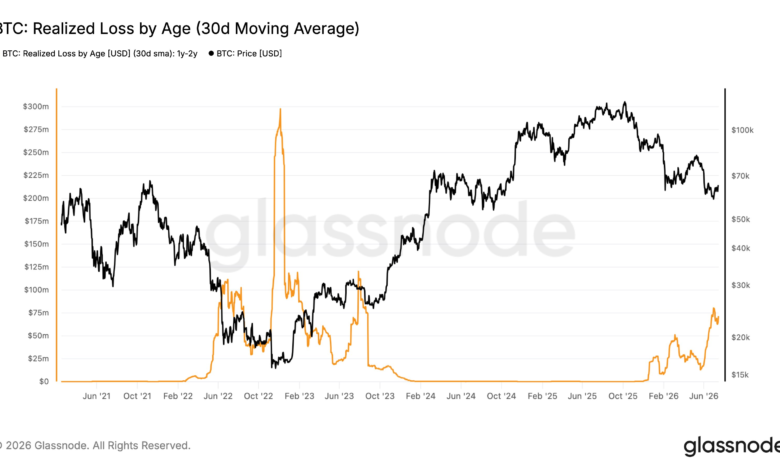
The accompanying chart reveals that the 30-day simple moving average (30D-SMA) of realized losses for this group recently spiked past $75 million before starting to roll over. This reversal is a crucial indicator for analysts looking to identify macro trend shifts.
“When the 30D-SMA of their realized loss cools and rolls over, it has often been among the clearest early signals that the heaviest distribution phase is behind the market,” Cryptovizart noted.
The Battle for $69,000
While the capitulation of mid-term holders offers a long-term bottoming signal, other metrics point to more immediate hurdles for Bitcoin bulls.
Momentum indicators on higher timeframes are also flashing signs of a potential turnaround. Specifically, the stochastic relative strength index (RSI) on two-month charts is currently forming conditions that historically align with major market reversals. The stochastic relative strength index is a momentum oscillator used to identify overbought and oversold conditions, and its current positioning suggests that selling momentum may be exhausting itself on a macro scale.
However, any sustained upward move will have to contend with significant overhead resistance. In the latest edition of its weekly newsletter, The Week Onchain, Glassnode highlighted the aggregate cost basis of short-term holders (STHs) as a key level to watch.
Short-term holders, defined as wallets holding coins for less than 155 days, represent the speculative retail and institutional capital that highly influences short-term price action. Currently, the average cost basis for these short-term holders sits at approximately $69,000—a level that holds immense historical and psychological significance, as it aligns with the peak of the 2021 bull market.
“The first meeting with that level will likely draw a strong reaction, because the people most inclined to sell are the ones about to be made whole,” Glassnode wrote.
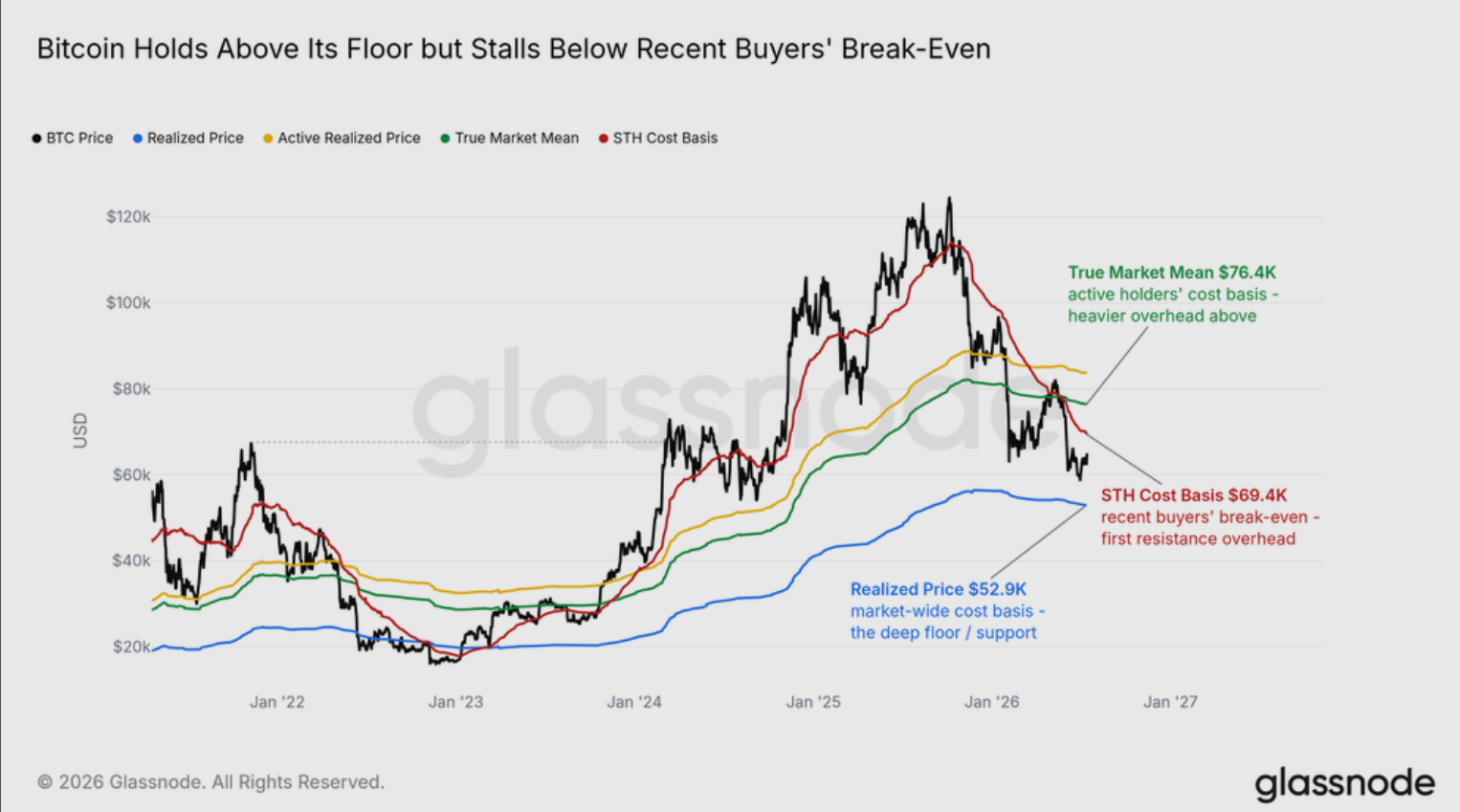
BTC/USD chart with cost-basis levels (screenshot). Source: Glassnode
As Bitcoin navigates this transitional phase, the interaction between capitulating long-term holders and break-even short-term speculators will likely dictate the market’s direction heading into the latter half of the year.