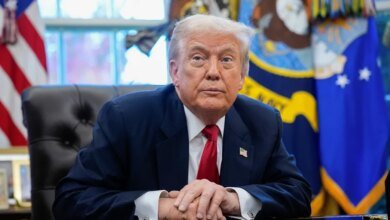
Trump’s ‘Buy Dell’ Endorsement Ignites Ethics Debate Amid Personal Financial Stake
Ethical concerns mount as Trump promotes Dell while holding company shares.
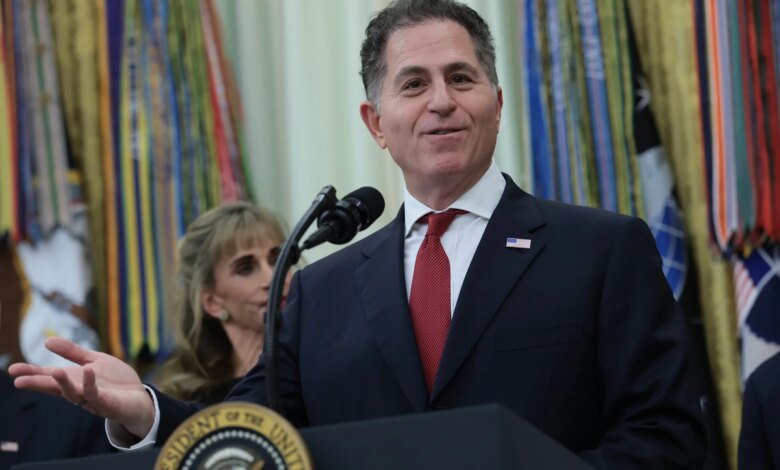
When President Donald Trump stood at the opening bell of the stock market on Monday, his direct exhortation to “buy a Dell computer” did more than just boost a tech giant’s share price; it signaled a departure from long-standing executive norms regarding the separation of public office and private enterprise. Standing alongside billionaire Michael Dell, Trump explicitly linked his praise for the company to the couple’s contributions to his namesake investment accounts for children, known as the Trump Accounts.
The financial implications of these endorsements are not merely theoretical. An account bearing Trump’s name held between $1 million and $5 million in Dell stock shortly before his endorsement wave began in February, according to financial filings reported by Fortune. Since then, Trump has repeatedly used public platforms—from a campaign stop in Georgia to a White House luncheon—to promote the company. On the three specific days Trump offered public praise, Michael Dell’s paper wealth saw gains of $606 million, $8.0 billion, and $4.6 billion, though these figures are subject to broader market forces.
Richard Painter, a former White House ethics lawyer, characterized the move as an “egregious” violation of the federal standards of conduct that prohibit executive branch employees from using their office for the endorsement of any product, service, or enterprise. Painter noted that such endorsements can distort market behavior, as investors may interpret the President’s favor as a signal of impending government favoritism. Indeed, the Department of Defense recently awarded Dell a five-year contract worth up to $9.7 billion for software licensing consolidation.
While the President’s comments coincided with a 4.4% rise in Dell shares on Monday, analysts in the enterprise hardware sector suggest the company’s trajectory is rooted in the broader AI servers boom rather than political theater. Patrick Moorhead, chief analyst at Moor Insights & Strategy, argues that Dell is currently locked in a “two-horse race” with Supermicro to supply the massive data centers operated by hyperscalers. According to Moorhead, Trump’s rhetoric likely influences retail investors rather than the institutional investors who focus on the company’s record $24.4 billion in AI orders.
Michael Dell’s proximity to the executive branch is a long-standing strategic fixture. He has advised every administration since George W. Bush on technology policy and innovation. While Dell has framed his $6.25 billion gift to the Invest America initiative as a bipartisan philanthropic effort, his relationship with the current administration has remained resilient. In 2017, Dell notably remained on the President’s manufacturing council even as other corporate leaders resigned following Trump’s comments regarding white nationalists in Charlottesville.
The White House has defended the President’s remarks, stating he was rightfully praising the Dells as patriots for their multi-billion dollar contributions to the Trump Accounts. However, the intersection of a President’s personal investment portfolio and his public promotion of a specific corporation remains a point of significant regulatory friction.