US Treasury Confirms $131 Million Tether Freeze Linked to Iran Amid Escalating Geopolitical Conflict
The action, executed by Tether on the Tron network, targets wallets tied to the Central Bank of Iran under the U.S. Treasury's Operation Economic Fury.
In a major escalation of financial warfare coinciding with rising military hostilities in the Middle East, the United States government has ordered the freezing of more than $130 million in cryptocurrency linked to Iran.
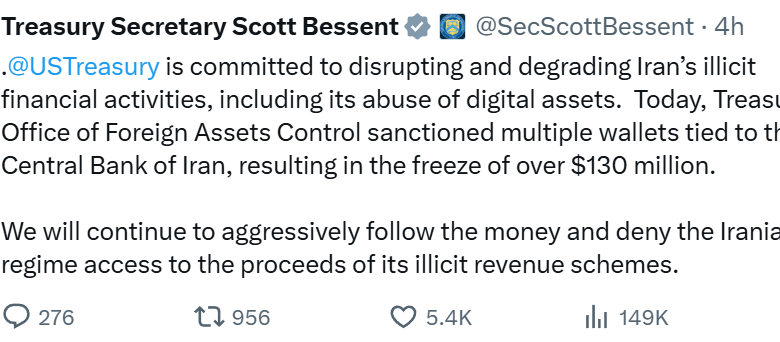
On Tuesday, U.S. Treasury Secretary Scott Bessent confirmed the action, which targeted digital wallets connected to the Central Bank of Iran. The official confirmation followed onchain observations earlier in the day by blockchain investigator Specter, who pointed to public ledger data showing that stablecoin issuer Tether had blacklisted four Tron-based wallets holding $131 million worth of USDT (USDT).
“US Treasury is committed to disrupting and degrading Iran’s illicit financial activities, including its abuse of digital assets,” Bessent said Tuesday. “We will continue to aggressively follow the money and deny the Iranian regime access to the proceeds of its illicit revenue schemes.”
Geopolitical Tensions Boil Over
The decisive move on the digital ledger comes at a highly precarious moment. A fragile ceasefire between the U.S. and Iran has collapsed, prompting a rapid return to overt military and economic confrontation. The U.S. has reinstated its maritime blockade of Iranian ports, and the U.S. military’s Central Command (CENTCOM) has launched a fresh campaign of airstrikes against targets in Iran. Concurrently, Iran’s military asserted on Tuesday that it had executed drone strikes targeting U.S. military personnel stationed at Jordan’s Al Azraq Air Base.
To understand how a sovereign nation’s assets can be frozen on a public blockchain, one must look at the architecture of centralized stablecoins. While networks like Tron are decentralized and permissionless, the smart contracts governing USDT contain administrative functions. Tether, the issuer, retains the ability to blacklist specific addresses, effectively locking the funds and preventing them from being transferred or redeemed. Tron has increasingly become the network of choice for USDT transactions globally, favored for its low transaction fees and high throughput compared to Ethereum. However, this high volume has also drawn intense scrutiny from blockchain intelligence firms and global regulators tracking illicit flows.
Operation Economic Fury
This is not an isolated enforcement action. In April, Tether complied with a similar directive from U.S. authorities, freezing over $344 million in USDT. These actions are part of a broader, aggressive campaign known as Operation Economic Fury, which the U.S. Treasury launched in March 2025 to choke off Iran’s access to international capital.
In May, Secretary Bessent revealed that the U.S. had successfully seized or frozen approximately $1 billion in Iranian cryptocurrency assets since the operation’s inception. Elaborating on the strategy in June, Bessent stated:
“Through Economic Fury, the Treasury Department is disrupting the foreign procurement networks that support the Iranian military’s efforts to acquire weapons. Treasury has frozen the Iranian regime’s assets, severely disrupted its economy, and dismantled the Iranian war machine. Treasury will not tolerate any support of the Iranian military.”
The scale of Iran’s digital asset operations has been well-documented by blockchain analytics firms. According to blockchain intelligence firm TRM Labs, Iran-linked entities moved $3.8B through CoinEx, demonstrating the persistent use of non-compliant exchanges to funnel capital past international sanctions. As the geopolitical landscape grows increasingly volatile, the intersection of blockchain technology and state-level sanctions enforcement is set to remain a primary battleground.