Aikido releases Altar, a 388 GB AI model for local vulnerability detection
The open-source model identified 23 of 32 known flaws and can run on four Nvidia H200 GPUs.
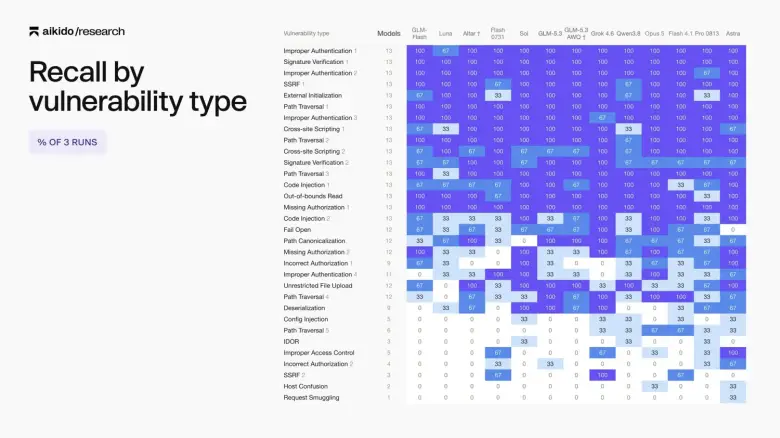
SAN FRANCISCO — Software security startup Aikido has released Altar, a compressed, open-source artificial intelligence model designed to find software vulnerabilities without sending sensitive code to an external server. It runs on a company’s on-premises servers or in a private cloud. In tests across 30 software projects containing 32 known vulnerabilities, it identified 23 flaws, matching the detection rate of the much larger model from which it was built.
That local deployment is intended to address obstacles faced by security teams in banking, healthcare and critical infrastructure: the data-exposure risks of cloud-based AI and commercial models that may refuse to examine potential exploits. During a breach at AI repository Hugging Face involving autonomous agents exploiting platform vulnerabilities, internal defenders tried to use premier commercial cloud models to analyze attack vectors in real time. Built-in safety filters repeatedly flagged their defensive queries as potentially malicious, forcing the teams to turn to open-source models.
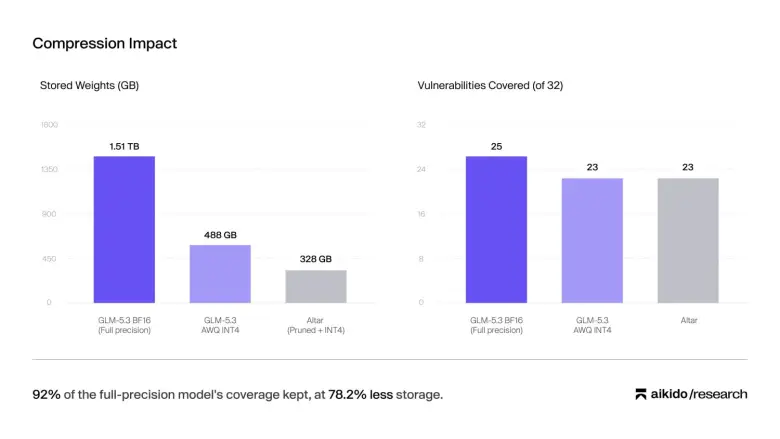


Altar is based on GLM-5.3, an open-source foundation model developed by China’s Zhipu AI. GLM-based models have a strong reputation for technical reasoning and cybersecurity work, but the uncompressed GLM-5.3 occupies about 1.5 terabytes (TB), making local deployment impractical for most corporate IT environments. Aikido removed parameters unnecessary for code analysis through compression and quantization, first bringing the model down to 488 gigabytes (GB) and then to 388 GB.
At that size, Altar can run on one node with four Nvidia H200 GPUs. Their high-capacity HBM3e memory supplies the bandwidth and VRAM needed to run the model at high speed without offloading data to external networks. That matters when an investigation involves proprietary codebase files, internal documentation or zero-day vulnerability data: sending those materials to third-party cloud APIs conflicts with zero-trust architecture principles and compliance mandates including HIPAA in healthcare and GLBA in financial services.
Aikido says the reduction cut the hardware footprint by more than 70% while retaining 92% of the base model’s core cybersecurity capabilities. In an initial pilot in a live corporate environment, Altar was credited with flagging a critical zero-day vulnerability during a routine security audit.
Larger proprietary security models such as Claude Mythos and GPT Cyber may have broader general-knowledge bases. Altar’s open weights, however, let security teams inspect its decision-making, fine-tune it for proprietary coding styles and deploy it behind air-gapped firewalls. It is a successor to the Aikido Machine, which scanned repositories for bugs and outdated dependencies but used external cloud-provider APIs for deep semantic analysis.
Aikido said its immediate work on Altar will focus on integration into active developer workflows, interaction with external developer tools and longer-term sequential reasoning to trace complex, multi-step exploit chains in legacy software architectures.