TCL Targets 700Hz OLED Monitors Using Inkjet Printing Tech
Inkjet-printed OLED manufacturing could slash production costs as global monitor shipments surge past 6 million units in 2026.
TCL is engineering OLED monitor panels capable of reaching 700Hz refresh rates, a specification that would shatter current limits for PC displays and push the boundaries of competitive gaming hardware well beyond what existing graphics technology can fully utilize.
The Chinese electronics conglomerate plans to produce the panels in 32-inch and 34-inch sizes at its Generation 8.6 OLED fabrication plant in Guangzhou. Manufacturing is slated to begin in 2028, according to supply chain data from market research firm Omdia. TCL has not disclosed target resolutions, response times, or a commercial release window for the finished monitors.
A 700Hz refresh rate means the display redraws the image 700 times per second. For context, the fastest OLED gaming monitors available to consumers in late 2026 peak at 480Hz, while elite esports professionals largely rely on 360Hz TN or Fast IPS LCD panels where motion clarity outweighs color accuracy. Driving a 700Hz panel requires frame rates that even flagship GPUs like Nvidia’s GeForce RTX 5090 struggle to sustain outside of lightweight competitive titles such as Valorant or Counter-Strike 2. The technology may ultimately depend on next-generation silicon arriving closer to the end of the decade to realize its full potential.


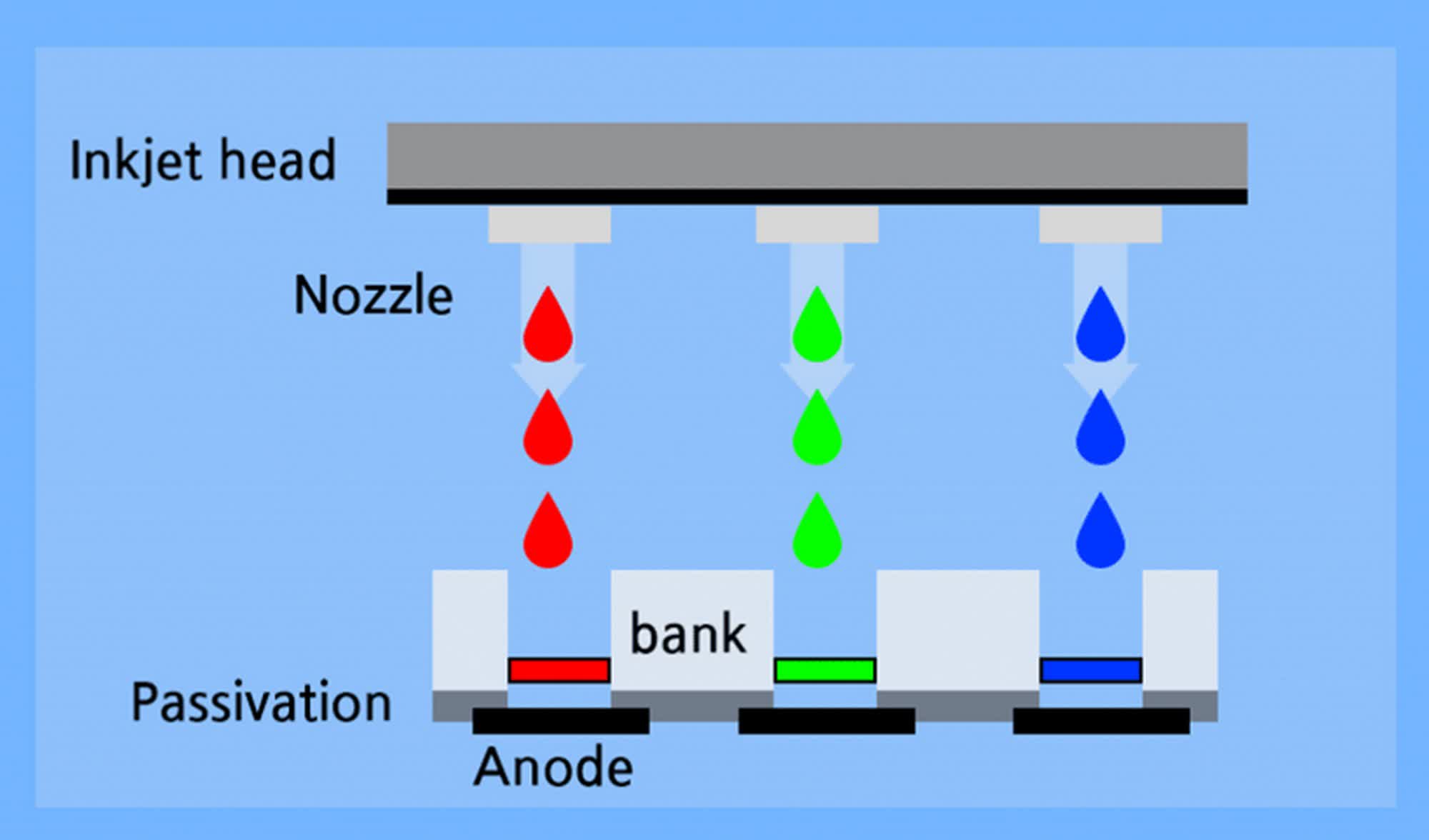
Rather than relying on conventional manufacturing methods, TCL intends to build these extreme-speed panels using inkjet-printed OLED (IJP OLED) technology. The process uses piezoelectric nozzles to spray picoliter-sized droplets of liquid-dissolved organic light-emitting materials directly onto a substrate, functioning similarly to a standard desktop printer applying ink to paper.
This represents a fundamental departure from vacuum thermal evaporation (VTE), the industry-standard method used by Samsung Display and LG Display to manufacture virtually all commercial OLED screens today. VTE requires heating organic compounds inside a vacuum chamber and passing the vaporized molecules through fine metal masks—ultrathin, perforated sheets that dictate pixel placement. Fine metal masks are notoriously difficult to scale for larger panels because they sag under their own weight, causing alignment defects that ruin yield rates.
IJP bypasses the mask entirely. Proponents of the technology estimate it reduces waste of expensive organic luminescent compounds by up to 90%. Because it does not rely on fragile shadow masks, inkjet printing scales much more efficiently to large Gen 8.6 glass substrates, making the production of massive 4K and 8K OLED TVs significantly more economical. The technique also supports advanced, non-standard pixel structures required for specialized high-refresh-rate architectures.
TCL’s CSOT (China Star Optoelectronics Technology) division has spent years refining IJP processes, positioning the company to challenge the South Korean duopoly that currently dominates the OLED supply chain. If successful, the Guangzhou fab could establish a new cost baseline for premium displays.
That cost reduction arrives as the OLED monitor market undergoes rapid commoditization. Mainstream 27-inch, 240Hz QHD OLED gaming monitors have seen retail prices collapse by more than 40% so far in 2026, settling around $350. Industry tracking indicates prices will edge toward $300 next year, removing the primary barrier that kept self-emissive displays confined to enthusiast budgets.
Global OLED monitor shipments are projected to hit a record 6.1 million units in 2026, a 79% increase over the previous year, with volume expected to surpass 7.5 million units in 2027. Asus currently leads the sector, commanding an estimated 23% of all OLED monitor shipments this year, followed by MSI at 14%.
While TCL manufactures a broad portfolio of consumer electronics ranging from smartphones to home appliances, its display division operates primarily as an upstream supplier. Whether TCL will brand a 700Hz monitor under its own name or supply the raw panels to established gaming brands like Asus, MSI, or Alienware remains undetermined as the 2028 production target approaches.