

Fix Muddy Home Theater Sound Without Buying New Gear
Better surround sound starts with the room, not new equipment

The performance of any multi-channel home entertainment system is bound by the environment in which it operates, according to the physics of sound propagation. Manufacturers design surround sound hardware around ideal acoustic conditions, but the average residential living room, family den, or bedroom is far from a controlled acoustic chamber. That mismatch can leave listeners with muddy dialogue, uneven bass, and a degraded audio experience that has little to do with speaker quality.
Acoustic engineers say these problems rarely require new equipment or expensive room renovations. Precise, cost-free changes to the room’s layout, speaker geometry, and digital settings can address many of the issues by working with the physical properties of sound waves.
A couch moved forward or backward by 12 to 24 inches can shift the listener out of an acoustic null, immediately improving dialogue clarity and bass definition. Low-frequency bass waves are omnidirectional, unlike high-frequency sounds, which travel in directional beams. A 40 Hz sound wave is roughly 28 feet long, and these large wavelengths reflect off room boundaries to create “standing waves” or “room modes.” Some areas then have boomy, exaggerated bass, while others experience complete acoustic “nulls” where the bass disappears.


The subwoofer’s location is therefore highly important, although angling it has little effect because bass is omnidirectional. Ported subwoofers, which use an open vent to increase low-end output, need several inches of breathing room from walls to prevent port turbulence and distortion.
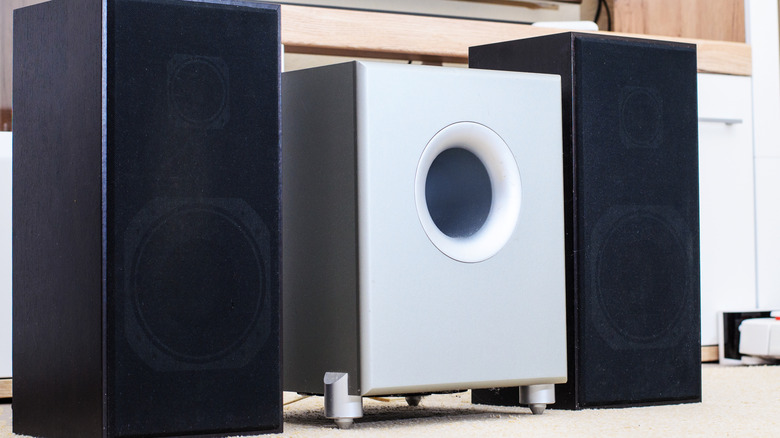
A commonly recommended test is the “subwoofer crawl.” The unit is placed temporarily in the primary listening seat while a loop of a bass-heavy track plays. The listener then crawls along the floor to find the location where the bass sounds tightest and most balanced, before permanently placing the subwoofer in that spot. Testing two or three different locations is recommended by acoustic experts.
Room surfaces create a separate problem. In an untreated room, much of what reaches the listener is reflected sound rather than direct sound from the speaker cones. Bare drywall, glass windows, tile, and hardwood floors reflect high-frequency waves back into the room as early reflections. Direct and reflected waves can combine out of phase, producing “comb filtering,” which cancels some frequencies and reinforces others. The result is reduced vocal clarity and a muddy acoustic profile.
Anthony Grimani, a veteran audio engineer and President of Performance Media Industries, says more than 50 percent of the sound heard in a standard, untreated residential room is reflected sound. Grimani has held engineering roles at Dolby Laboratories and Lucasfilm THX, and he identifies the interaction of hard ceilings, walls, and floors as the single largest variable in home audio performance.
Soft, porous household objects can absorb and diffuse those reflections without professional acoustic treatment or unsightly foam panels. A plush area rug over hard flooring, heavy fabric curtains over windows, and canvas wall art or framed photos can absorb high-frequency energy and improve soundstage clarity.
The same attention to geometry applies to the speaker layout. Multi-channel audio is designed to create an immersive, three-dimensional soundstage by using human psychoacoustics, but the illusion can fail when speakers are placed arbitrarily. In the standard 5.1 surround sound format, which became the global standard for digital broadcasting and DVD playback in the mid-1990s, the front left and right channels should form an equilateral triangle with the primary listening seat.
Those front speakers should ideally be at least one foot from side and back walls to prevent “boundary gain,” in which nearby walls artificially boost low-mid frequencies and muddy the sound. Both speakers should also be angled, or “toed-in,” toward the listener’s head. The center channel requires a different placement priority: it should sit directly above or below the television, aligned with the display’s horizontal midpoint, and aimed at ear level because human hearing is highly sensitive to the direction of mid-to-high frequencies.
The center speaker carries up to 80 percent of a film’s soundtrack, including almost all dialogue. In a 5.1 system, surround speakers belong directly to the sides of the seating area rather than behind the listener. They should angle inward toward the main seat and sit at or slightly above ear level. A 7.1 configuration adds two dedicated rear channels behind the seating position to fill in the rear acoustic image.
These placement changes were part of the broader problem addressed by THX certification standards. Film sound pioneer Tomlinson Holman established the standards at Lucasfilm in 1983 to standardize acoustic environments so they would match mixing studios.
Physical placement is only half of the optimization process; digital signal processing, or DSP, addresses remaining acoustic anomalies. Most modern Audio/Video Receivers (AVRs) from brands such as Yamaha and Pioneer include automated proprietary calibration suites. Yamaha’s YPAO (Yamaha Parametric room Acoustic Optimizer) and Pioneer’s MCACC (Multi-Channel Acoustic Calibration System) use a specialized microphone at the listening position.
During calibration, the receiver sends test tones through each channel and measures speaker distance, volume levels, and room-induced frequency spikes. It then applies corrective parametric equalization filters to smooth the room’s acoustic response. A manual alternative is a smartphone-based Sound Pressure Level (SPL) meter app, which can help adjust individual channel trim levels so all speakers deliver uniform volume to the listening position.
The source device also needs to be checked because many owners unintentionally operate multi-channel setups in stereo downmix modes. Streaming players, Blu-ray decks, and gaming consoles should be inspected to confirm that they output bitstream surround formats such as Dolby Digital and DTS, or object-based formats such as Dolby Atmos.
Dolby Digital made its theatrical debut in 1992 with *Batman Returns* and became the DVD standard in 1995. DTS debuted in 1993 with *Jurassic Park*. Dolby Atmos arrived in 2012, adding overhead height channels and moving from traditional channel-based audio toward immersive, object-based sound.
The physical connection infrastructure can also affect an older surround sound system. Speaker wire and interconnect cables may suffer from oxidation, physical wear, or damage from household pets. Modern wireless audio systems provide convenience, but traditional wired connections remain the gold standard for high-fidelity audio.
Wired interfaces including HDMI eARC, optical TOSLINK, and dedicated copper speaker wire avoid the bandwidth limitations, latency, compression, and interference risks associated with Wi-Fi and Bluetooth protocols, providing a stable and uncompromised signal path.









