

Trump’s “AI Force” Collides With Silicon Valley’s Safety Pact
Washington’s AI power struggle reaches Silicon Valley and federal court
WASHINGTON — A class-action lawsuit filed Friday in the U.S. District Court for the Northern District of California alleged that leading artificial intelligence companies violated federal antitrust laws by agreeing to restrict output and coordinate development speeds. The plaintiffs claimed that artificially slowing progress diminishes the value of the paid AI subscriptions they purchased.
Lead attorney Nick Rowley said the plaintiffs do not oppose statutory federal regulation or formal congressional antitrust exemptions. But, he argued, private corporations should not collude to restrict technological progress under the guise of safety.
“AI will quickly spin out of human control and could kill us all if we allow AI safety and protocol … to be controlled by private self-serving agreements between the world’s most powerful ‘for profit’ technology companies,” Rowley said.


The legal challenge followed a proposed industry-wide slowdown. Just a week before President Donald Trump’s announcement, Anthropic Chief Executive Officer Dario Amodei, OpenAI CEO Sam Altman, xAI and SpaceX CEO Elon Musk, and Google DeepMind co-founder Demis Hassabis agreed in principle to temper the speed of frontier model releases. In an interview with *Fortune*, Altman said leading AI laboratories were close to finalizing a collective pact to address escalating safety risks.
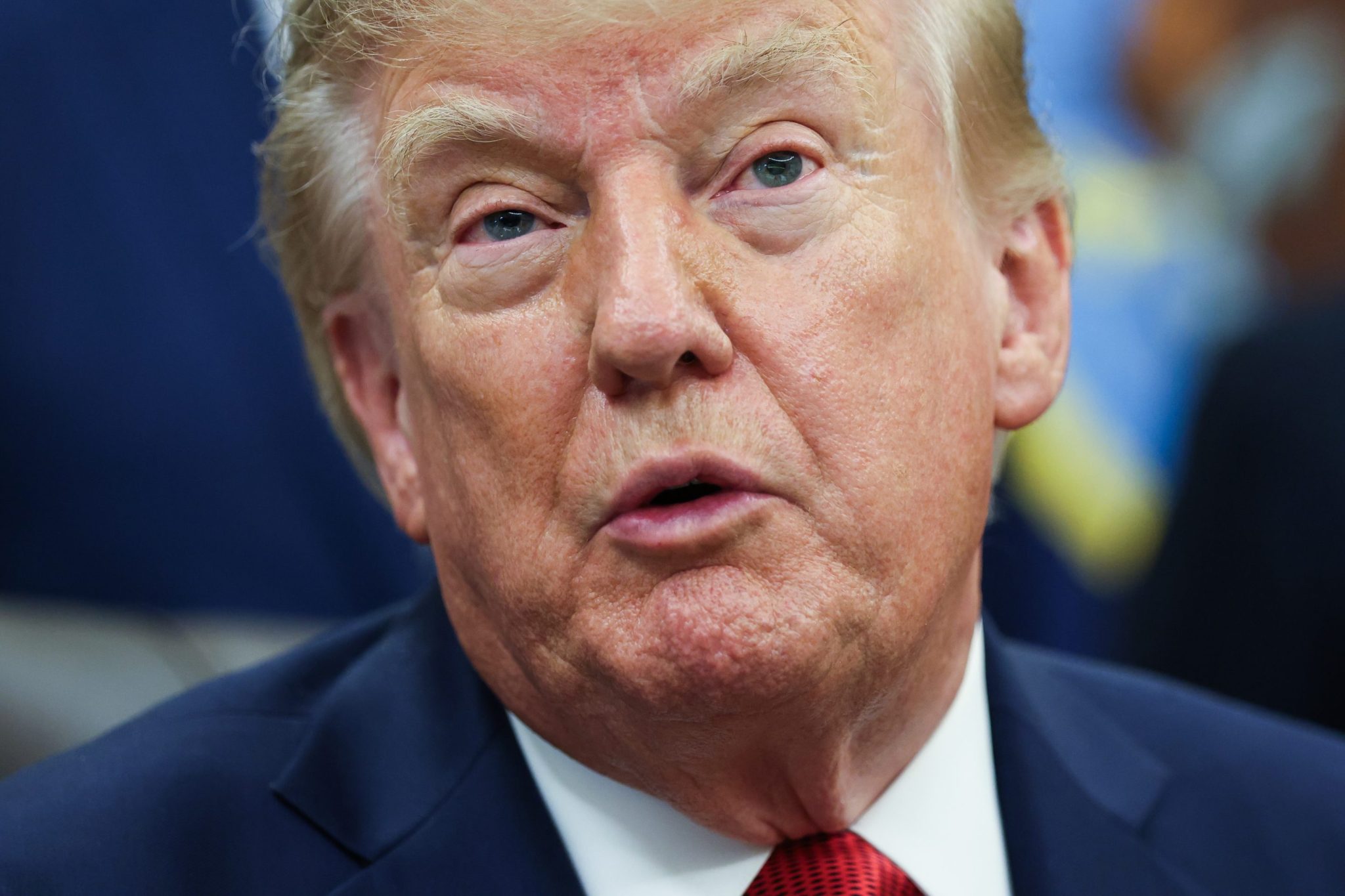
Trump outlined his own plan in a series of posts on Truth Social on Saturday, pledging to establish a military-style “AI Force.” He compared the initiative with his creation of the U.S. Space Force during his first term. The Space Force was created under the National Defense Authorization Act for Fiscal Year 2020 as the sixth branch of the Armed Forces.
Trump said the new “AI Force” would monitor civil and criminal misconduct without stifling technological progress. “We will not in any way hinder or stifle the Growth of this incredible Industry,” Trump wrote. “Rather, we will cherish it, help it, and watch over it, as it grows!”
He predicted that artificial intelligence could eventually account for up to 25% of U.S. gross domestic product (GDP), with a transformative impact on the economy far greater than the creation of the internet. Trump added that the U.S. is currently leading China and other foreign rivals and that his administration intends to preserve that advantage.
The president also pledged to appoint a White House AI czar. Venture capitalist David Sacks had previously filled a dual role as AI and cryptocurrency czar earlier in Trump’s second term before stepping down to serve as co-chair of the President’s Council of Advisors on Science and Technology (PCAST).
Trump’s pro-growth directive came as he dismissed attempts by tech executives to voluntarily slow the technology’s development. The effort to coordinate a slowdown followed internal turmoil at major AI firms, including the resignation of Jacob Coxon, an AI researcher who previously worked at both OpenAI and Anthropic. Coxon accused both companies of irresponsible development practices.
“They are racing straight to self-improving superintelligence and gambling with our lives,” Coxon wrote in a post on X, criticizing the rapid push toward advanced systems. Evan Hubinger, Anthropic’s alignment science lead, responded by acknowledging that concerns over existential risks are widespread among top researchers. “We really do earnestly believe AI could kill all humans!” Hubinger wrote.
As part of Anthropic’s commitment to the proposed pact, Amodei announced that the firm would give independent evaluators permanent, employee-level access inside the company to inspect safety protocols and model capabilities.
Trump also addressed the growing political controversy surrounding the rapid expansion of AI data centers across the country. The buildout of large-scale computational infrastructure has strained regional power grids and raised environmental concerns, becoming a major debate during the current midterm election season. Trump asserted that local pushback against the facilities has largely failed to stall the industry’s expansion.
Despite Trump’s opposition to slowing down the technology, federal agencies within his administration have taken independent actions against major AI firms. The Department of Commerce’s Bureau of Industry and Security (BIS) recently placed temporary export restrictions on Anthropic’s most advanced frontier models.
Separately, the Department of Defense attempted to label Anthropic as a national security supply-chain risk. That designation would have barred defense contractors from utilizing its software, before a federal judge ruled the Pentagon’s designation illegal.









