
From Tariffs to War: How Economic Pressure Helped Push America Into Conflict
America’s trade wars have repeatedly carried consequences far beyond the marketplace
WASHINGTON — The United States entered the War of 1812 after years of failed economic diplomacy, domestic hardship, and mounting disputes with Great Britain and France. More than two centuries later, the deployment of aggressive trade barriers, embargoes, and financial sanctions remains a primary tool of statecraft, often presented by policymakers as a peaceful alternative to military conflict. Historical precedents and modern trade disputes, however, demonstrate that economic warfare can carry severe domestic consequences and sometimes precede the armed conflicts it was meant to prevent.
During the late 2010s, the United States pursued a dual-front economic campaign: sweeping import tariffs against global trading partners and a “maximum pressure” campaign of severe financial sanctions against Iran. The Trump administration imposed tariffs on steel, aluminum, and billions of dollars of Chinese imports under Section 232 of the Trade Expansion Act of 1962 and Section 301 of the Trade Act of 1974. The stated goals were to counter foreign trade practices and stimulate domestic manufacturing.
A Tax Foundation analysis, conducted by the nonpartisan tax policy research organization, estimated that the tariffs raised core goods prices for American consumers by 3.1%. The same study projected that the measures would reduce long-run U.S. Gross Domestic Product (GDP) by 0.4% and eliminate approximately 345,000 full-time equivalent jobs. The opposition Federalist Party had issued a similar warning about the domestic consequences of economic coercion more than two centuries earlier.


In the early American republic, the resumption of the Napoleonic Wars in 1803 left the United States caught in a commercial crossfire. Great Britain and France routinely seized neutral American merchant ships trading with their rivals. British Royal Navy impressment intensified the dispute, as American merchant sailors were forcibly conscripted on the claim that they were British subjects.
The crisis reached a turning point in June 1807 during the *Chesapeake-Leopard* Affair. The British warship HMS *Leopard* attacked and boarded the U.S. Navy frigate USS *Chesapeake* off the coast of Virginia, killing three crew members and seizing four suspected deserters. Military weakness prevented President Thomas Jefferson and his Democratic-Republican allies in Congress from launching a direct war, so they pursued an economic alternative.
In December 1807, Congress passed the Embargo Act. It barred all export shipping from U.S. ports and prohibited American ships from departing for foreign destinations. Jefferson and his supporters predicted that withholding vital American agricultural exports and raw materials would starve the British and French economies and force both empires to respect American sovereignty. They also argued that the measure would stimulate U.S. manufacturing by compelling the country to become self-reliant.
Federalists in the commercial, shipping-dependent hubs of New England strongly protested. They warned that a total cessation of trade would cause domestic economic ruin. Within a single year, U.S. exports plunged by roughly 80% and imports fell by nearly 60%. Farmers could not find international buyers for surplus crops, shipping fleets rotted at northern piers, and unemployment swept through port cities, plunging the young nation into a deep depression before a single shot had been fired.
The modern sanctions campaign against Iran also produced a military standoff rather than the intended capitulation. In May 2018, the administration unilaterally withdrew from the 2015 Joint Comprehensive Plan of Action (JCPOA), commonly known as the Iran nuclear deal, and reimposed secondary financial sanctions. The “maximum pressure” campaign sought to force Tehran back to the negotiating table by crippling its oil exports.
During 2019, military tit-for-tats unfolded in the Persian Gulf. Commercial oil tankers were targeted in the Gulf of Oman, the administration designated Iran’s Islamic Revolutionary Guard Corps (IRGC) as a foreign terrorist organization, and an Iranian surface-to-air missile downed a U.S. Navy RQ-4A Global Hawk surveillance drone in June. In September, drone and missile attacks on Saudi Aramco’s Abqaiq and Khurais oil processing facilities temporarily removed 5.7 million barrels of daily crude production, approximately 5% of global oil supply.
The International Energy Agency (IEA) categorized the Saudi Aramco incident as the largest single oil-supply disruption in history, keeping international energy markets highly volatile. In a July 2019 speech on the Senate floor, Sen. Kirsten Gillibrand (D-NY) criticized the administration’s lack of clear diplomatic outcomes.
“It was launched without a clear plan, executed without a coherent strategy, and has become a costly, self-inflicted disaster for the American people,” Gillibrand said. “Every justification that we were given for this conflict has proven hollow.”
The Embargo Act was repealed in March 1809, just days before James Madison succeeded Jefferson as president. Madison nevertheless continued the strategy of economic coercion by signing the Non-Intercourse Act of 1809. The law reopened trade with every nation except Great Britain and France and promised to restore relations with whichever superpower first ceased violating American shipping.
Congress replaced that measure in 1810 with Macon’s Bill No. 2. It lifted all trade restrictions but required the United States to reimpose non-intercourse against either Britain or France if the other repealed its commercial restrictions. French Emperor Napoleon Bonaparte exploited the provision by pretending to revoke French decrees against U.S. shipping. Madison accepted the maneuver and reimposed restrictions against Britain in late 1810, moving the two countries closer to war.
As the economic measures failed to halt British maritime aggression, nationalistic lawmakers took control of the 12th Congress. The faction became known as the “War Hawks” and was led by Speaker of the House Henry Clay of Kentucky and Representative John C. Calhoun of South Carolina. They viewed the trade disputes as a justification for territorial expansion and argued that British Canada was vulnerable, could easily be seized, and would eliminate British influence on the western frontier.
“The conquest of Canada is in your power,” Clay declared on the House floor in 1810. “I verily believe that the militia of Kentucky are alone competent to place Montreal and Upper Canada at your feet.”
On June 18, 1812, at Madison’s request, Congress declared war on Great Britain. No Federalist voted in favor. The highly partisan vote reflected a deeply divided nation entering its first major conflict since the Revolutionary War, while the original maritime grievances remained unresolved.
American forces quickly encountered military failure. In July 1812, Brigadier General William Hull led troops across the Detroit River into Upper Canada, expecting local residents to join the American cause. He issued an optimistic proclamation: “Inhabitants of Canada! You will be emancipated from tyranny and oppression. Had I any doubt of eventual success I might ask your assistance, but I do not. I come prepared for any contingency.”
Hull’s staff reported that British forces and their Native American allies appeared to be “deserting by hundreds,” encouraging him to march south toward Fort Malden. Tecumseh, the Shawnee leader who had formed a powerful confederacy of Native American tribes allied with the British, instead launched guerrilla strikes against Hull’s overextended supply lines along the Detroit River. The attacks forced the American force back to Detroit.
At Fort Mackinac on Lake Huron, an American garrison surrendered to a joint British and Native American force without firing a shot. The American commander did not know that war had been declared. Fearing that northern tribal forces would sweep south, Hull ordered the immediate evacuation of Fort Dearborn at the mouth of the Chicago River, the site of modern-day Chicago.
On August 15, 1812, 66 soldiers, nine women, and 18 children attempted to march from Fort Dearborn toward Fort Wayne. William Wells, a frontier scout, and 30 Miami warriors escorted the party. Wells had been captured by the Miami as a child, married the sister of Chief Little Turtle, and later left the tribe to fight for the United States at the Battle of Fallen Timbers in 1794. Tecumseh, who had also fought at Fallen Timbers, regarded Wells as a traitor.
Shortly after the column left Fort Dearborn, approximately 500 Potawatomi and Winnebago warriors ambushed it in the sand dunes. Most of the soldiers, women, and children were killed. Wells was singled out for retribution, killed and beheaded, and his heart was reportedly consumed by his captors.
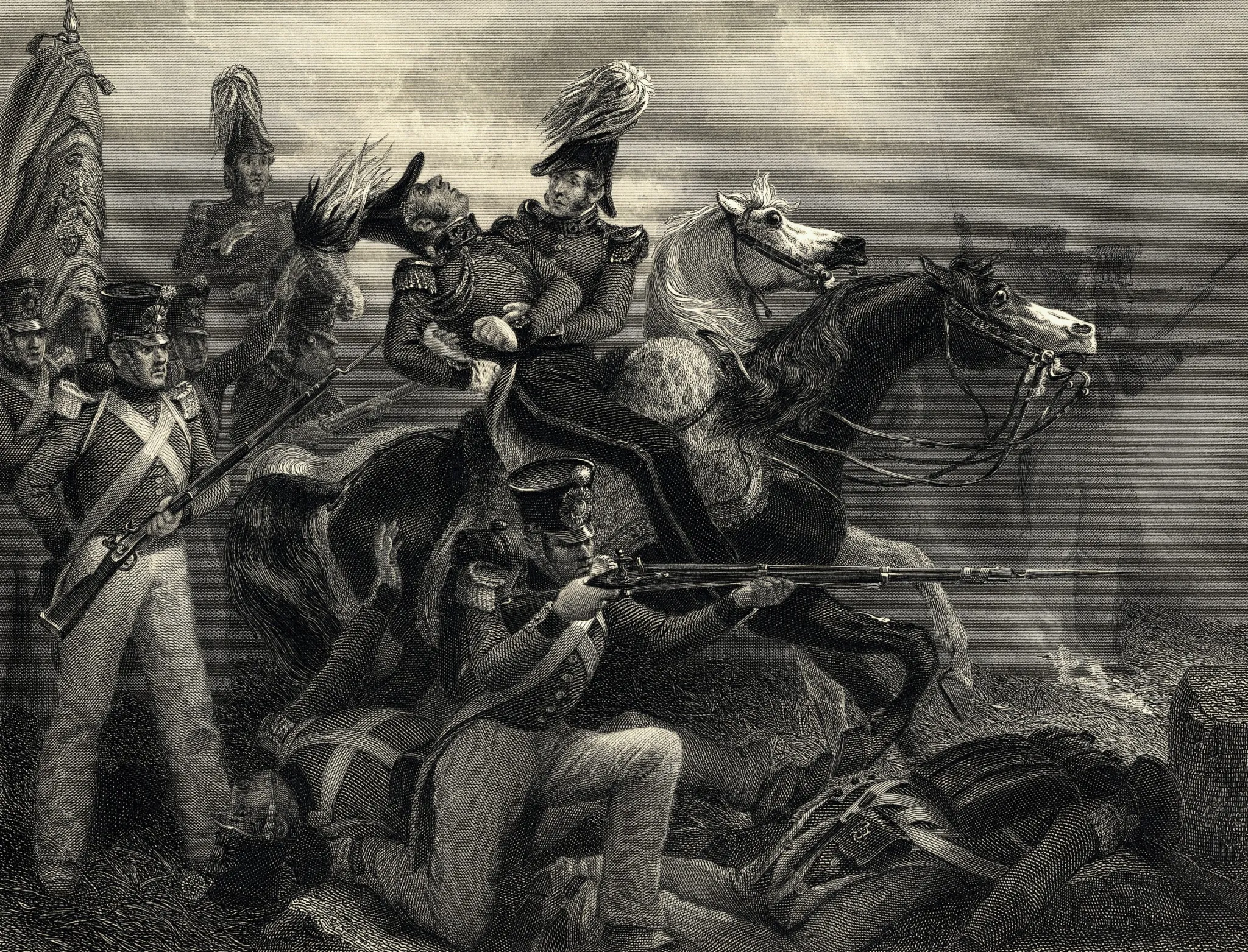
Hull soon learned that British Major General Isaac Brock, the governor general of Upper Canada, was advancing with reinforcements. Brock used psychological tactics to make Hull believe that his Native American force was much larger than it was. British artillery on the Canadian shore began bombarding Fort Detroit, and a cannonball struck the officers’ mess, killing four men.
Hull surrendered the fort, his entire garrison of 2,500 troops, and all of Michigan Territory without a battle. He was later court-martialed for cowardice and neglect of duty and sentenced to death. President Madison ultimately pardoned him because of his Revolutionary War service. Two more American attempts to invade Canada in late 1812, one at the Niagara River and another toward Montreal, failed because of poor coordination and state militias’ refusal to cross the Canadian border.
Despite the humiliations, Madison won re-election in November 1812. In his second inaugural address in March 1813, he described the war as “just in its origin and necessary and noble in its objects.” Gouverneur Morris of New York, a prominent Federalist and draftsman of the U.S. Constitution, questioned both the war’s necessity and Madison’s leadership. Morris also publicly questioned the president’s state of mind.
“When I read Mr. Madison’s message I supposed him to be out of his senses, and have since been told that he never goes sober to bed,” Morris wrote in a letter to a friend. “Whether intoxicated by opium or wine was not said, but I learned last winter that pains in his teeth had driven him to use the former too freely.”
The strategic balance changed in late 1813 and 1814 after Napoleon’s position in Europe deteriorated. In September 1813, American Master Commandant Oliver Hazard Perry defeated the British fleet at the Battle of Lake Erie and reported, “We have met the enemy and they are ours.” General William Henry Harrison used the naval victory to retake Detroit and secure the Northwest Territory.
In October 1813, Napoleon was defeated at the Battle of Leipzig and abdicated in April 1814. With the French threat resolved, Britain redirected its military apparatus toward North America. The British army sent 14,000 battle-hardened veterans to Canada, while the Royal Navy expanded its blockade of the U.S. Atlantic coast. The blockade halted the remaining American commerce, deprived the federal treasury of customs duties, and left the domestic economy in ruins.
By the winter of 1814, British forces occupied eastern Maine with the intention of annexing it into Canada. British raids continued along the Atlantic seaboard, and a massive expeditionary force was sailing toward New Orleans. The original war objectives—formal cessation of impressment and conquest of Canada—remained completely unachieved as the national treasury approached bankruptcy and the military reached its limits.
In August 1814, Vice Admiral Sir Alexander Cochrane’s British fleet landed an expeditionary force under Major General Robert Ross at Benedict, Maryland, on the Chesapeake Bay. The British easily routed raw American militia at the Battle of Bladensburg, an engagement so disorganized that it became known as the “Bladensburg Races.” British troops then marched unopposed into Washington, D.C., on the night of August 24, 1814.
Inside the House of Representatives, British soldiers piled mahogany desks, chairs, and tables in the center of the chamber, mixed in rocket powder, and ignited the pile. The heat cracked structural stone, melted glass, and destroyed the Capitol’s interior. At the White House, British officers ate a dinner prepared for the fleeing President Madison before setting fire to the executive mansion.
The White House fire consumed the interior, including mahogany doors, yellow damask curtains, red velvet cushions, and the presidential pianoforte. Only scorched exterior stone walls remained. After British forces departed, an anonymous resident wrote on the ruined sandstone of the Capitol: “George Washington founded this city after a seven years’ war with England; James Madison lost it after a two years’ war.”
American forces later repelled the British assault on Baltimore at the Battle of Fort McHenry in September 1814. The defense inspired Francis Scott Key to write the lyrics to “The Star-Spangled Banner,” but the nation’s strategic position remained precarious. Madison sought a diplomatic exit as British forces held eastern Maine and continued raids along the Atlantic coast.
Peace commissioners from the United States and Great Britain had been meeting in the neutral Belgian city of Ghent since August 1814. The American delegation included Henry Clay and John Quincy Adams. They recognized that Napoleon’s defeat had made impressment practically moot because the Royal Navy no longer needed to conscript sailors for a European war. The Americans dropped their demands concerning maritime rights and Canadian territory.
On December 24, 1814, the diplomats signed the Treaty of Ghent. It restored relations to *status quo ante bellum*, literally “the state in which things were before the war.” Captured territory was returned, and neither side made concessions concerning maritime rights, trade blockades, or impressment.
The treaty had not yet crossed the Atlantic when a British invasion force was decisively defeated at the Battle of New Orleans on January 8, 1815. American forces commanded by Major General Andrew Jackson won the late battle, and the subsequent arrival of the peace treaty allowed the public to view the conflict as a triumphant victory.
The post-war period brought intense national pride and economic expansion known as the “Era of Good Feelings.” The Federalist Party, which had opposed the war and floated proposals for New England’s secession at the Hartford Convention, was politically destroyed by the wave of patriotism. For nearly a decade, organized partisan warfare subsided as the nation focused on domestic industrial growth and western expansion, briefly fostering the belief that the United States had entered a new era of political unity.