

Why Modern Wi-Fi Routers Need So Many Antennas
More antennas improve wireless capacity, but they cannot overcome every coverage or ISP limitation
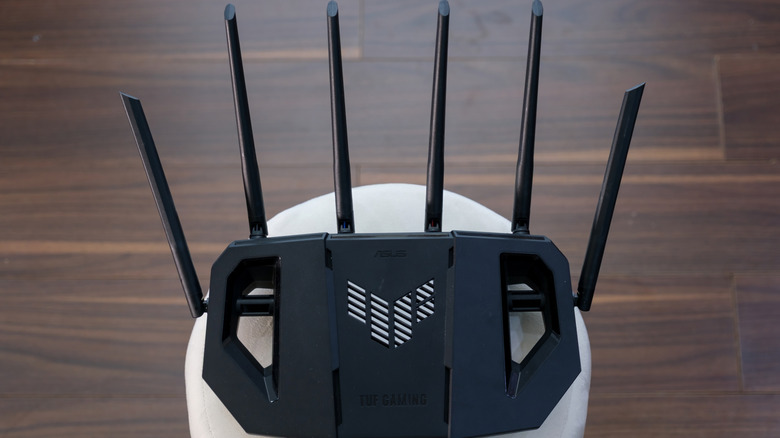
Wireless routers have moved from basic single-antenna units to complex multi-antenna arrays with as many as eight external masts. The change has followed advances in radio frequency (RF) engineering, signal processing, and IEEE 802.11 wireless networking protocols designed for high-density client environments and rising data throughput requirements.
Early commercial home networks were largely governed by the legacy 802.11b and 802.11g standards in the 2.4 GHz spectrum. Routers typically used a Single-Input Single-Output (SISO) architecture, with one transmitter and one receiver processing a single data stream at a time.
As homes and businesses added smartphones, streaming devices, computers, smart appliances, and dozens of other internet-connected endpoints, those single-antenna systems encountered severe airtime contention and network congestion. The response was Multiple-Input Multiple-Output (MIMO), formally standardized with IEEE 802.11n, or Wi-Fi 4, in 2009.


MIMO uses spatial multiplexing to split a high-rate data stream into multiple lower-rate streams that travel across distinct spatial channels simultaneously. The approach depends on more than visible hardware: spatial multiplexing requires physical antennas, dedicated internal RF transceiver chains, and baseband processors.
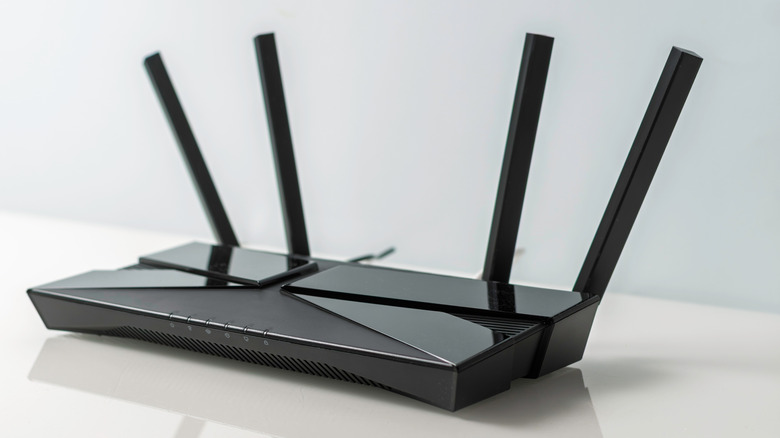
Each additional physical antenna or internal antenna element creates an independent transmission path. Compatible client devices can therefore negotiate multiple spatial streams, including 2×2, 3×3, and 4×4 configurations, multiplying local area network throughput across the same frequency channels without requiring additional spectrum bandwidth.
Multi-antenna hardware also helps routers manage indoor radio propagation. Signals reflect from concrete walls, metal framing, glass, furniture, interior structures, and human bodies, producing multipath propagation, signal fading, and phase distortion at the receiver.
Spatially separated antennas collect multiple versions of the incoming waveform. The router’s baseband processor can select or combine the cleanest paths, reducing packet drop rates and retransmissions. This spatial diversity addresses physical conditions that a single signal path cannot reliably overcome.
Another use of an antenna array is explicit and implicit beamforming. A standard omnidirectional antenna radiates radio frequency energy uniformly across 360 degrees, while a router with multiple antennas can use its internal digital signal processor to calculate the receiving device’s location and channel state.
The router adjusts the phase, amplitude, and timing of each antenna’s transmission. After the phase-shifted signals travel through physical space, they create constructive interference at the client’s precise coordinates and destructive interference elsewhere.
That targeted transmission improves signal-to-noise ratios (SNR), supports higher modulation schemes such as QAM-1024 and QAM-4096, and helps maintain stable throughput across longer physical distances.
The capabilities of these arrays expanded with Multi-User Multiple-Input Multiple-Output (MU-MIMO). It first appeared for downstream traffic in the 802.11ac Wave 2 standard, or Wi-Fi 5, and was later expanded to bidirectional multi-user operations in 802.11ax, including Wi-Fi 6 and 6E.
Under legacy Single-User MIMO (SU-MIMO), a router communicated with one device at a time and cycled through active connections using Carrier Sense Multiple Access with Collision Avoidance (CSMA/CA) time-slicing. MU-MIMO instead divides an antenna array’s spatial streams among multiple clients concurrently.
By transmitting independent data frames to different devices simultaneously, MU-MIMO reduces latency and buffer bloat in networks with high client counts. The number of external antennas, however, does not automatically determine a router’s total network performance.
Six- to eight-antenna routers are intended for high-density settings such as corporate offices, commercial cafes, and smart homes with dozens of concurrent high-bandwidth users. Their radio chips distribute antenna elements across multiple frequency bands: 2.4 GHz, 5 GHz, and the 6 GHz band introduced with Wi-Fi 6E and Wi-Fi 7.
In an average residential environment, two to four high-efficiency antennas can deliver maximum throughput to standard 2×2 client devices. A larger physical antenna count is not necessarily the most effective response to every coverage problem.
On large floor plans and in multi-story structures, physical distance and structural attenuation can weaken RF propagation. Adding antennas to one centralized router offers limited benefits in those environments compared with distributed mesh networking systems.
Mesh systems position multiple lower-profile nodes throughout a building, providing wider coverage and more consistent link rates by eliminating physical line-of-sight obstructions. Even when an advanced multi-antenna router maximizes the internal wireless physical link rate, or PHY, on a local area network (LAN), its internet performance remains subject to the service connection.
WAN throughput is strictly limited by the bandwidth caps and latency constraints provisioned by the consumer’s Internet Service Provider (ISP).