Harmeet Dhillon Leaves the Civil Rights Division Leaderless and Three-Quarters Empty
She resigned three weeks ago, and the White House asked her to wait until after the midterms. What she leaves behind is a division with about a hundred of its four hundred lawyers, twenty-seven lost voter-roll suits, and no one named to run it.
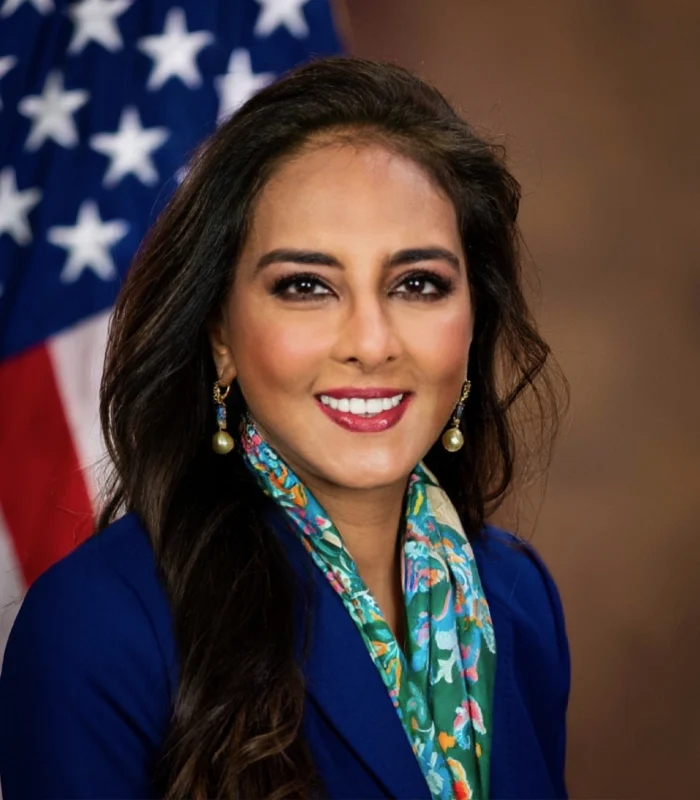
Harmeet Dhillon resigned on Thursday, three weeks after she had already resigned.
Attorney General Todd Blanche announced it in a post on X. He said he had accepted the resignation of an assistant attorney general who “led the Civil Rights Division with conviction the past 18 months” and “defended the civil liberties of every American and enforced the law without fear or favor.” Dhillon told Fox News Digital a different timeline: “I wasn’t asked to resign. I resigned three weeks ago, and Susie asked me to please wait until after the midterms.” She had informed White House chief of staff Susie Wiles three weeks before Election Day, and she told Fox she had achieved what she set out to do in Washington and wanted to return to private practice in California. Dhillon was confirmed in April 2025 by a 52–45 Senate vote, with Alaska’s Lisa Murkowski the only Republican opposed, to lead a division Congress created with the Civil Rights Act of 1957.
The division she ran for nineteen months has about a hundred of its roughly four hundred lawyers left. Dhillon said on a Breitbart News podcast in August 2025 that about 75 percent of its lawyers — about 300 out of 400 — had left in the first seven months of the administration. She later called the departure “the biggest single personnel self-purge in DOJ history” on the “Pod Force One” podcast in December, adding, “I think there was some denial and they had crying sessions together.” She recruited conservative lawyers to replace them. CNN reported those hires “have far from made up for the ouster of decades of knowledge on civil rights laws.” Some conservatives complained the inexperienced lawyers in her section could not handle cases referred to the division. Former officials told Bloomberg Law the department is bracing for more top political appointees to leave before the new Congress convenes.
On May 21, 2025, the division moved to dismiss its lawsuits against the police departments of Louisville and Minneapolis, close the underlying investigations, and retract the Biden administration’s findings of constitutional violations. It closed investigations and retracted findings for six more departments — Phoenix, Trenton, Memphis, Mount Vernon, Oklahoma City, and the Louisiana State Police. The division also dismissed more than fifty half-century-old school desegregation cases, from Waterbury, Connecticut, to Flagler County, Florida. “Overbroad police consent decrees divest local control of policing from communities where it belongs,” Dhillon said in the department’s release that day. “Today, we are ending the Biden Civil Rights Division’s failed experiment of handcuffing local leaders and police departments with factually unjustified consent decrees.”
The two decrees were proposed settlements, filed in the final weeks of the Biden administration and awaiting a judge’s approval. Minneapolis opposed the dismissal. Judge Paul A. Magnuson granted it on May 27, 2025, with prejudice, writing that the court had “grave misgivings about the proposed consent decree serving the public interest.” Judge Benjamin Beaton dismissed Louisville’s proposed decree on December 31, 2025. He wrote that “the responsibility to lead the Louisville Metro Police Department in compliance with federal law must remain with the city’s elected representatives and the people they serve.” Minneapolis still has a state court consent decree with the Minnesota Department of Human Rights, and Louisville agreed to hire its own monitor, while Mayor Craig Greenberg pledged to keep pursuing reform.
The division sued 30 states and Washington, D.C., demanding unredacted voter-registration lists, including driver’s license numbers and partial Social Security numbers. It has lost 27 of the 31 lawsuits, with no win requiring any state to hand over its data. The 27th defeat came on October 23, when a judge appointed by President Donald Trump dismissed the suit seeking Utah’s complete voter registration database.
In California, Judge David O. Carter dismissed the suit demanding the rolls of 23 million Californians, calling the request “unprecedented and illegal” and accusing the federal government of trying to “abridge the right of many Americans to cast their ballots.” The department sued California and Los Angeles County on October 15 over a 48-hour deadline to review a federal list of about 20,000 purported likely noncitizens. Carter denied the request on October 28, finding the department unlikely to succeed and likely lacking standing. The department acknowledged in court that it intended to share the voter data with the Department of Homeland Security for criminal and immigration enforcement. In Alaska, a judge rejected the department’s suit to block certification in the Senate race, where a second candidate named Daniel J. Sullivan appeared on the ballot without a party label.
In July 2025, Dhillon sent Texas officials a letter claiming four Democratic-held congressional districts were unconstitutional racial gerrymanders and urging the state to redraw them. Democracy Docket, which has tracked the division’s election work, says she helped set in motion the mid-decade redistricting campaign the midterm results then thwarted. In August 2026 she announced the department would send about 1,000 election monitors, up from roughly 289 in 2022 and 714 in 2024. The NAACP sued, arguing the plan amounts to voter intimidation.
Universities and law schools were accused of discriminating against white and Asian students, and UCLA and Harvard were sued over antisemitism on campus. CNN reported the efforts “rarely resulted in a court win — or even in a lawsuit at all,” and that some universities committed to help root out antisemitism while the department offered “little framework or follow up.”
The division opened a Second Amendment investigation into the Los Angeles County Sheriff’s Department on March 27, 2025, after numerous complaints. It filed its first affirmative lawsuit in support of gun owners on September 30, accusing the department of denying thousands of residents their right to carry a concealed weapon “not through outright refusal, but through a deliberate pattern of unconscionable delay.” Between January 2024 and March 2025 the sheriff’s department received 3,982 new applications and approved two. The average wait before an application advanced was 281 days; the median was 372; the longest was about 1,030 days, nearly three years. On August 13, 2026, the department announced a settlement. The sheriff’s department agreed to bring its procedures in line with the Supreme Court’s Bruen decision and publish carry-permit statistics for four years under federal-court enforcement, if Judge Sherilyn Peace Garnett approves the agreement. Individual applicants cannot enforce the terms themselves, and the sheriff’s department admits no liability. “We applaud their efforts and are happy to be able to bring this litigation to a successful conclusion!” Dhillon said in the announcement.
One Los Angeles County applicant who posted a timeline on Reddit in February 2026 wrote that the permit took “7 months, 5 days, and $645.88,” and that the interview, first set for July 2026, was moved up to November 2025 after the department sued. “The lawsuit be working!” the applicant wrote. An earlier applicant posted a timeline that ran from July 2022 to October 2024, about two years and two months, with nineteen months passing before the sheriff’s department even asked for his background documents. The first timeline dates from after the lawsuit was filed, and the second ended before Dhillon took office.
“Abandoning in-process cases against racism and racial violence, rescinding police consent degrees against racism, and refusing to investigate ICE agents including homicides committed by ICE, those have been worse.” That was one Reddit user’s verdict on the resignation news on Thursday, ranking the abandoned cases worse than the voter-roll suits and the fight against “woke ideology” listed first. Another quoted the staffing figure back at the story and wrote of being “of 2 minds”: glad principled lawyers refused to cooperate, and worried about “what BS the remaining crew will do.” The first commenter assumed Dhillon would soon be “hauled in to testify in congressional hearings soon,” where the Democrats who won the midterms will hold the gavels in January.
The department’s top Capitol Hill liaison, Patrick Davis, resigned at the end of October. Henry Whitaker, a veteran litigator and a key aide in the attorney general’s office, is leaving the government for another opportunity, the department said in a court filing. No successor to Dhillon has been named.