$11.2M Bet on Plant Bioelectricity Targets Farm Input Costs
Cheap sensors reading cambium-level electrical signals could undercut legacy precision agriculture hardware.
Commercial growers spend billions annually guessing when crops need water or fertilizer. A San Francisco startup says it can replace that guesswork with sensors that cost tens of dollars, backed by a machine learning model trained on the electrical signals running through plant tissue.
Electric Plant closed an $11.2 million seed round to commercialize the system, according to TechCrunch. Onto Ventures and Climactic led the financing, with participation from Ponderosa, Endeavor Catalyst, Ludlow, Michigan Rise, The Fund, Schox VC, and Dug Song.
The core technology relies on stainless steel screws driven into the cambium — the living tissue layer just beneath a plant’s bark — to detect microvolt fluctuations. Those readings transmit over a low-power wireless network to a base station, then to a cloud-based large language model called Bombadil. The company says deploying just two sensors per acre provides enough data to adjust irrigation and nutrient schedules, potentially cutting water use by 20% or more while increasing yields.


Current precision agriculture hardware skews expensive. Soil probes, handheld spectroscopes, and satellite imagery platforms routinely cost thousands of dollars per unit. Electric Plant CEO Justin Mast told TechCrunch his company’s devices are priced in the tens of dollars. That pricing gap matters for row crop farmers operating on thin margins who cannot justify outfitting hundreds of acres with high-end telemetry gear.
Mast co-founded the company three years ago with Lee von Kraus, a neuroscientist who previously worked with DARPA. They spent that time building a training dataset covering roughly 125 species, including ferns, redwoods, tomatoes, and dahlias.
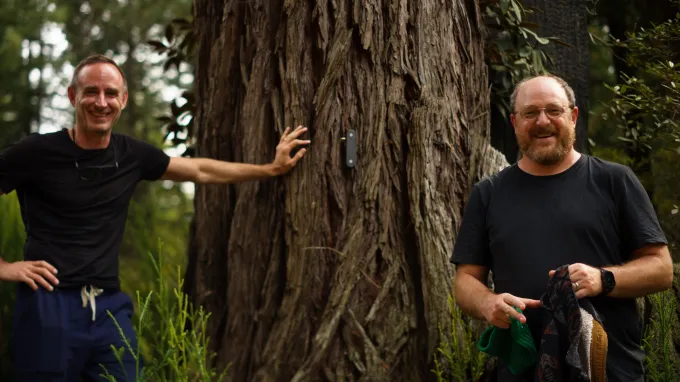
Electric Plant co-founders Lee von Kraus (right) and Justin Mast stand next to a tree with a sensor attached to it.Image Credits:Electric Plant
The underlying science traces back to earlier research on electrically active flora. Mast cited a study involving a houseplant wired to a motorized stand that moved toward light sources based on internal electrical currents as his initial introduction to the field. Plant electrophysiology has existed as a niche scientific discipline for decades, but applying large-scale machine learning to interpret those signals for commercial agriculture is a recent development.
Mast declined to name specific customers. Applications extend beyond traditional farming into forestry management, where monitoring the real-time physiological stress of trees across vast tracts of land remains logistically difficult using conventional tools.
“This is the most diverse model ever created on biological electrical signals,” Mast said. “No one’s ever done anything equivalent to this in the animal world.”
When you purchase through links in our articles, we may earn a small commission. This doesn’t affect our editorial independence.