Erik Spoelstra’s Toughest Task: Fixing Miami’s Shooting for Giannis
Poor perimeter shooting derailed Miami last season, and adding two paint-dominant stars makes floor spacing the defining tactical hurdle for Spoelstra.
Miami averaged 13.7 made three-pointers per game last season, connecting on just 36.1% of its attempts from beyond the arc. That statistical profile belonged to a team that finished 43-39 and missed the playoffs entirely. Now, head coach Erik Spoelstra has to build a functional offense around those numbers with two dominant interior players who demand space.
The arrival of Giannis Antetokounmpo, formerly of the Milwaukee Bucks, alongside captain Bam Adebayo fundamentally alters the geometry of the Heat’s half-court sets. Both players operate most effectively attacking the rim or facilitating from the high post. Defenses will collapse into the paint unless Miami’s perimeter shooters consistently punish them for doing so. The franchise’s immediate ceiling depends less on star power than on whether role players can convert open looks at a rate that keeps driving lanes viable.
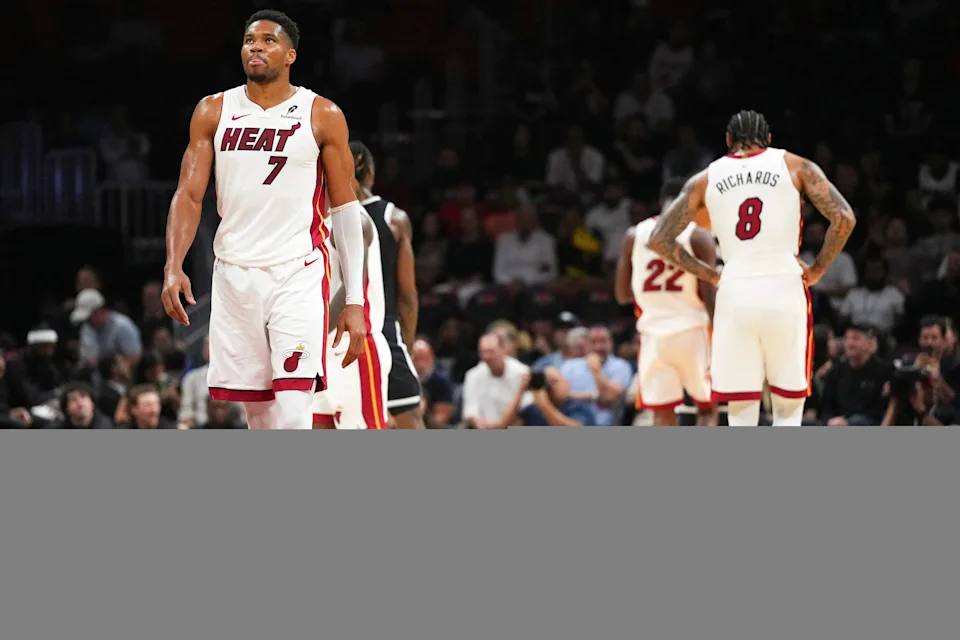
Oct 14, 2026; Miami, Florida, USA; Miami Heat forward Giannis Antetokounmpo (7) walks to center court during a foul call in the first half against the Brooklyn Nets at Kaseya Center. Mandatory Credit: Jim Rassol-Imagn Images

Spoelstra faces a rotation puzzle Wednesday when Miami opens the season against the Minnesota Timberwolves. The starting shooting guard job remains unresolved, with Davion Mitchell, Tim Hardaway Jr., Klay Thompson, and Pelle Larsson offering distinct tactical profiles. Mitchell provides ball pressure. Hardaway Jr. and Thompson bring established perimeter scoring, though consistency varies. Larsson enters his third year facing heightened expectations to develop into a reliable contributor.
None of these options guarantees the spacing Antetokounmpo enjoyed during his years in Milwaukee, where the Bucks routinely ranked near the top of the league in three-point attempts to clear the lane for his drives. Miami’s roster construction requires Spoelstra to decide nightly whether to prioritize shooting or defensive playmaking based on matchups.
Bench production compounds the issue. Nikola Jović offers size and versatility, while Bobby Portis Jr. brings rebounding and interior energy off the bench. Neither solves the perimeter spacing deficit. If Miami cannot stretch defenses, opponents will pack the paint, neutralizing the primary advantage of pairing Antetokounmpo with Adebayo.
Transition offense presents an alternative path. Andrew Wiggins and Antetokounmpo give Miami the athleticism to push pace and generate easy baskets before half-court defenses set up. But relying on fast breaks over an 82-game schedule rarely sustains a playoff contender. Teams that miss the postseason often do so because their half-court execution stalls during slower-paced games late in the year.
The Heat last missed the playoffs after a 43-39 campaign, a record that exposed offensive limitations no amount of coaching could fully mask. Spoelstra has historically maximized rosters lacking elite talent, but integrating two stars with overlapping spatial requirements demands schematic adjustments rather than motivational ones.
Featured Image: Jim Rassol-Imagn Images