Veritas Anti-Counterfeit Chip Targets Luxury Superfakes
The second-generation hardware now works on metal and glass, expanding verification capabilities to jewelry and fragrance bottles.
The luxury goods industry loses an estimated $3 trillion annually to counterfeits, according to the OECD and EUIPO, a figure that has climbed steadily as manufacturing precision improves. The rise of so-called superfakes—replicas so exact they routinely deceive professional authenticators—has forced fashion houses to look beyond traditional holograms, serial numbers, and static QR codes. Veritas, a hardware startup founded by former Tesla technical product manager Luci Holland, is attempting to close that gap with a cryptographic chip designed to bind a physical object permanently to a verified digital identity.
Unlike standard NFC tags or printed QR codes, which counterfeiters can clone and attach to fake merchandise, the Veritas chip generates a unique cryptographic response every time it is scanned. A built-in tamper-detection wire ensures that any attempt to physically remove the chip from its host product breaks the circuit, immediately invalidating the item’s digital certificate. This dynamic authentication model addresses the primary vulnerability in current anti-counterfeiting efforts: the separation between a product and its proof of origin.
Holland, whose background spans engineering, art, and design, structured the chip to be embedded into goods without altering their aesthetic or structural integrity. The company recently completed development on its second-generation hardware, which resolves a longstanding limitation in RFID and NFC technology. Standard chips frequently fail when placed near metal due to electromagnetic interference. The new Veritas iteration operates reliably on metallic surfaces and can be read through glass, expanding its application beyond apparel and leather goods into fine jewelry, trophies, and fragrance bottles.


The commercial strategy relies on a dual-interface ecosystem. Consumers use an iOS application to scan items, instantly retrieving a certificate of ownership and provenance history. Brands access a separate management portal to maintain product records and build post-purchase engagement. Rather than treating authentication solely as a loss-prevention tool, the portal allows companies to leverage verified ownership for gated experiences, including exclusive event access, private clubs, and early entry to limited product releases.
This utility model mirrors the broader shift in luxury retail toward lifecycle management. Competitors like Aura Blockchain Consortium—a joint venture backed by LVMH, Prada, and Cartier—have pursued software-based digital passports, while Entrupy uses artificial intelligence and microscopic imaging to authenticate items after production. Veritas differentiates itself by embedding the verification mechanism directly into the manufacturing process at the hardware level, making the object itself the key rather than relying on external databases or visual analysis.
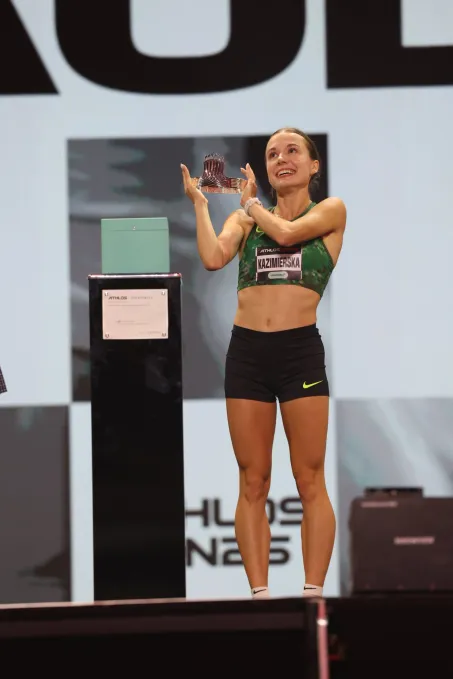
Early deployments have focused on high-profile partnerships to demonstrate the technology’s versatility across different materials. Veritas embedded its chips into all 18 championship crowns produced for ATHLOS, a women’s track-and-field competition established by Reddit co-founder Alexis Ohanian. In a separate demonstration targeting the sneaker resale market—a sector where authentication failures cost buyers millions annually—the company integrated a chip into a custom pair of LeBron James’ original Nike sneakers reimagined by artist Adam Port. Scanning the footwear surfaces its complete chain of custody and creative history.
Ohanian is also a financial backer. His venture firm, Seven Seven Six, led Veritas’ $1.75 million pre-seed funding round earlier this year. The investor roster includes DoorDash co-founder Stanley Tang, Reys skincare co-founder Gloria Zhu, and former TechCrunch editor Josh Constine. The capital has primarily funded the transition from prototype to production-ready hardware and the rollout of the brand-facing software infrastructure.
Veritas presented its second-generation hardware and enterprise platform during this week’s TechCrunch Disrupt Startup Battlefield, where the winner was announced Thursday afternoon.