Aging Solar Fleet Creates $Multi-Billion Repowering Market as First-Gen Systems Hit Inverter Failure Curve
First-generation systems cross 10-year threshold as inverter failures surge and original installers vanish
The residential solar industry is confronting a demographic cliff of its own making. More than 3.2 million U.S. homes installed photovoltaic systems between 2010 and 2018, a boom driven by plunging module prices and generous federal tax credits. Those arrays are now crossing the 10- to 15-year threshold where string inverters — the box that converts DC panel output to household AC power — statistically begin to fail in large numbers.
Unlike solar modules, which routinely carry 25-year performance warranties and often produce well beyond that, the balance-of-system electronics have always been the weak link. String inverters typically carry 10- to 12-year standard warranties, with extended coverage to 20 or 25 years purchased separately. Rapid shutdown devices, mandated by the 2014 and 2017 National Electrical Code cycles, and early-generation monitoring gateways are also hitting end-of-life.
This creates a structural mismatch: millions of homeowners own generating assets with decades of productive life remaining, but the electronics enabling that production are aging out. Compounding the problem, the installation landscape has consolidated dramatically. Of the roughly 6,000 solar contractors active in 2016, fewer than 2,500 remain today, according to Solar Energy Industries Association tracking. Bankruptcies, acquisitions, and market exits left an estimated 1.5 million residential systems “orphaned” — operational but without their original service provider.

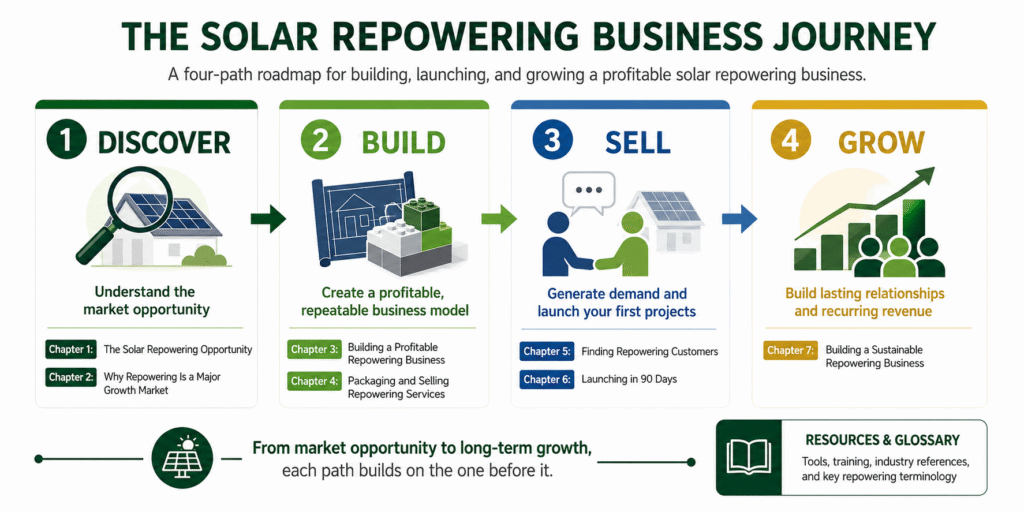
Tigo Energy, a Milpitas, Calif.-based supplier of module-level power electronics and monitoring platforms, this week published a 42-page “Repowering Business Playbook” aimed at helping independent contractors capture this emerging service market. The guide arrives as Tigo’s own field data shows accelerating traction: more than 11 megawatts of residential repowering projects completed using its TS4 optimizer platform, including a single integration partner surpassing 1,000 individual inverter replacements across aging and orphaned arrays.
“We’re watching the leading edge of a 15-year replacement cycle that will define the next decade of residential solar economics,” said Jing Tian, Tigo’s chief growth officer. “Contractors who treat this as a series of emergency service calls will miss the recurring-revenue opportunity. The ones who build structured service tiers around diagnostics, optimization, and storage integration will own the customer relationship for the next 20 years.”
The playbook outlines a three-tier service architecture. The “Restore” tier addresses immediate failures — inverter swaps, rapid shutdown compliance upgrades, monitoring restoration — typically a one- to two-day job priced at $3,000 to $8,000 depending on system size and jurisdiction. The “Optimize” tier adds module-level power electronics (MLPE) such as Tigo’s TS4-O or TS4-A-F units, which enable panel-level monitoring, mismatch mitigation, and NEC 2017/2020 rapid shutdown compliance without replacing the central inverter. The “Future-Proof” tier integrates AC- or DC-coupled battery storage, whole-home backup switching gear, and capacity headroom for EV charger loads — projects that can exceed $25,000 but unlock federal Investment Tax Credit eligibility for the storage portion under the Inflation Reduction Act’s standalone storage provision.
Critically, the economics differ from new construction. Repowering avoids customer acquisition costs that now average $4,000 to $6,000 per residential install, per EnergySage marketplace data. Permitting is often simpler: many jurisdictions treat inverter-for-inverter swaps as like-for-like equipment replacement, requiring only an electrical permit rather than a full structural and fire review. And the sales cycle compresses from 60-90 days for new solar to 14-21 days for a diagnosed failure or proactive upgrade.
Policy shifts are accelerating demand. California’s Net Energy Metering 3.0, implemented April 2023, slashed export compensation by roughly 75%, making self-consumption via battery storage economically rational for the first time at scale. Hawaii, Arizona, and Massachusetts have enacted similar export-rate reductions. Meanwhile, time-of-use rate structures spreading across utility territories increase the value of stored midday solar for evening use.
The playbook recommends a 90-day market-entry sequence: month one for crew training on MLPE commissioning, service menu pricing, and proposal templates; month two for database mining of CRM records older than 10 years, municipal permit scraping for vintage system clusters, and referral agreements with roofing and HVAC contractors who encounter aging arrays during unrelated work; month three for closing pilot projects, documenting case studies with production-before-and-after data, and converting single-service customers into annual maintenance agreements — typically $300 to $600 per year for remote monitoring, quarterly performance reports, and priority emergency response.
Early adopters report gross margins of 35% to 45% on repowering work versus 18% to 22% on new residential installs, where module commoditization and fierce competition compress pricing. The recurring maintenance layer adds annuity-like revenue: a contractor managing 500 systems at $400 annually generates $200,000 in predictable cash flow with minimal incremental labor.
Insurance and warranty dynamics remain a friction point. Most module manufacturers honor performance warranties regardless of inverter brand, but some require approved MLPE for mismatch-related claims. Inverter manufacturers including SolarEdge, Enphase, and SMA have certified third-party replacement pathways, though firmware locks on older communication protocols can complicate monitoring integration. Tigo’s platform addresses this with protocol-agnostic data ingestion, a feature the playbook highlights as a competitive differentiator.
The broader market implication: residential solar is maturing from a construction industry into an asset management industry. Analogous to the HVAC replacement cycle that sustains a $120 billion U.S. service market, the solar O&M (operations and maintenance) segment could reach $4 billion to $6 billion annually by 2030, per Wood Mackenzie estimates, driven almost entirely by the installed base aging into its first major hardware refresh.
Tigo’s 1,000-inverter replacement milestone, achieved through a single unnamed national integration partner in the past 18 months, suggests the inflection point has arrived. The company plans quarterly playbook updates incorporating field feedback, regulatory changes, and new storage product certifications — starting with the next revision scheduled for January 2025.