Ethiopia-Eritrea War Risk Surges After Drone Strikes Hit Addis Ababa
Suspected drone attacks on Addis Ababa military sites follow the collapse of the Tigray ceasefire and unverified reports of Eritrean troop movements across the border.
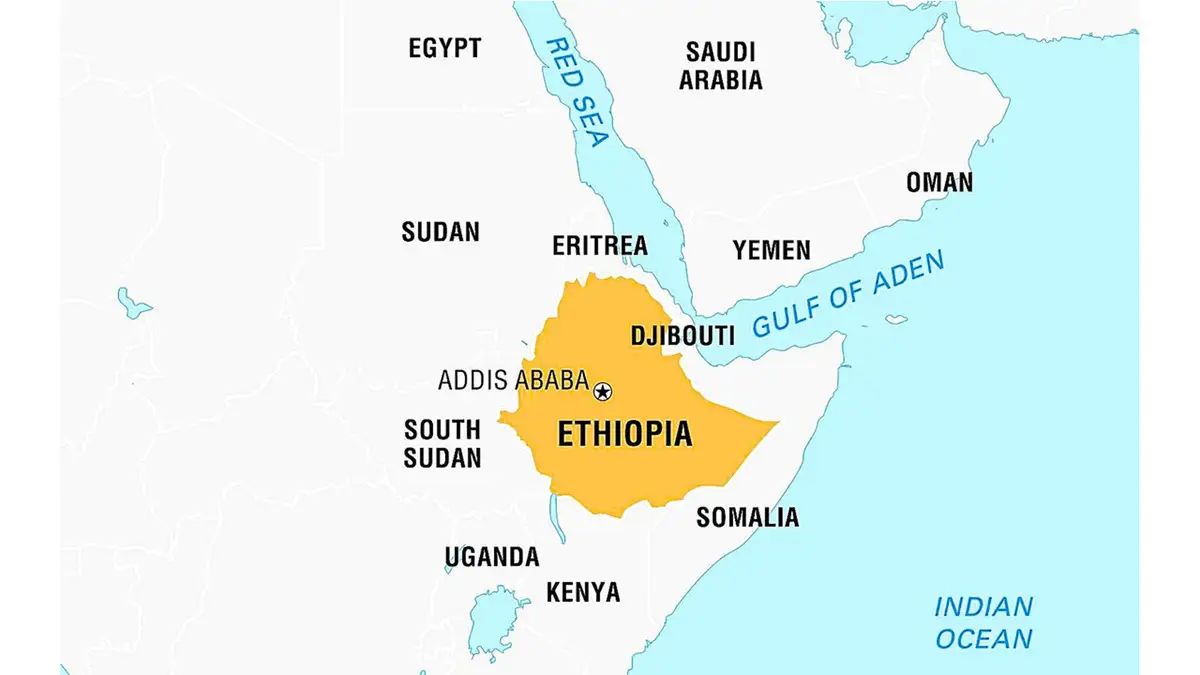
Explosions struck military installations in Ethiopia’s capital in early October, triggering U.S. Embassy warnings about long-range attacks and raising the prospect of a broader war between Ethiopia and Eritrea that could destabilize one of the world’s most critical maritime corridors.
The U.S. Embassy in Addis Ababa confirmed awareness of multiple suspected strikes targeting Ethiopian defense sites this month. Officials urged American citizens to exercise caution and rely on verified information, warning that social media accounts were circulating false reports about the security environment. While explosions around the city — which hosts the African Union headquarters — are confirmed, independent verification of drone impacts on buildings remains unavailable. The Ethiopian government has not responded to requests for comment.
A coalition of rebel factions operating under the banner of the Ethiopian Peoples’ Forces Alliance for Survival claimed responsibility for the attacks, asserting they deployed drones. Security researchers dispute that claim. Jalale Getachew Birru, a regional expert with the Armed Conflict Location and Event Data project, noted that if the strikes involved aerial or drone platforms, they exceed the known technical capacity of domestic insurgent groups. Such capabilities would substantiate Addis Ababa’s allegations of direct foreign state involvement.


Blen Mamo, executive director of the Ethiopian Horn Review think tank, said confirmed rebel drone use would fundamentally alter the conflict by shifting strategic advantage toward whoever controls the airspace.


The strikes follow a sharp military escalation in northern Ethiopia. Federal forces retook Mekelle, the capital of the Tigray region, earlier this month, dismantling a four-year ceasefire with the Tigray People’s Liberation Front. Ethiopian Airlines announced the resumption of flights to Mekelle beginning Oct. 11. Concurrently, unverified reports and circulating video footage show large convoys of uniformed soldiers moving through the border city of Adigrat, allegedly indicating an incursion by Eritrean troops. Ethiopian forces reportedly launched retaliatory drone operations to push them back across the frontier.
Eritrea gained independence from Ethiopia in 1993, leaving its larger neighbor landlocked. Access to the Red Sea has since remained Ethiopia’s most volatile geopolitical objective. During his Oct. 5 inauguration for a new five-year term, Prime Minister Abiy Ahmed declared sea access “of vital importance to Ethiopia’s civilization” and pledged to secure an outlet based on “the principle of give and take.” Analysts view this rhetoric as a direct challenge to Eritrean sovereignty over its coastline and port infrastructure, particularly Assab and Massawa.
Abiy’s ambitions collide with a newly formed regional counterweight. Egypt, Sudan, Eritrea, and Somalia recently established a coalition opposing Ethiopia. The alliance is driven largely by the Grand Ethiopian Renaissance Dam, a massive hydroelectric project on the Blue Nile that downstream nations Egypt and Sudan argue threatens their water security. Egypt has simultaneously expanded military and technical cooperation with Asmara, extending its strategic footprint along Ethiopia’s northern border while deepening its influence in Somalia and Red Sea port initiatives.
Cameron Hudson, a former CIA analyst and National Security Council Africa director, assessed that external powers may exploit the weakness of Ethiopia’s internal rebel coalition to exert leverage against Abiy. He warned that miscalculations among armed actors could ignite a regional conflagration, urging the Trump administration to intervene before local disputes trigger global consequences.
Hudson specifically pointed to the Bab el-Mandeb strait, the narrow chokepoint at the southern end of the Red Sea through which roughly 12% of global trade passes. Houthi militants have already disrupted shipping lanes in the area amid the broader Middle East conflict involving Iran. A simultaneous ground war in the Horn of Africa threatening the strait’s security would immediately impact international supply chains and energy markets, directly affecting U.S. economic interests.
Washington has initiated diplomatic contacts to contain the fallout. Undersecretary of State for Political Affairs Allison Hooker met this month with Eritrean Foreign Minister Osman Saleh and spoke with Ethiopian Foreign Minister Gedion Timotheos. Assistant Secretary for African Affairs Frank Garcia also held talks with Saleh. Both officials emphasized respecting sovereignty and territorial integrity across the region.
State Department spokesman Thomas Piggott subsequently issued a formal statement warning that cross-border tensions threaten the entire Horn of Africa. He called on Ethiopia and Eritrea to exercise maximum restraint and return to the framework established by their 2018 peace agreement, which ended two decades of hostility following the 1998-2000 border war but has frayed significantly since the Tigray conflict began in 2020.
Federal police units have resumed patrols in Mekelle aboard pickup trucks as Ethiopian authorities attempt to consolidate control over the recaptured territory.