London Collector’s 38-Year Flat Evolution Reveals Shifting Tastes in English Country Style
How a decorator's multigenerational collection reveals shifting British design values
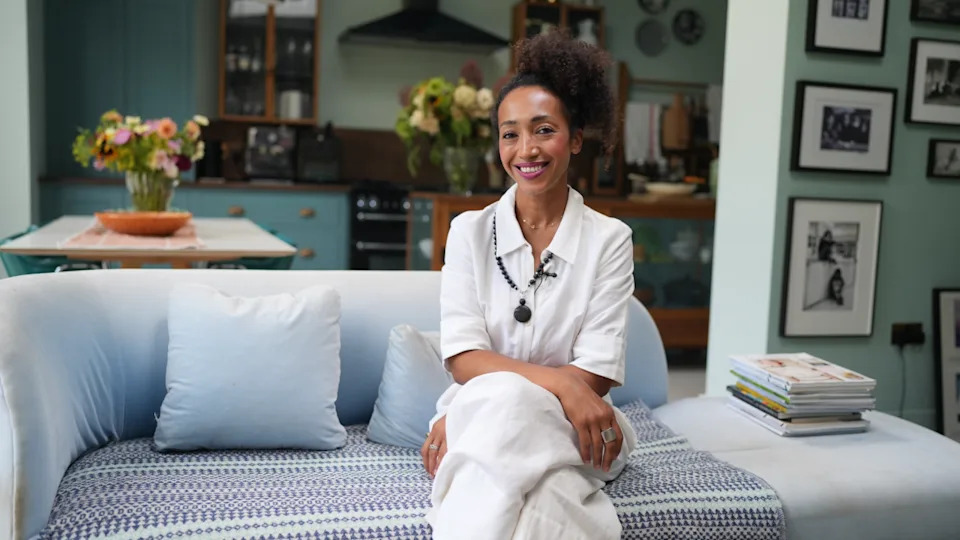
Cindy Leveson’s London flat tells a story that spans nearly four decades of collecting, two merged apartments, and a design philosophy that treats heirlooms as living artifacts rather than museum pieces. The decorator and artist first purchased the property 38 years ago, later expanding into the neighboring unit with her husband John to create a combined residence that functions as both family archive and evolving canvas.
The result is a layered interior where English country house tradition meets Parisian influences — most visibly in the kitchen’s colorful wallpaper — alongside Leveson’s own watercolors and design work. Family portraits share walls with antique silver, inherited textiles, and pieces acquired over decades of hunting. Nothing appears staged; the rooms carry the patina of genuine long-term occupancy.
Leveson’s background explains the approach. Raised by parents who surrounded her with antiques and art, she internalized a collector’s mindset that values provenance and personal connection over trend cycles. That perspective aligns with a broader shift in British interior design, where the “country house look” has migrated from rural estates into urban flats, adapted for smaller footprints and contemporary living.


The flat’s expansion mirrors a well-established London property strategy: combining adjacent units to create lateral space in buildings where vertical expansion isn’t possible. In prime neighborhoods, this approach has created some of the city’s most distinctive homes, allowing collectors to display pieces that would overwhelm a single apartment’s footprint.
Homeworthy, the design platform featuring Leveson in its Tastemaker series, positions her story as part of a growing content category that blends editorial profile with commerce. The series promotes a “Collected Home Trunk” product line, reflecting how design media increasingly monetizes access to tastemakers’ aesthetics. Leveson’s participation — genuine collector turned brand ambassador — illustrates the blurring line between documentation and curation in digital design publishing.
What distinguishes Leveson’s approach from the Instagram-ready “collected look” is duration. Thirty-eight years in one address means acquisitions accumulate organically: a painting bought on a honeymoon, a chair inherited from a grandmother, a textile sourced from a now-closed market. The imperfections — faded upholstery, mismatched frames, walls dense with pictures hung over decades — read as authenticity rather than styling.
Design historians note this represents a specific British tradition: the “room of requirement” approach where spaces adapt to objects rather than objects being sourced for spaces. It contrasts with the American decorator model of comprehensive schemes executed in compressed timelines. Leveson’s flat, still evolving after nearly four decades, embodies the former.
The kitchen’s Parisian wallpaper — a rare deliberate design intervention in a largely organic scheme — signals how even committed traditionalists selectively incorporate outside influences. It’s a reminder that English country style has always been porous, absorbing French, Dutch, and Chinese elements through centuries of trade and aristocratic marriage.
Leveson maintains there’s always room for one more painting. At 38 years and counting, the flat’s evolution continues.