

Microsoft and Nvidia have introduced a new generation of Windows PCs built around Nvidia’s N1X family of Arm-based processors, positioning the hardware as the foundation for running large artificial intelligence models directly on personal devices. The partnership centers on the newly announced Surface Laptop Ultra and the RTX Spark chip architecture, shifting the competitive dynamics of the PC processor market away from the traditional x86 dominance held by Intel and AMD.
The Surface Laptop Ultra starts at $2,599 for a configuration featuring 24 GB of RAM, 512 GB of storage, 18 CPU cores, and 5,120 GPU cores. A maximum specification reaches $5,899, equipping the machine with 128 GB of RAM, 1 TB of storage, 20 CPU cores, and 6,144 GPU cores. Microsoft is offering up to $1,000 in cash back for buyers trading in eligible MacBook Pro models, signaling a direct challenge to Apple’s high-end professional laptops powered by M-series silicon.
Unlike previous AI-focused developer systems such as the DGX Spark, which relied on Nvidia’s GB10 chip and ran Linux, the new hardware lineup runs Windows 11. The N1X chips are architecturally related to the GB10 but are designed specifically for consumer and enterprise Windows environments, delivering up to 1 petaflop of FP4 AI performance depending on the configuration. Nvidia partnered with MediaTek on the design of these processors, cementing their place within the broader Arm ecosystem rather than the x86 architecture that has defined Windows machines for decades.


This architectural pivot carries significant implications for software compatibility, particularly in gaming. Qualcomm’s Snapdragon X series previously established a foothold for Windows on Arm, but developers largely hesitated to port demanding games to the platform. Nvidia’s entry into the Arm-based Windows PC market provides game studios with a stronger financial incentive to optimize titles for Arm instructions. Microsoft confirmed support for Gears of War at launch, with Call of Duty integration scheduled for 2027. Because these optimizations target the underlying Arm instruction set, applications ported for Nvidia’s N1X chips will natively benefit competing Windows on Arm devices, including those using Qualcomm silicon.
Beyond Microsoft’s proprietary hardware, Asus, Dell, HP, Lenovo, and MSI are manufacturing notebooks based on the RTX Spark architecture. Dell and HP also previewed compact desktop systems and high-end workstations incorporating Nvidia’s GB300 Grace Blackwell Ultra Desktop Superchip for users requiring heavier compute loads. Notebook shipments begin around October 16, while desktops and developer boxes follow later this year. For software engineers, Microsoft priced the Surface RTX Spark Dev Box at $5,999, bundling 128 GB of RAM, 2 TB of storage, 20 CPU cores, and 6,144 GPU cores.
The hardware specifications enable local execution of AI models exceeding 120 billion parameters, contingent on installed system memory. This capability fundamentally alters the economics of generative AI usage. Running inference locally eliminates per-token cloud computing costs, allowing enterprises and individuals to process sensitive data without transmitting it to external servers. The industry is moving toward hybrid AI architectures where routine tasks execute on-device while complex queries route to cloud-based frontier models. To automate this division of labor, Microsoft is integrating GitHub’s HydraFusion tool into Windows, starting with developer workflows to dynamically assign coding tasks between local and cloud models.
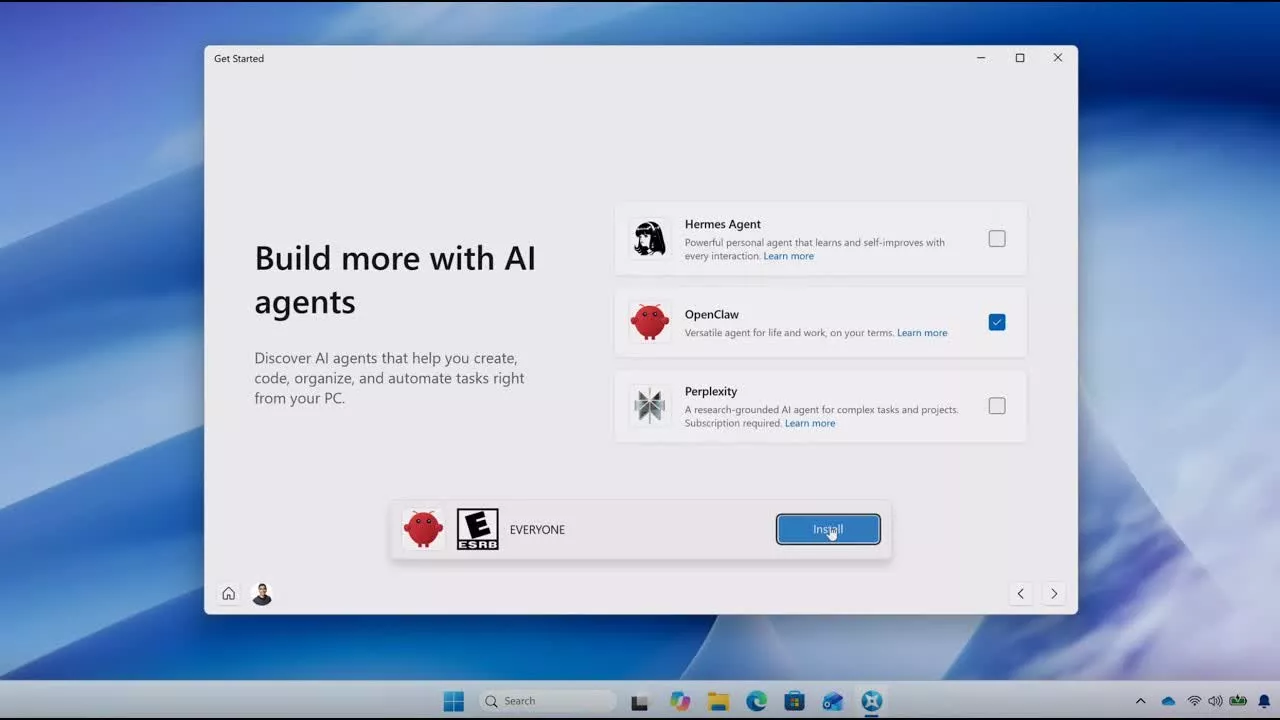
Executing autonomous AI agents locally introduces severe security risks if those agents access unrestricted file systems or network endpoints. To address this, Microsoft engineered Execution Containers, known as MXCs. These isolated environments restrict agent permissions, controlling specific file and network access points. Major agentic frameworks, including OpenAI’s Codex, OpenClaw, and Nvidia’s OpenShell, already support the MXC standard. For dedicated desk-side AI hardware, Windows now includes an integrated gateway and setup wizard to streamline configuring devices as localized companion computers.
Windows 11 itself received structural updates focused on agentic workflows. A new hybrid intelligence toggle in system settings grants Copilot permission to index local files and user activity, providing context for autonomous actions. An enhanced Autopilot agent operates alongside manual controls. The most broadly applicable update, Actions in Windows Search, allows users to type natural language commands directly into the search bar to alter system settings, organize directories, or send messages without navigating through menus. The hybrid toggle also simplifies downloading and configuring open-weight local models, removing technical barriers that previously limited on-device AI to advanced users.
The Surface Laptop Ultra pairs this compute density with a 15-inch mini-LED touchscreen capable of 1,000 nits of brightness, peaking at 2,000 nits for HDR content. Microsoft claims up to 15 hours of battery life for video playback and 12 hours during active web usage. The chassis utilizes a new magnetic USB-C power connector, replacing traditional barrel plugs or standard tethered cables.
Pre-orders and retail availability for the initial wave of RTX Spark notebooks and the Surface Laptop Ultra open ahead of the October 16 shipping date.



