

The first close image Hera sent back was taken on 7 November from 29 kilometres away, at 2.7 metres per pixel. Dimorphos sits at the top left of the frame, a 151-metre moonlet next to the 730-metre Didymos it orbits, and the face DART struck in 2022 is flat. The Dimorphos crater extends across the asteroid’s entire width. Patrick Michel, the Hera principal investigator, said scientists had debated whether Dimorphos sustained a crater, changed its shape or stayed the same, and that the answer turned out to be all three at once. The boulder fields on the rest of the body look as they did in DART’s 2022 images. The pair is 193.5 million kilometres from Earth.
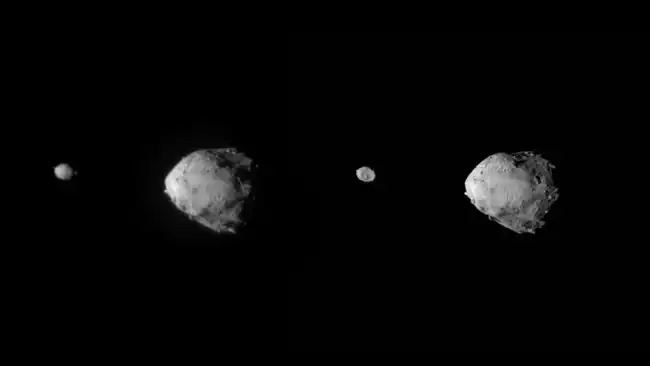
DART weighed 579 kilograms when it hit, travelling at 6.145 kilometres per second, and it struck at 23:14 UTC on 26 September 2022 between two boulders 6.5 and 6.1 metres long, about 25 metres from the centre of the face it approached. Telescopes on Earth measured what the impact did to the orbit. Dimorphos went from circling Didymos every 11 hours 55 minutes to every 11 hours 22 minutes, a shortening of 33 minutes, which works out to an along-track velocity change of 2.70 millimetres per second. Dimorphos became the first object in the Solar System to have its orbit shifted by human effort in a measurable way. What the surface looked like afterwards, nobody knew. DART’s camera died with the spacecraft. The only views of the impact site for four years were the last frames it transmitted on the way in.
In February 2024, Sabina Raducan and colleagues published shock-physics simulations of the impact in Nature Astronomy. The simulations matched the observed deflection and debris best with a weak rubble pile, a loose aggregate of boulders and gravel held together by gravity and a cohesive strength of less than a few pascals, closer to the asteroids Bennu and Ryugu than to solid rock. In those simulations the crater kept growing because nothing in the body stopped it, until it encompassed the entire asteroid. About 1 percent of the mass escaped as ejecta and about 8 percent shifted to new positions inside the body, and the shape settled from an oblate spheroid, 177 by 174 by 116 metres before impact, into a triaxial ellipsoid. The authors wrote that Hera might find a reshaped asteroid rather than a well-defined crater. Hera found a crater whose rim is the body itself, with a central mound visible at current resolution, on a face that used to be rounded. Raducan, speaking at the Berlin briefing on 25 November, called it a big crater almost as large as the body itself. The prediction and the image agree on the scale and differ on the neatness, and both readings stay in the record: a crater, and a reshaping, on the same face.


A second paper, by Ryota Nakano and colleagues in The Planetary Science Journal in June 2024, worked on what the reshaping did to the motion. Their simulations put the equatorial axis ratio changing from 1.06 to about 1.3, and they calculated that reshaping alone could account for roughly 125 seconds of the observed 33-minute period change, up to about 250 seconds within the uncertainty range. That is 6.3 percent of the 1,980 seconds telescopes measured, or 12.6 percent at the top of the range. The same work found that the impact perturbation combined with the new shape gave a strong possibility of a tumbling rotation state. Before the impact Dimorphos rotated in spin-orbit synchrony, turning once per revolution and keeping its long axis pointed at Didymos, the way the Moon keeps one face toward Earth. Hera’s images show it tumbling chaotically instead. Raducan described the motion as a barrel thrown down the stairs, rolling around Didymos. The survey consequence is practical: nobody can predict yet which face Dimorphos will show when Hera takes a photograph, which also means every side eventually comes into view.
Vincent Ottobre wrote: “The very first image, our first glimpse at just how huge the DART crater is compared to Dimorphos, that feeling seeing that was so cool to experience!” Ian Maclean wrote: “Did the orbital position of Dimorphos change too or just its orbital period ?” and asked in the same comment whether the debris cloud had scattered or been pulled back. The two questions are the two measurements Hera still owes. The period change is known to the minute. The mass will come from radio science, and the debris is being catalogued in the long-exposure images.
The number planetary defence needs from this experiment is called beta, the ratio of the momentum Dimorphos actually received to the momentum DART carried in. The spacecraft alone delivered 579 kilograms at 6,145 metres per second, about 3.56 million newton-seconds. Debris blasted off the surface recoiled and added more, and how much more depends on a mass nobody has measured. Dimorphos is put at about 4.3 billion kilograms by assuming it is as dense as Didymos. Across the plausible density range of 1,500 to 3,300 kilograms per cubic metre, beta runs from 2.2 to 4.9, a factor of 2.2 between the low and high ends. At a density of 2,400, beta is 3.61, and the total momentum imparted comes to about 12.8 million newton-seconds. Naomi Murdoch said at the briefing that with Hera’s measurements of the mass, the team will be able to see exactly how effective and efficient the DART impact was. Hera will get the mass from radio science, tracking how the two asteroids tug on the spacecraft and on each other, backed by the gravity measurements its CubeSats make close in. Until that number lands, the first kinetic deflection in history is known to have worked somewhere between twice and five times better than the spacecraft’s own momentum.
The ejecta that produced the extra push were watched from three directions in 2022. The Italian CubeSat LICIACube, released from DART fifteen days before impact, flew past about 55 kilometres from Dimorphos and photographed a cone opening at about 140 degrees, threaded with filaments and boulders moving at up to about 500 metres per second. A typical impact cone on Earth opens near 90 degrees. Hubble followed the debris for weeks as sunlight pushed the dust into a tail that stretched beyond 1,500 kilometres within hours and across 10,000 kilometres of space in ESA’s accounting, with a second tail appearing days later. NASA’s minimum success threshold for the mission had been a period change of about 73 seconds. The measured 33 minutes beat it by a factor of about 25, and the recoil from that cone is the reason.
Hera’s long-exposure images add a population nobody had catalogued. Stacking eleven observations from the Hyperscout H instrument shows hundreds of boulders moving around the pair, more than 100 of them between the size of a football and a washing machine. Their origin is unsettled. Murdoch said the team cannot yet say whether they are DART debris still in orbit or material launched off Didymos by secondary impacts, and Raducan noted DART was moving at six kilometres per second and would probably never have seen them. The boulders spread in rings out to 7 or 10 kilometres. The two CubeSats Hera carries are planned to fly trajectories about 2 and 3 kilometres from the system, which puts them at 20 to 43 percent of the ring radius, inside the debris. Claudia Balossi, the Juventas system engineer, said the CubeSats are right in the middle of it. Margherita Cardi, who oversees the Milani CubeSat at Tyvak, called the discovery a nightmare challenge and described a mix of excitement and panic. Heli Greus, Hera’s product assurance and safety manager, said the team had believed the scientists who told them it was just two rocks.
Jan Koet wrote: “The ridge on Didymos reminds me strongly of the ridge on the Saturn moon Iapetus. I wonder if there is a similar connection in its origin.” Didymos kept its central equatorial ridge and its boulder fields through the impact, and Hera imaged hemispheres of both bodies that DART never saw. Ian Tietjen wrote: “Human greed and hubris have basically destroyed the earth and now we have to go and destroy an innocent asteroid too. When will we learn?” ESA’s framing at the briefing ran the other way. Ian Carnelli, the Hera mission manager, unveiled the images in the dinosaur hall of Berlin’s Museum für Naturkunde. He said that 66 million years ago an asteroid impact changed the course of life on Earth, and that humanity is now validating how to prevent such an event from happening again. Josef Aschbacher, ESA’s director-general, called the two missions a transformation of a successful experiment into the knowledge needed for a reliable planetary defence capability. The officials speak in reliability and repeatability. The followers ask where the debris went, what the ridge is, and whether the hit should have happened at all.
Hera is a 1,150-kilogram spacecraft about the size of a small car, launched on 7 October 2024, and it is holding rectangular orbits around the pair at 25 to 30 kilometres, moving at an average of 12 centimetres per second. Its instruments are two Asteroid Framing Cameras, the Hyperscout H imager working in 25 colours at once, JAXA’s Thermal Infrared Imager, the PALT laser altimeter and a radio science experiment. In December the spacecraft is scheduled to close to about 13 kilometres for higher-resolution imaging and the mass determination. In January 2027 it deploys Juventas, built in Luxembourg, which will sound the interior with the smallest radar ever flown in space, a 50 to 70 megahertz instrument, and then attempt a landing with a gravimeter aboard. Milani, built in Italy, will prospect surface minerals and dust and also attempt a landing. The two are the first ESA CubeSats to operate beyond Earth orbit. The investigation runs six months, and the mission is planned to end with Hera itself descending onto Didymos.
Dimorphos orbits Didymos at an average separation of about 1 kilometre. Juventas carries a radar that will probe the interior of Dimorphos for the first time, and its planned trajectory sits inside the boulder ring Hera photographed in November.



