

OpenAI has deployed GPT-6 across all ChatGPT tiers, introducing a dual-model architecture that routes paid subscribers through a variant called GPT-6 Sol while directing free and Go-tier users to GPT-6 Luna. The rollout, which began Thursday for Plus, Pro, and Business accounts before expanding to the remaining user base on Friday, marks the first time OpenAI has simultaneously shipped its flagship model to both paid and unpaid tiers under distinct configurations.
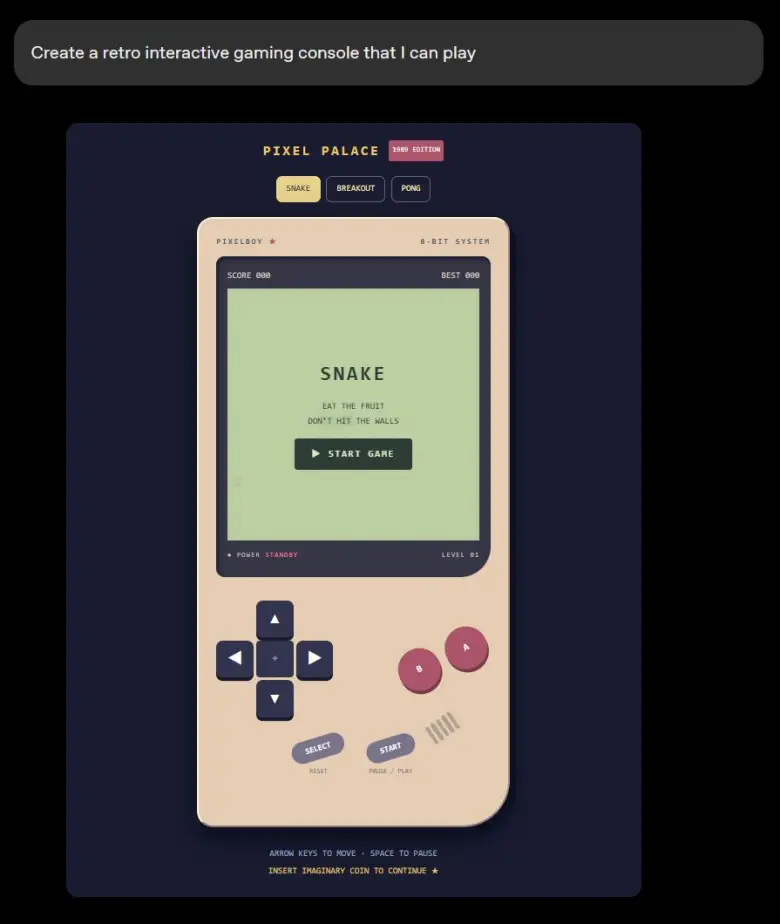
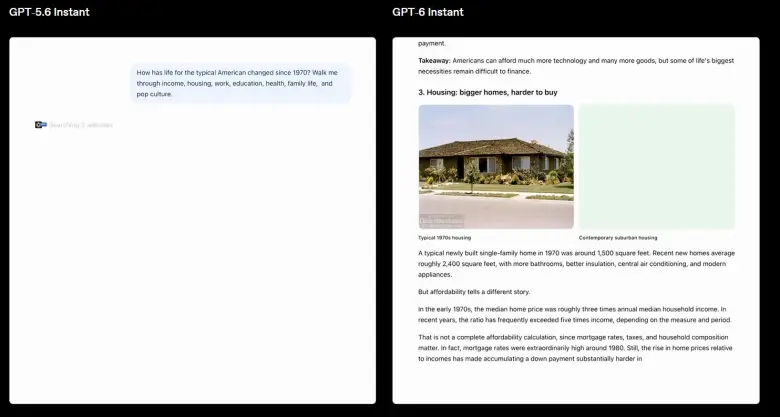
The most visible change is Intelligent UI, a system that abandons static text blocks in favor of dynamically compiled interfaces. Rather than returning paragraphs, GPT-6 assembles responses using native components — tables, interactive diagrams, mathematical formulas, images, and functional web applications built directly inside the chat window. A query about vacation packing generates visual outfit boards. A request to understand drone photography markets produces sortable data tables populated with relevant imagery. For complex math or science topics, the model renders interactive elements users can manipulate to test variables.




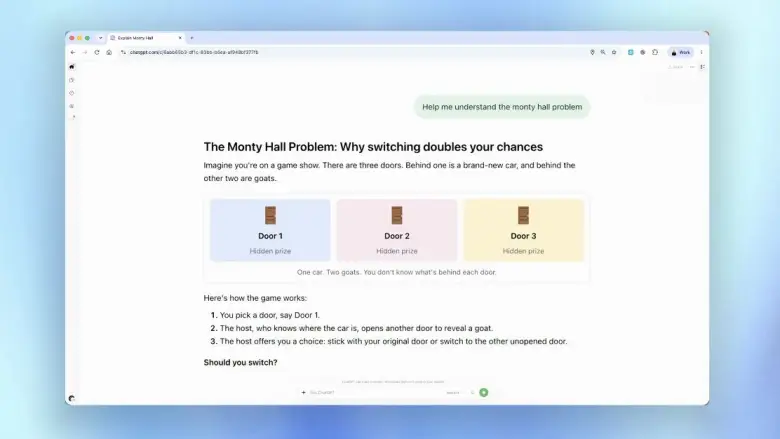
This approach mirrors a broader industry pivot toward multimodal rendering. Anthropic’s Claude introduced similar visual structuring capabilities earlier this year, signaling that the competitive baseline for generative AI has shifted from pure text generation to interface construction. OpenAI’s implementation relies on a proprietary component library paired with a compiler that processes the interface layout as the model generates it. The model determines whether a simple question warrants plain text or if a multi-step task requires a fully functional calculator embedded in the conversation thread.
Beneath the visual overhaul, OpenAI restructured how GPT-6 handles reasoning latency. The company is calling the new behavior “frontier intelligence,” a streaming logic framework where the model delivers partial answers continuously rather than forcing users to wait through a prolonged internal chain-of-thought process. Each fragment contains actionable information without filler, combining into a coherent final output. This addresses a persistent friction point in agentic workflows where high-reasoning models often stall for several seconds before producing their first token.
Benchmark tests conducted by OpenAI indicate that GPT-6 Extra High matches the response speed of the older GPT-5.6 Medium tier while outperforming GPT-5.6 Extra High on accuracy metrics. Web search integration also received targeted refinements. The model now exercises stricter judgment over when external queries are necessary, reducing redundant lookups and prioritizing authoritative sources to substantiate claims.
Splitting the deployment between GPT-6 Sol and GPT-6 Luna allows OpenAI to manage compute costs more aggressively. Historically, offering frontier-level reasoning to hundreds of millions of free users created unsustainable server loads. By routing unpaid traffic through the Luna variant, the company preserves access to the latest architecture while likely constraining certain resource-intensive parameters reserved for the Sol build used by paying customers.
All ChatGPT Plus, Pro, and Business users currently have access to the full GPT-6 feature set. Free and Go accounts gain entry starting Friday.



