Honda Tests Wireless EV Charging Roads for Trucks in Japan
The dynamic wireless power transfer pilot on the Tateyama Expressway targets 150 kW delivery to heavy freight vehicles without requiring stationary charging stops.
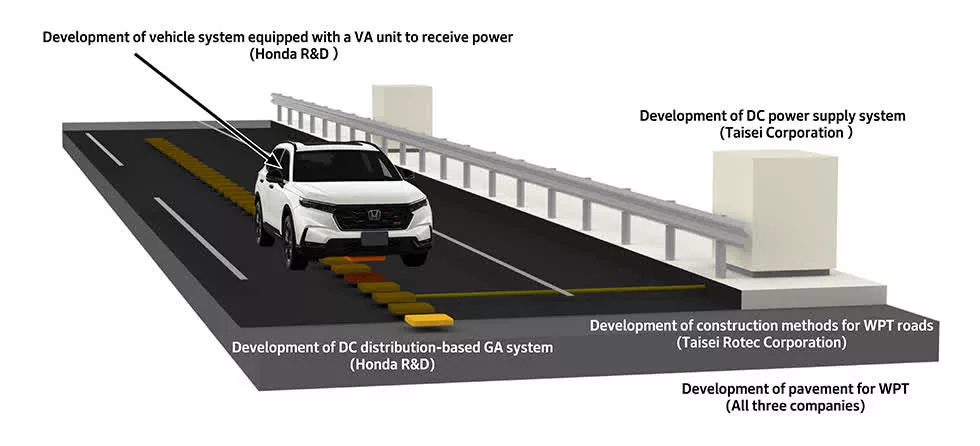
A consortium led by Honda’s research division will embed wireless power transmitters directly into a Japanese expressway starting in April 2027, aiming to eliminate stationary charging stops for heavy electric freight vehicles.
The pilot program targets the Tateyama Expressway in Chiba Prefecture as part of the broader Tateyama Project. Honda is developing the system alongside construction firm Taisei and road builder Taisei Rotec, focusing initially on commercial logistics fleets where vehicle downtime translates directly into lost revenue.
Unlike conventional plug-in fast chargers that require trucks to idle at depots or highway rest areas, this dynamic wireless power transfer technology uses magnetic resonance coupling. Transmitter coils buried beneath the asphalt generate an alternating magnetic field, which receiver coils mounted on the underside of a passing truck convert back into electrical current to replenish the battery while the vehicle maintains highway speeds.


Honda’s engineering approach relies on a direct current distribution network connecting the underground transmitters. Each embedded module integrates both the inverter and the coil into a single unit, reducing the wiring complexity typically associated with subterranean electrical infrastructure. The modular design allows installation teams to cut sections into existing paved roads rather than requiring entirely new highway construction.
Durability remains the most formidable engineering barrier for electrified roadways. Commercial trucks routinely exert massive downward force on pavement. To address this, the consortium engineered the charging units and surrounding road structures to support vehicles weighing approximately 20 tons. A dedicated test roadway scheduled for construction in late 2026 will undergo accelerated fatigue testing equivalent to one million wheel loads at 49 kilonewtons per wheel. Engineers will simultaneously monitor charging efficiency and measure electromagnetic field leakage to ensure safety compliance.
Subsequent verification phases will push power delivery toward 150 kilowatts and evaluate system reliability at higher driving speeds. These figures represent testing objectives for the development phase rather than guaranteed performance metrics for the 2027 expressway deployment.
Japan is not the only country pursuing dynamic charging infrastructure. In the United States, Florida is advancing plans for a roughly three-quarter-mile electrified segment on State Road 516 capable of delivering up to 200 kW to compatible vehicles. Detroit previously hosted a demonstration project utilizing similar buried-coil technology developed by the Israeli firm Electreon.
Despite the technical momentum across multiple countries, economic viability remains unproven. A Honda engineer told Reuters that comparing the system’s cost to traditional DC fast-charging networks is premature, as the financial model for installing and maintaining high-voltage equipment beneath active traffic lanes still requires comprehensive assessment.
Vehicle compatibility presents another immediate constraint. Standard passenger and commercial electric vehicles lack the necessary underbody receiver hardware, meaning the technology currently serves only specially modified fleets rather than the general driving public.
Construction on the durability testing roadway begins in late 2026, preceding the full expressway integration planned for the start of Japan’s fiscal year on April 1, 2027.