Kalshi Gold Micro-Markets Surpass Ether Fees in Rapid Shift
Short-duration commodity contracts now drive 80% of non-sport revenue as platform scales beyond crypto
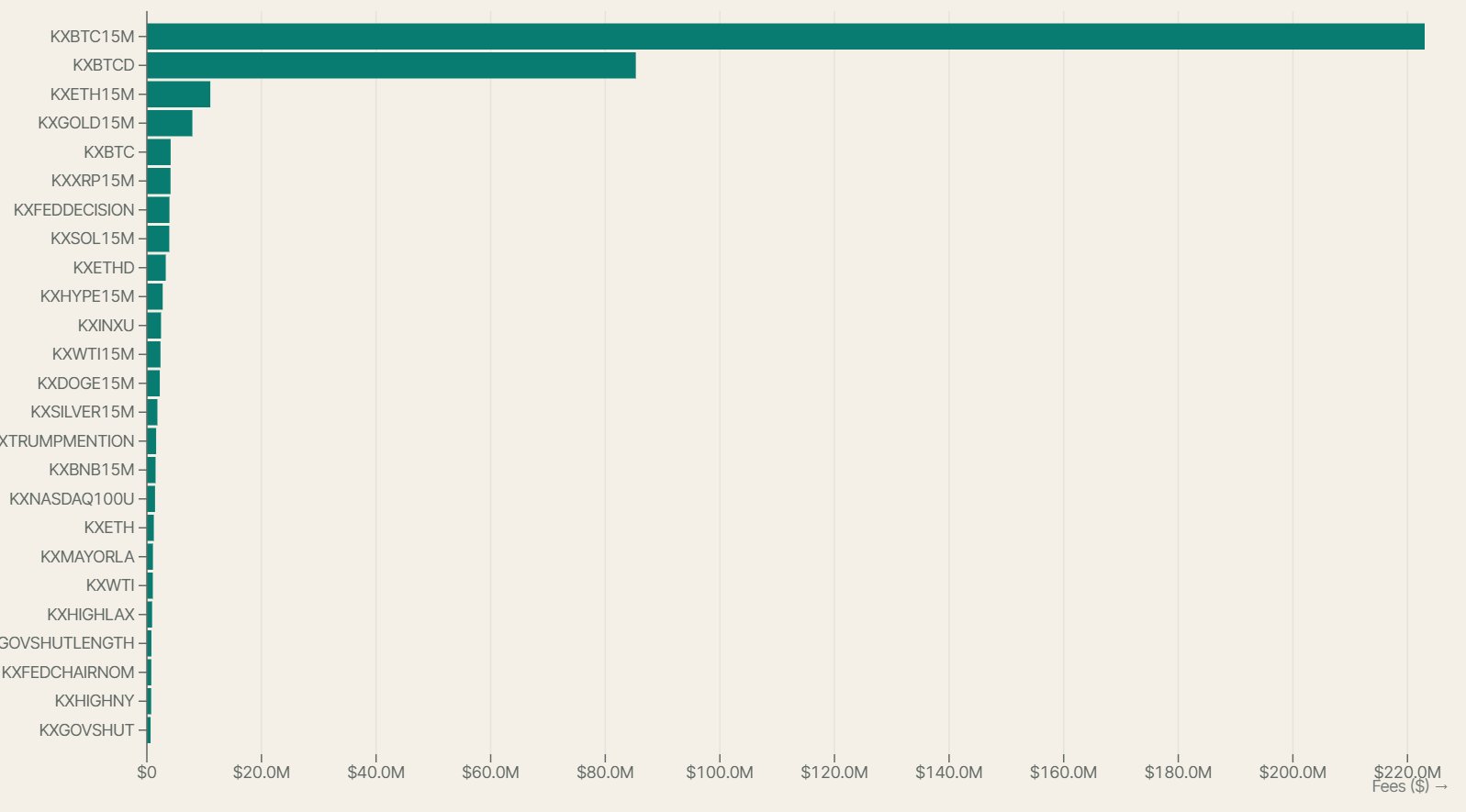
Ultra-short-term gold contracts on Kalshi have overtaken Ether markets in fee generation, signaling a decisive pivot toward traditional commodities within the regulated prediction market sector. Just weeks after launching in August, 15-minute gold markets generated approximately $5 million in estimated trading fees during September, nearly double the $2.6 million produced by equivalent Ether contracts, according to data from Predict Charts.
This rapid ascent highlights a structural shift in trader behavior on event-driven platforms. While Bitcoin remains the dominant asset class with $60.4 million in September fees, the velocity at which gold captured market share suggests that high-frequency commodity speculation is scaling faster than crypto assets did at similar stages. Kalshi reported that total commodities trading volume reached $400 million within seven months of expansion, exceeding the seven-month cumulative volume of its crypto markets by a factor of four.
The outperformance of gold over Ether occurred despite significant growth in digital asset micro-contracts. Ether 15-minute contract volume climbed to 318 million in September, up from 6.1 million in January 2026. However, gold recorded 542 million contracts traded in the same period, demonstrating superior liquidity and participation rates for the precious metal compared to the second-largest cryptocurrency.


Revenue concentration in these short-duration instruments is reshaping the platform’s unit economics. An analysis by InGame covering the seven days through Oct. 5 found that 15-minute markets across crypto, commodities, and financials accounted for 80% of all non-sport fees, totaling $20.4 million. These markets represented only 13% of total trading volume but generated 20% of fees, indicating higher monetization efficiency per dollar wagered.
This fee premium stems from Kalshi’s pricing mechanics rather than explicit surcharges. The exchange applies a variable fee structure based on contract probability; trades priced near 50/50 odds incur higher fees as a percentage of volume than those reflecting extreme confidence. Short-duration binary outcomes naturally cluster around even odds due to inherent market noise, making them structurally more profitable for the exchange than longer-dated forecasts where prices often drift toward certainty.
The surge in micro-market activity coincides with broader corporate expansion. Reuters reported recently that Kalshi is in advanced talks to raise new funding at a $40 billion valuation. The ability to diversify revenue streams beyond crypto and sports into traditional commodities like gold provides investors with evidence that the prediction market model can sustain growth across multiple asset classes without relying solely on digital currency volatility.
Bitcoin 15-minute markets previously set the benchmark for this format, becoming the largest market series outside parlays by July after their December introduction. Gold’s ability to eclipse Ether’s fee contribution so quickly establishes a new precedent for how rapidly traditional assets can integrate into derivative-style prediction environments when offered in granular, high-frequency increments.