Ireland Targets Kerrygold Tariff Relief After Whiskey Win
Dublin leverages the Ryder Cup and deep bilateral investment ties to navigate Trump's reshoring agenda and secure new agricultural trade concessions.

Irish Prime Minister Micheál Martin is pressing the Trump administration to extend tariff relief to Kerrygold butter, moving quickly to capitalize on a recent presidential commitment to eliminate duties on Irish whiskey.
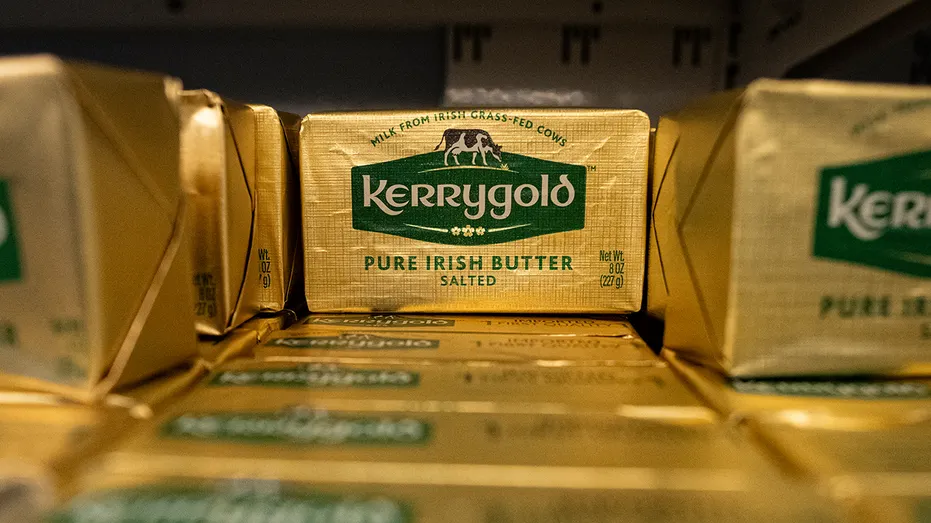
The push for dairy concessions follows weeks of intensive diplomatic engagement between Dublin and Washington. Martin identified the Irish butter brand as his next trade priority during an interview in New York, arguing that American consumers already heavily favor the product. Kerrygold generated more than $1 billion in U.S. retail sales in 2025, according to its parent cooperative Ornua, making it one of the most valuable food imports Ireland sends to the United States.
Securing tariff exemptions for agricultural exports has become a central focus for European nations navigating the current U.S. trade environment. The whiskey breakthrough emerged directly from President Donald Trump’s Sept. 13 visit to his golf resort in Doonbeg, County Clare. Martin said he lobbied for parity with Scotch whisky, which had already received favorable treatment under U.S. trade policy. The discussion gained momentum after Trump presented the trophy to Irish golfer Shane Lowry — who hails from the same town as the Tullamore D.E.W. distillery — following Lowry’s victory at the Amgen Irish Open. Trump subsequently announced his intention to lift the whiskey tariffs before the crowd.


U.S. and Irish officials are now meeting to finalize the mechanics of that whiskey commitment. Martin characterized the negotiations as ongoing but expressed confidence that the administration would follow through.

Rather than resisting the broader America First economic agenda, Dublin has recalibrated its strategy to absorb the pressure of U.S. reshoring efforts. Trump has consistently used tariffs and trade leverage to compel American multinationals to expand domestic manufacturing and investment. For Ireland, which built its modern economy over several decades by serving as the primary European gateway for U.S. technology and pharmaceutical giants, this represents a structural challenge.
Martin acknowledged the effectiveness of the administration’s tactics, noting the visible increase in corporate capital deployment within the United States. Instead of treating the shift as a threat, the Irish government is using it to audit its own competitiveness. Dublin’s response involves streamlining bureaucratic processes and reinforcing the value proposition offered by state agencies such as IDA Ireland, which handles foreign direct investment, and Enterprise Ireland, which supports indigenous companies expanding abroad.
Ireland currently holds the rotating presidency of the Council of the European Union, giving Martin a platform to address broader continental regulatory friction. He noted that U.S. corporations frequently cite European over-regulation as a barrier to expansion. Simplifying those frameworks has become a stated priority of the Irish presidency, with Martin conceding that Europe trails both the United States and China in overall economic competitiveness.

The economic relationship between the two countries operates in both directions, a fact Dublin emphasizes to counter the narrative that Ireland functions solely as a tax haven extracting American capital. Nearly 800 Irish-owned companies operate in the United States, employing approximately 200,000 workers. Irish foreign direct investment into the U.S. exceeds $390 billion, ranking Ireland as the fifth-largest source of FDI into the American economy. Much of this footprint is concentrated in healthcare, construction materials, and financial services.
Martin described his multiple meetings with Trump this year as involving “some choice language” and tough negotiation, but ultimately productive. The diplomatic channel remains highly active, anchored by shared cultural touchpoints and frequent executive travel.
The next major convergence point is the Ryder Cup, scheduled to take place at Adare Manor in County Limerick. Martin has formally invited Trump to attend the tournament, viewing the event as another opportunity to advance bilateral trade discussions outside traditional diplomatic settings.