When Communities Push Back: The New Governance Challenge of Transformative Innovation
Virginia's data center opposition and the prediction markets legal fight reveal a collapse in the traditional sequence of innovation and governance — and a new imperative for corporate boards.
Virginia’s polling numbers tell a striking story. In late March, a Washington Post-Schar School survey found that just 35% of Virginia voters would tolerate a new data center in their neighborhood — a steep drop from 69% two years earlier. The shift is not abstract. In Prince William County, a proposed data-center development near Manassas National Battlefield consumed years in litigation. A state appeals court ultimately struck down the county’s rezoning approvals on procedural grounds unrelated to the project’s merits. The county chose not to appeal the ruling, and the developer withdrew its challenge shortly after.
Across the country, a parallel struggle is playing out in the courts. Prediction markets — platforms allowing users to trade contracts tied to real-world events — have expanded rapidly. But the legal framework governing them remains unsettled. Are sports-related event contracts federally regulated derivatives, or state-regulated gambling? Earlier this month, New Jersey petitioned the U.S. Supreme Court to review an appellate decision that endorsed federal jurisdiction over such contracts. Other courts have ruled differently, leaving a patchwork of conflicting precedents.
These two cases may appear unrelated. They are not. Both illustrate the same phenomenon: transformative innovation now arrives into an environment that is already debating it, contesting it, and reshaping it — often before the innovation has fully matured.


Historically, that sequence did not look like this. Consider aviation. After the Wright brothers’ first flight in 1903, decades passed before airports, pilot training programs, air traffic control systems, insurance markets, and federal safety standards emerged. Travelers gradually accepted the airplane as part of modern life. The innovation built the institutions that made it ordinary.
Today, that sequential model has collapsed. Investment in artificial intelligence is surging while data centers face organized community resistance over electricity consumption, water usage, noise, and land use. Customers are adopting prediction markets while legislatures and courts scramble to categorize them. Social media followed a similar arc: early enthusiasm for connection and democratized communication gave way to intense scrutiny over mental health effects, misinformation, and the economics of attention.
The nuclear industry offers a contrasting example. The physics of atomic power did not change after the accidents at Three Mile Island, Chernobyl, and Fukushima. What changed was society’s willingness to embrace the technology. The internet moved in the opposite direction — from an academic curiosity to indispensable infrastructure.
What distinguishes the current moment is not simply the pace of change but the simultaneity of it. Inventors, investors, customers, community groups, regulators, and courts all encounter transformative innovations roughly at the same time, and their responses influence one another in real time. There is an irony at work: the information environment that earlier transformative innovations helped create, and that artificial intelligence now amplifies, is itself accelerating this convergence. Previously isolated concerns can attract political attention almost instantaneously. Political attention can alter regulatory expectations. Regulatory uncertainty can shift investor sentiment. Investor questions can reshape corporate strategy.
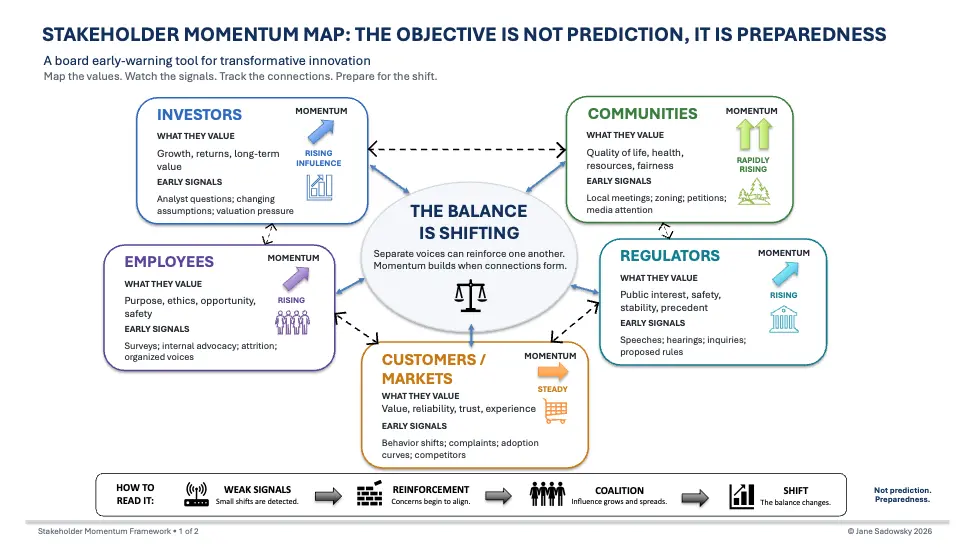
This dynamic creates a governance challenge that conventional stakeholder analysis may not fully capture. Boards have long been urged to identify their stakeholders — investors, customers, employees, regulators, communities. Those questions remain useful but provide a snapshot. The more urgent question may be where influence is moving.
Which constituencies are gaining ground? Which groups that once appeared unrelated are beginning to reinforce one another? What early signals suggest that an isolated concern is becoming a broadly shared opposition — or, alternatively, a broad coalition of support?
At the heart of this challenge lies a more fundamental difficulty. Stakeholders do not always disagree about how to distribute the benefits and costs of innovation. Sometimes they disagree about what value means in the first place.
A company proposing a data center can quantify capital investment, construction jobs, permanent employment, and incremental tax revenue. Those benefits are real and measurable. But a resident may be primarily concerned about water supplies. What exchange rate exists between a dollar of tax revenue and a gallon of water? Between national competitiveness and the character of a local community? Between shareholder return and a resource a community believes is already scarce?
There is no established answer. And prediction markets surface a different version of the same problem. One participant may prize the informational efficiency a market produces. Another may object to gambling or addiction concerns. A third may question whether certain events should be subject to wagering at all. The disagreement is not about market mechanics. It is about what ought to count as value.
For boards and executives, the practical implication is significant. Corporate leaders are accustomed to evaluating trade-offs that can ultimately be translated into financial terms. But some of the most consequential questions surrounding transformative innovation involve competing value systems that do not share a common unit of measurement.
This means that governance cannot wait for consensus to form. Boards will sometimes proceed despite substantial opposition — just as they may decline opportunities that enjoy broad support. What matters is visibility: understanding which stakeholders are becoming more influential, how their definitions of value differ, where separate concerns are beginning to intersect, and what early movements suggest about the direction of the balance.
Some companies are creating innovations that reshape society. Many more are being reshaped by innovations they neither invented nor control. Their customers may adopt new behaviors. Their employees may develop new expectations. Regulators may confront questions that did not exist when their current rules were written. Investors may reassess risk.
The governance questions differ depending on which side of the innovation a company occupies. But neither group can afford to monitor only the technology itself. Both must watch how the world around the innovation is shifting.
The defining challenge of this era may not be keeping pace with innovation. It is governing while society is still deciding what progress means.