Week 5 College Football Betting: Unders, SEC Shootout Scripts and Road Tests Shape the Board
Pace metrics expose inflated totals in the Big Ten while SEC game scripts drive specific team-total wagers for Week 5.

The fifth week of the 2026 college football season presents a betting card defined by stark contrasts: elite defenses colliding with run-heavy offenses in the Big Ten, an SEC matchup practically engineered for high scoring, and several teams navigating their first true road tests. For bettors looking past the marquee names dominating the AP Top 25, Week 5 offers distinct value in pace metrics, situational spots, and game-script dependencies.
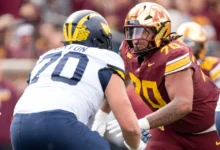
The most mathematically compelling opportunities this weekend cluster around low-scoring projections where offensive inefficiency meets defensive rigidity. The Big Ten clash between Michigan and Minnesota anchors this approach. Minnesota’s box score — averaging 27 points per game — masks a fundamentally flawed offense that ranks just 85th nationally in Expected Points Added (EPA) per play. The Golden Gophers have relied heavily on short fields generated by fumble recoveries, including a fumble returned for a touchdown. That brand of scoring is notoriously unsustainable and highly susceptible to regression against a Michigan defense ranked inside the top 10 against the run and the top 25 against the pass.
Michigan’s own offensive structure further suppresses the total. Quarterback Bryce Underwood has been efficient, particularly when targeting wide receiver JJ Buchanan, who averages nearly 20 yards per reception. Yet the Wolverines rank 90th in rushing success rate while maintaining a heavily run-centric playcalling philosophy. This approach burns clock and limits total possessions. With both programs ranking in the bottom 10 nationally in pace, the full-game under of 43.5 and the first-half under of 21.5 carry strong structural support. Bettors should note these wagers are highly correlated; taking both requires reducing unit size to manage overall exposure.

A similar pace-and-efficiency squeeze defines the Friday night tilt between Fresno State and Washington State, where the total sits at 45.5. Washington State’s offense lacks the mechanics to sustain drives, ranking in the bottom five nationally in offensive success rate and converting just 25% of third-down attempts. Quarterback Caden Pinnick has thrown more interceptions than touchdowns while absorbing 13 sacks, and kicker Jack Stevens has connected on only two of seven field goal attempts. Fresno State operates one of the country’s slowest tempos, a pace that decelerates further when holding a lead. The combination of stalled drives, long fields, and poor finishing makes points difficult to manufacture for either side.
In Piscataway, New Jersey, Indiana visits Rutgers with a bloated total of 56.5 that ignores recent on-field realities. The Hoosiers’ defense is legitimate, surrendering just 69.5 rushing yards per game. However, Indiana’s offense showed severe limitations last week against Northwestern, raising questions about quarterback Josh Hoover’s ability to operate efficiently in his first road environment of the season. Rutgers’ recent 35-point output against USC reflects the Trojans’ defensive collapse rather than a sustainable offensive explosion from the Scarlet Knights. A final score resembling 38-10 remains well within the probability matrix here.
The Southeastern Conference delivers the sharpest contrast to the Big Ten grind, specifically in Gainesville, where Missouri faces Florida. Rather than betting the spread, the most logical angle targets Missouri’s team total over 25.5. Florida has built its 2026 identity on early offensive strikes, but the Gators’ defense has hemorrhaged points, yielding a combined 67 over the last two weeks to SEC opponents, including 39 to Auburn. Game script dictates that if Florida scores at its current clip, Missouri quarterback Austin Simmons will be forced into aggressive, up-tempo passing situations. A low-scoring Missouri victory appears highly improbable given Florida’s offensive ceiling, meaning the Tigers likely need to approach 30 points simply to remain competitive, regardless of the final outcome.
Early kickoff dynamics in Starkville present another situational fade of inflated totals. Alabama travels to Mississippi State with a first-half under set at 30.5. The Crimson Tide have historically struggled to find immediate rhythm on the road in noon starts. Through three games prior to their matchup with South Carolina, Alabama was outscored 21-20 in the first quarter and trailed Kentucky 17-13 at halftime two weeks ago. Alabama’s defense, which ranks fourth in the FBS by allowing opponents to convert only 23.1% of third downs, will likely suffocate Bulldogs quarterback Kamario Taylor early. Halftime adjustments frequently open up second-half scoring, making the first-half restriction the optimal entry point.
Several matchups hinge entirely on teams leaving their home stadiums for the first time. Arizona hosts Cincinnati as a 7-point favorite in a spot that heavily favors the Wildcats. Cincinnati secured a mild upset over Kansas State last week despite being outgained, losing the time-of-possession battle, and failing on third down. Now facing their first road trip of the year, the Bearcats encounter an Arizona squad already tested by a road game at BYU and a recent 34-24 victory at Washington State. Wildcats quarterback Noah Fifita has been exceptional in Tucson, posting an 84% completion rate with six touchdowns and zero interceptions at home in 2026. Arizona’s pass rush, tied for the Big 12 lead with 15 sacks, should exploit a Bearcats offense that barely functioned statistically even in victory last week.
Baylor also navigates its first true road test against Arizona State, laying 4 points. Bears quarterback DJ Lagway returned from a two-game ankle injury absence to beat Colorado 23-13 in Waco, but his career road splits are alarming. Last season, Lagway completed 68% of his passes with 10 touchdowns and five interceptions at home, compared to a 58% completion rate, five touchdowns, and nine interceptions away from Waco. Arizona State possesses a top-20 pass defense and superior coaching infrastructure to exploit Baylor, which ranks 121st nationally in penalty yards per game.
Outside the Power conferences, Massachusetts presents a unique volume play. The Minutemen sit at a surprising 4-0, scoring at least 35 points in every contest while leading the MAC with 194.8 rushing yards per game. Their team total over 26.5 against Eastern Michigan carries a -145 price tag justified by matchup dominance. UMass ranks 31st in the FBS in total defense and holds the second-best turnover differential in the country at plus-10. Eastern Michigan averages just 292 total yards per game, ranking 132nd nationally, ensuring the Minutemen will control possession and field position throughout the afternoon.
Temple enters its American Athletic Conference matchup against South Florida as an underdog despite superior underlying metrics. The Owls outgained Army in their lone common-opponent comparison but lost due to execution errors, going 0-for-2 on fourth down and 3-for-9 on third down. USF’s undefeated record was padded against FIU, Delaware State, and Bowling Green. Temple averages 218 rushing yards per game at 5.7 yards per carry, and wide receiver Colin Chase leads the AAC in receiving average. The Owls’ rushing defense remains vulnerable, but their offensive floor suggests they can cover or win outright against a schedule-inflated Bulls roster.
DraftKings odds remain subject to movement through Saturday’s opening kickoffs.