BioPykrete: Super Ice 10 Times Stronger Than Regular Frozen Water
Engineered protein bonds cellulose nanocrystals to ice, creating a concrete-strength material designed for polar construction.
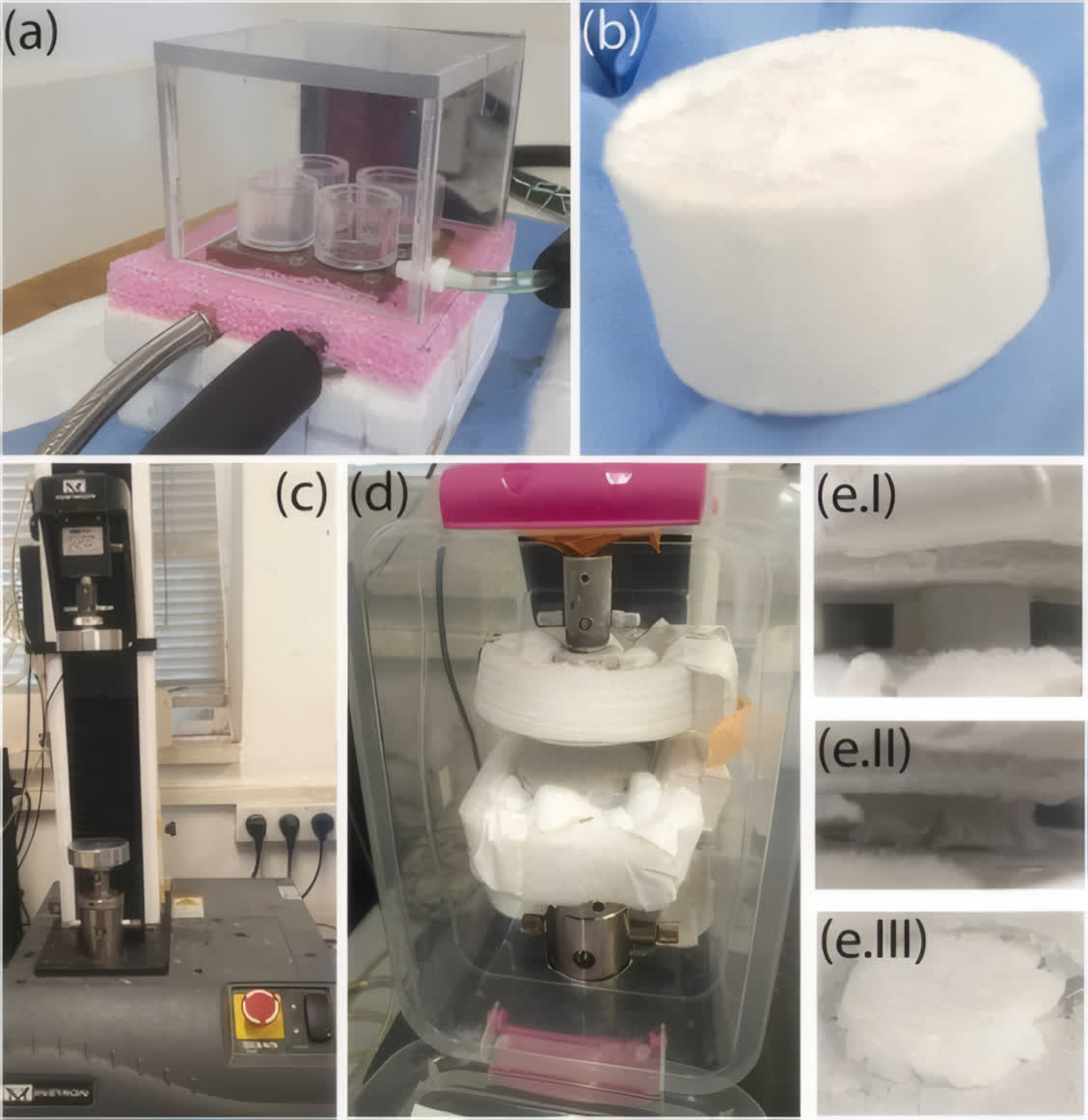
A research team at the Hebrew University of Jerusalem has engineered a frozen composite material capable of withstanding ten times more compressive force than ordinary ice, reaching structural thresholds comparable to poured concrete. The substance, designated BioPykrete, absorbs roughly seventy times more energy before fracturing and deforms gradually under stress rather than shattering catastrophically.
The breakthrough relies on molecular bonding rather than simple physical mixing. During the freezing process, plant-derived cellulose nanocrystals self-assemble into a three-dimensional lattice that encapsulates microscopic pockets of water. A genetically engineered fusion protein, identified as CBM3a-AFPIII, anchors the structure together. One domain of the protein binds directly to the ice crystal lattice while the opposing domain locks onto the cellulose fibers. This dual-action biological adhesive doubled both the compressive strength and the energy absorption capacity compared to identical ice-cellulose mixtures lacking the protein.
Professor Ido Braslavsky, who led the research effort, noted that the objective was to control how the distinct components connect at the molecular level rather than simply suspending fibers in frozen water. By arresting crack propagation through this reinforced network, the material avoids the sudden brittle failure characteristic of standard ice.


Reinforcing frozen water for structural purposes carries significant historical precedent. In 1942, British inventor Geoffrey Pyke proposed Project Habakkuk, a World War II initiative to construct massive, unsinkable aircraft carriers from Pykrete—a rudimentary mixture of ice and wood pulp designed to resist torpedo strikes. While Winston Churchill backed the concept and a scaled prototype was tested in Canada, the project was ultimately shelved due to escalating costs and shifting wartime priorities. Modern materials science has now replaced wood pulp with precisely structured nanocellulose and introduced targeted protein chemistry to achieve what mid-century engineering could not.

The immediate practical application targets polar infrastructure. Constructing research stations, temporary shelters, or logistical platforms in Arctic and Antarctic environments currently requires shipping steel and concrete over vast distances at extreme expense and high carbon cost. A biodegradable building medium synthesized primarily from water and abundant plant cellulose offers a localized alternative. Because the core ingredients are naturally occurring and non-toxic, structures built from BioPykrete would melt back into the environment without leaving industrial waste, aligning with strict environmental protocols governing Antarctica under the Madrid Protocol.
This approach mirrors broader trends in biomimetic materials engineering. Researchers at the University of Maryland previously developed “Superwood” by chemically removing lignin and hemicellulose from natural timber, then compressing it to collapse internal voids, yielding a product stronger than many metal alloys. Both innovations share a foundational philosophy: radically upgrading the mechanical properties of ubiquitous natural resources through precise structural manipulation rather than synthetic replacement.
Despite the laboratory success, BioPykrete remains strictly in the proof-of-concept phase. Deploying any ice-based material in real-world construction demands surviving thermal fluctuations. The researchers specified that future development must address freeze-thaw durability, creep resistance under sustained loads, and comprehensive life-cycle environmental assessments. Standard concrete gains strength over decades; proving that a water-based composite can maintain structural integrity during prolonged polar summers represents the primary obstacle to field deployment.
The findings detailing the protein-mediated reinforcement mechanism and the resulting mechanical properties have been published by the Hebrew University research group.