

Ukraine’s Drone Factory Produces More in a Year Than the U.S.
A Kyiv facility’s output exposes the scale of Ukraine’s wartime drone industry
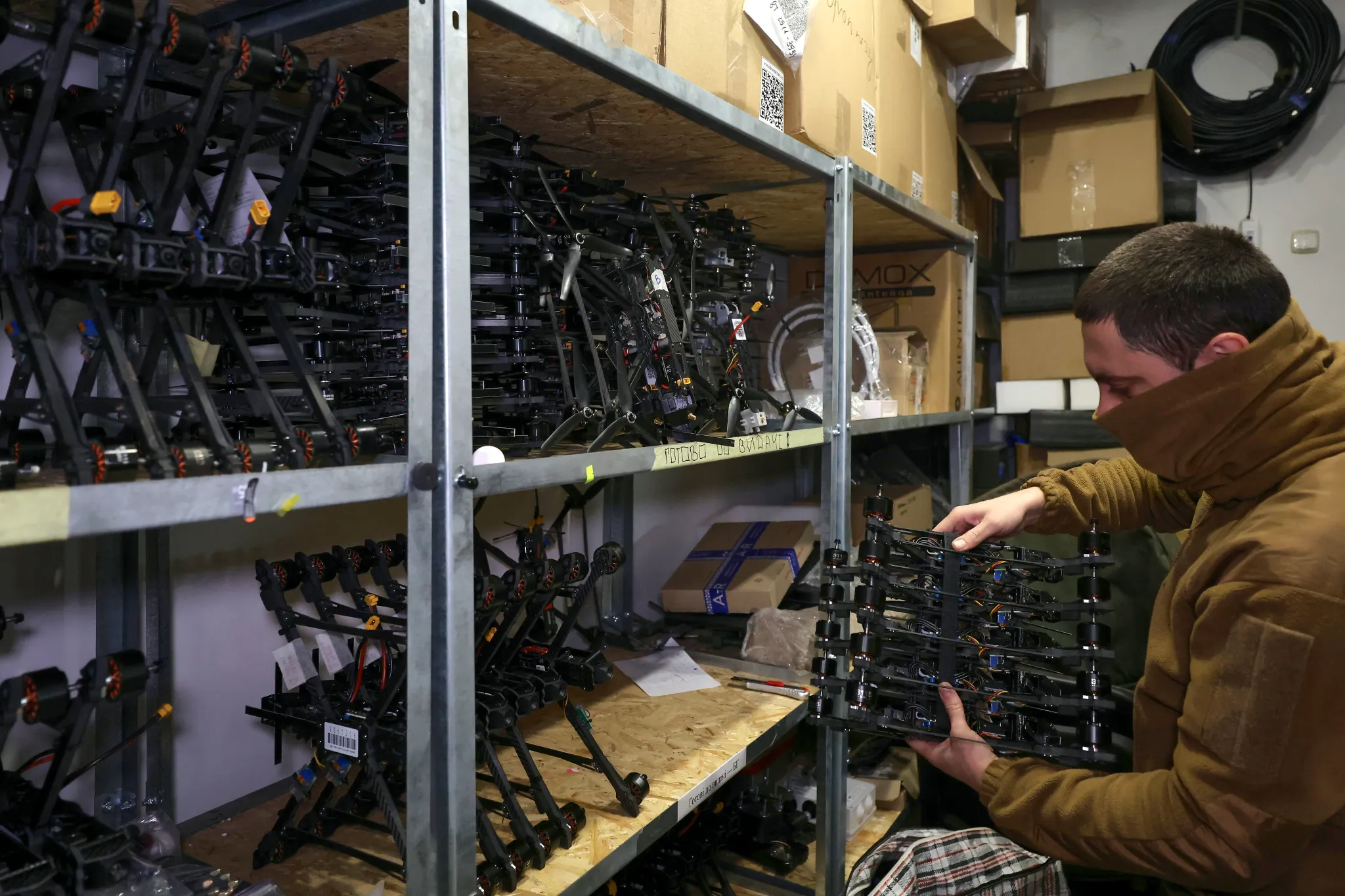
KYIV, Ukraine — General Cherry supplies specialized strike and interceptor drones to more than 200 Ukrainian military units while maintaining a covert manufacturing facility on the outskirts of Kyiv. That single factory can assemble approximately 100,000 First-Person View (FPV) strike drones and interceptors every month.
Its annual potential output of 1.2 million units is four times the entire annual drone production of the United States, which currently stands at roughly 300,000 defense-grade drones across all manufacturers combined. Traditional Western defense contractors typically work within procurement timelines of three to five years; Ukraine’s defense technology ecosystem instead operates on accelerated three-month iteration cycles.
The production tempo is tied to the electronic warfare arms race along the frontline. Russian military forces deployed dense electronic warfare (EW) networks, including heavy jamming platforms such as the Krasukha-4 and mobile signal disruptors, causing traditional radio-controlled FPV drones to repeatedly lose their control links in high-threat sectors.


Ukrainian engineers initially responded by shifting operating frequencies across non-standard radio bands to bypass Russian jammers. As Russian electronic warfare units adapted, Ukrainian defense developers moved toward tethered fiber-optic FPV drones, which unspool thousands of meters of ultra-thin glass fiber-optic cable during flight.
The control signal and video feed on these systems travel through a physical tether rather than over the airwaves. As a result, the drones are completely immune to radio-frequency jamming, direction-finding, and spectrum interception. High-tensile, bend-resistant fiber wire and precision-wound spools have since expanded their operational reach.
Early tethered drones were limited to short tactical distances, while newer configurations are extending operational ranges toward 50 kilometers, or approximately 31 miles. Those systems enable unjammable precision strikes deep behind enemy lines, even as Russian loitering munitions and reconnaissance drones increasingly use automated target recognition (ATR) powered by onboard computer vision algorithms.
Trained on optical image datasets of civilian and military infrastructure, Russian ATR systems can identify and strike targets such as commercial fuel stations and power sub-stations independently. They do not require an active radio command link or satellite navigation.
The same pressure that drives rapid technical changes has altered factory organization. Missile strikes targeting major urban centers often involve high-speed ballistic and hypersonic missiles, including the Iskander-M and Kinzhal, which travel at multiple times the speed of sound. In cities such as Kyiv, these warheads frequently strike urban targets seconds before automated civil air-raid alert systems can sound warnings.
To reduce exposure, Ukrainian drone makers have abandoned centralized factory models. Companies such as General Cherry distribute components, assembly, and testing across dozens of isolated, modular workshops. If one node is struck or compromised, the broader supply chain continues operating without halting overall output.
Ukraine’s defense firms are also moving toward vertical integration. Early in the war, Western critics described the country’s drone industry as relying on “hobby-grade” commercial assembly dependent on parts imported from China. Domestic manufacturers now produce proprietary flight controllers, customized electric motors, lightweight structural frames, and specialized warheads in-house.
This internal supply-chain control allows developers to alter circuit designs or firmware within days in response to field feedback from frontline units in the Donbas and Zaporizhzhia fronts. The demands of a full-scale Russian invasion now in its third year have pushed Ukrainian firms to revise approaches to military mass production, supply chain resilience, and battlefield electronic warfare.
That defense activity continues alongside wartime civil society. Ukraine has been under martial law since Russia’s full-scale invasion on Feb. 24, 2022, while the country has endured twelve years of armed conflict dating back to the 2014 annexation of Crimea and war in eastern Ukraine. Civic institutions across major centers including Kyiv and Lviv remain active.
Military brigades in urban centers display public recruitment campaigns alongside commercial advertising and compete openly for volunteers. Public street demonstrations in Kyiv following changes in defense ministry leadership reflect civic activism seen during the 2004 Orange Revolution and the 2014 Euromaidan Revolution of Dignity.
Commercial activity across western and central Ukraine also continues despite daily operational risks. Civilian infrastructure sites remain subject to autonomous drone strikes, while public commercial life in major cities persists alongside ongoing military production.
Ukraine’s expanding defense-tech industrial base is influencing military planning in Washington and among NATO allies. The U.S. Department of Defense has monitored the production model while carrying out its own “Replicator” initiative, launched in late 2023 to field thousands of low-cost, attrition-tolerant autonomous systems across multiple domain spaces.
U.S. policy efforts addressing critical mineral supply chains, rare earth processing, and domestic microelectronics are also aimed at manufacturing bottlenecks highlighted by the war in Eastern Europe.
Defense analysts anticipate that Ukraine’s wartime technological expansion will reshape its post-war economy. Dual-use technologies developed for battlefield survival—including autonomous navigation, edge-AI computing, computer vision, specialized robotics, and rapid fabrication—are expected to transition into precision agriculture, automated demining, commercial aviation, and industrial robotics.









