

UK Overtakes Germany in Europe’s Corporate Power Shift
Britain Leads Europe’s Biggest Companies as Profits Come Under Pressure

The United Kingdom has overtaken Germany for the first time in the four-year history of the Fortune 500 Europe ranking, claiming 76 places on the 2026 list compared with Germany’s 73. Germany, long considered Europe’s economic motor, has therefore relinquished the leading position for the first time.
British companies have aggressively recalibrated their strategy since the country’s departure from the European Union, pivoting heavily toward North American markets. “After Brexit, they have no choice but to look beyond Europe entirely, with many expanding their presence in the U.S.,” said Howard Yu, a professor at the IMD Business School in Switzerland.
Yu noted that competing in the U.S. commercial market forces corporations to streamline operations and build global competitiveness. The U.K.’s corporate rise has also benefited from technology and research: it scored more than 30 percentage points above the European Union average on the European Commission’s latest Innovation Scorecard and hosts more high-value tech “unicorns” than any other European country, according to research from the Hurun Research Institute.


Europe’s 500 largest commercial enterprises generated a record $15.5 trillion in combined revenues, an amount roughly equivalent to half of the total European gross domestic product. Yet total net profits rose only 3% this year to just above $1 trillion, recovering from a 5% drop in 2025. Overall profit margins shrank for a second consecutive year, falling to 6.5% from 7.1% on the 2024 list.
Macroeconomists attribute the divergence between record sales and narrowing margins to broader economic stagnation and elevated input prices across the continent. “The gap between revenue and profit growth suggests that many European companies have been able to pass on only part of the shocks they have faced,” said Guido Cozzi, professor of macroeconomics at the University of St. Gallen in Switzerland. “It’s less a sign that businesses are genuinely booming, and more a sign that prices are rising faster than what companies are actually producing or how efficiently they’re running.”
The concentration of corporate power remains pronounced. The U.K., France, Germany, and Switzerland together house more than half of all companies on the list and account for over 50% of total corporate profits.
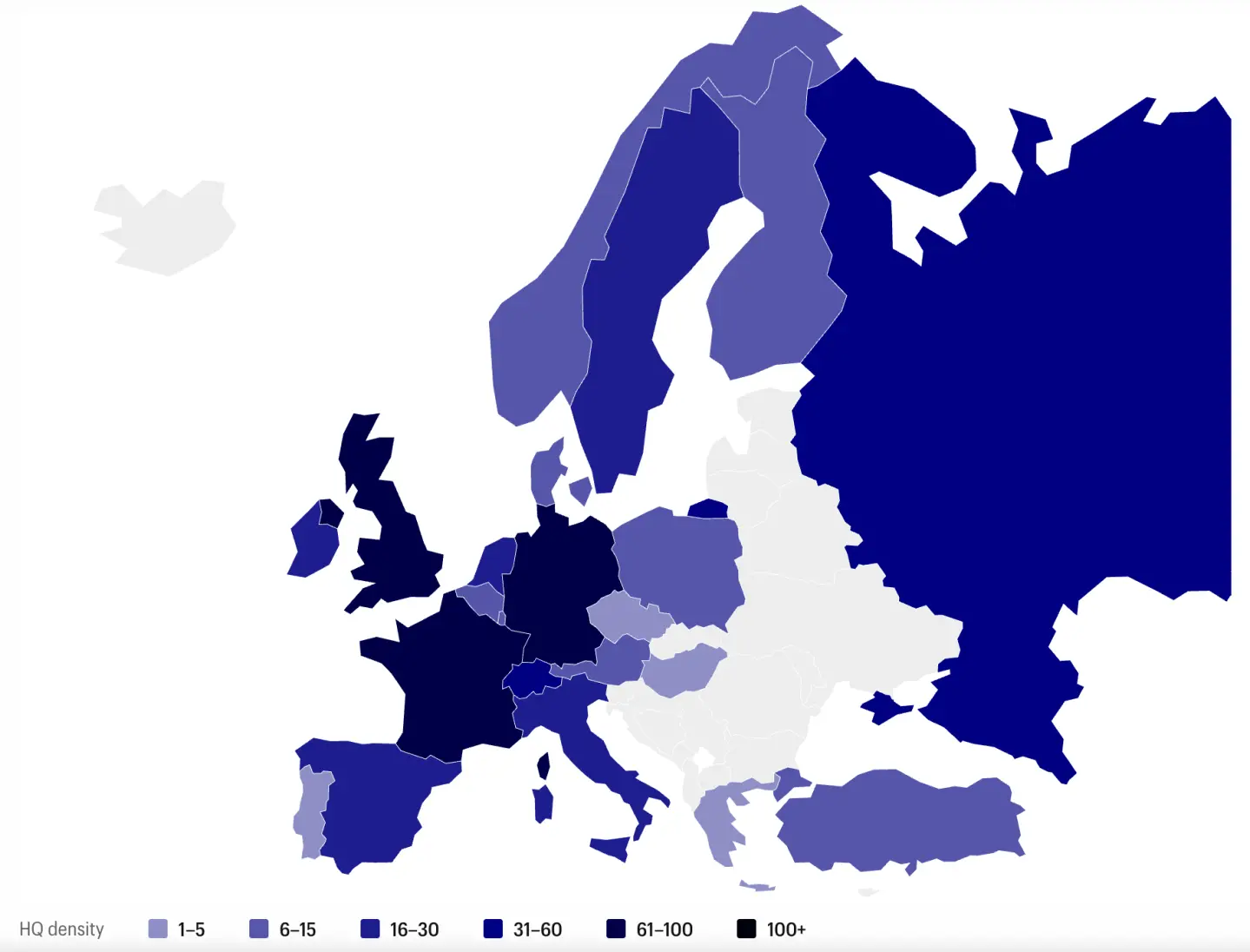
Industrial and energy heavyweights occupied the highest positions. Wolfsburg-based automaker Volkswagen AG held the No. 1 spot for the third consecutive year, recording revenue growth of 3.4% and exceeding $363 billion. European carmakers faced supply chain disruptions, new trade tariffs, and heightened competition from Chinese electric vehicle manufacturers.
The remaining places in the top five went to energy producers. British energy producer Shell ranked second, followed by Swiss commodities trader Glencore, British energy group BP, and French oil giant TotalEnergies. Regional geopolitical shocks boosted energy-sector earnings, particularly shipping disruptions in the Strait of Hormuz that sent crude prices higher and caused second-quarter net profits at Shell and BP to more than double.
Financial services remained Europe’s single largest sector by revenue, net earnings, and overall headcount. The list included 105 financial companies, which collectively generated 24% of all revenue, 40% of total net profits, and employed 14% of the combined workforce.
London-headquartered HSBC was the list’s most profitable enterprise, generating $22 billion in profit for 2025. Only 25 firms across the entire 500-company index recorded annual profits exceeding $10 billion.
Yu attributed the profitability of European financial institutions to their extensive global network built over decades. “These players have spent decades building footprints across emerging markets and have a depth of presence few global rivals can match,” Yu said. “This is a genuine strategic advantage, rather than a legacy accident.”
The number of female CEOs leading Fortune 500 Europe companies increased to 43 from 41 last year. Combined revenues for women-led enterprises rose 24% to $1.2 billion. BP remains the only corporation among the top 10 led by a female chief executive, following Meg O’Neill’s appointment to succeed former CEO Murray Auchincloss.
The average Fortune 500 Europe company is 109 years old, and more than half of the firms on the list were founded over a century ago. The oldest enterprise is brewing giant Anheuser-Busch InBev, ranked No. 65, which traces its origins back 660 years to the Den Hoorn brewery established in Leuven, Belgium, in 1366.
At the opposite end of the age range, the youngest company is German automotive technology manufacturer Aumovio, spun off from Hanover-based Continental AG in 2025. While corporate longevity underscores the historical endurance of European industry, experts warn against relying on past dominance.
“Many of these institutions have grown too comfortable,” Yu said, noting that century-old corporate structures must continually adapt to global technological disruption and shifting economic trade flows.









