

U.S. solar module quotes rise more than 40% ahead of Dec. 4 tariff deadline
The 15% duty applies when shipments enter the United States, while domestic polysilicon and wafer capacity remains limited.
U.S. solar developers face a 15% tariff on imported polysilicon and related solar components starting Dec. 4, with median quotes for imported modules scheduled to arrive after the deadline already more than 40% above pre-proclamation prices, according to procurement data from Anza.
Anza’s Sept. 9 data showed median prices of $0.38 per watt for post-deadline imported module deliveries among suppliers that had updated their pricing. Before the Aug. 7 presidential proclamation establishing the duties, the median was $0.27 per watt. A comparison of identical stock keeping units (SKUs) under equivalent contract terms found a direct price increase of about 15%, matching the tariff rate; additional cost adjustments in total delivery quotes pushed the median increase above 40%.
By Sept. 9, 55% of active suppliers on the Anza platform had incorporated Section 232 duty adjustments into their prices, covering 65% of the modules available there. The tariff is enforced by the U.S. Department of Commerce and applies to foreign imports of polysilicon, the primary raw material used in solar manufacturing, as well as solar ingots, wafers, cells and assembled photovoltaic modules. The Secretary of Commerce determined that import volumes and market conditions threaten U.S. national security.
The duty applies when goods enter the United States, so equipment must complete entry through U.S. Customs and Border Protection before Dec. 4 to avoid it. Aaron Hall, president of Anza, said developers already in procurement cannot wait until December to make purchasing decisions because of transit schedules and port processing times.
Developers are seeking module and component stock that has already cleared customs and is held in U.S. warehouses, while some are considering expedited freight to get offshore shipments through customs before the deadline. They are also reviewing purchase agreements for liability provisions covering retroactive tariffs and warehousing costs, and asking vendors for written commitments to absorb potential tariff exposure. Blended procurement models combining domestic components with imported hardware are another option developers are assessing to optimize project economics and qualify for federal tax incentives.
The Aug. 7 proclamation set minimum import pricing and duty requirements for polysilicon, adding to other U.S. trade actions affecting the solar supply chain. The Department of Commerce and the U.S. International Trade Commission are conducting antidumping and countervailing duty (AD/CVD) investigations into crystalline silicon photovoltaic cells and modules imported from Cambodia, Malaysia, Thailand and Vietnam. Those four Southeast Asian nations have historically supplied the majority of U.S. solar module imports.
Separately, the Office of the United States Trade Representative maintained and increased Section 301 tariffs under the Trade Act of 1974, raising import duty rates on Chinese solar cells and modules to 50% in 2024. The Section 232 authority comes from the Trade Expansion Act of 1962, which allows the President to adjust imports when the Department of Commerce determines that a commodity is being imported in quantities or under circumstances that threaten national security.
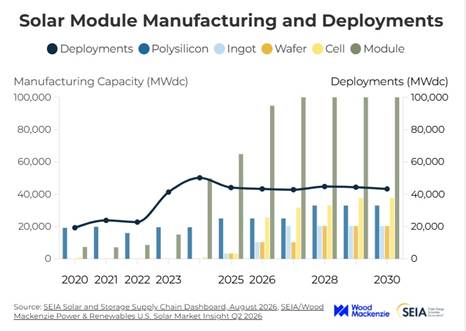
Domestic module assembly capacity is larger than U.S. capacity for upstream solar materials. The Solar Energy Industries Association (SEIA) puts current domestic operational solar module manufacturing capacity at 75.3 gigawatts (GW), enough to meet current annual U.S. installation demand. SEIA projects domestic capacity for ingots and cells to expand significantly within the next year, while production of solar-grade polysilicon and silicon wafers is not projected to reach scaled market matching until 2028.
Federal support for U.S. solar manufacturing relies primarily on the Inflation Reduction Act of 2022. Its Section 45X Advanced Manufacturing Production Credit provides $0.07 per watt for solar modules, $0.04 per watt for solar cells, $12 per square meter for photovoltaic wafers and $3.00 per kilogram for solar-grade polysilicon.
Developers using domestic hardware may also qualify for a 10% Domestic Content Bonus Credit under Internal Revenue Code Sections 48 and 48E if project components meet statutory domestic manufacturing percentage thresholds.






One Comment