Two Corpse Flowers Bloom Together and Draw a Record Crowd
Odora and Odorysseus open together at The Huntington in a rare double bloom

SAN MARINO, Calif. — The Huntington Library, Art Museum, and Botanical Gardens recorded its first double bloom since 2018 when two endangered titan arums (*Amorphophallus titanum*), popularly known as corpse flowers, opened simultaneously inside the conservatory. The specimens, nicknamed Odora and Odorysseus, remained open for only 24 to 48 hours before collapsing.
Horticulturists had expected Odorysseus to bloom independently on a Sunday. The plant measured 71 inches in height, while Odora stood at 41 inches and began opening its spathe just hours later. Brandon Tam, associate curator of orchids at The Huntington, said recent atmospheric conditions in Southern California, particularly high regional humidity, likely encouraged both specimens to unfurl together.
By 8:51 a.m. on the morning of the bloom, The Huntington had logged more than 5,700 advance reservations, according to Keisha Raines, assistant director of news and media relations. The figure exceeded the approximately 4,900 visitors recorded during the garden’s previous single-flower bloom event, excluding walk-in entries and additional bookings processed later in the day.


Parking lots across the 207-acre estate filled early, sending traffic into surrounding San Marino residential neighborhoods. Visitor queues inside the gates stretched along garden pathways far beyond the conservatory exit. Paige Patino, who lives 10 minutes from the grounds, came to see both plants active at once, while Lilla Saito of North Hollywood took two hours off work after following the facility’s livestream and waited 45 minutes to view the exhibit.
The bloom’s brief timing also brought visitors from farther away. Spouses Jennifer Kraus and Abigail Cruz drove two hours from the Inland Empire early in the morning after seeing updates on social media. Ventura resident Michelle Shock and her 8-year-old daughter, Fable, had arranged a tea party at the nearby Rose Garden two weeks earlier and arrived to find the corpse flower bloom coinciding with their visit.
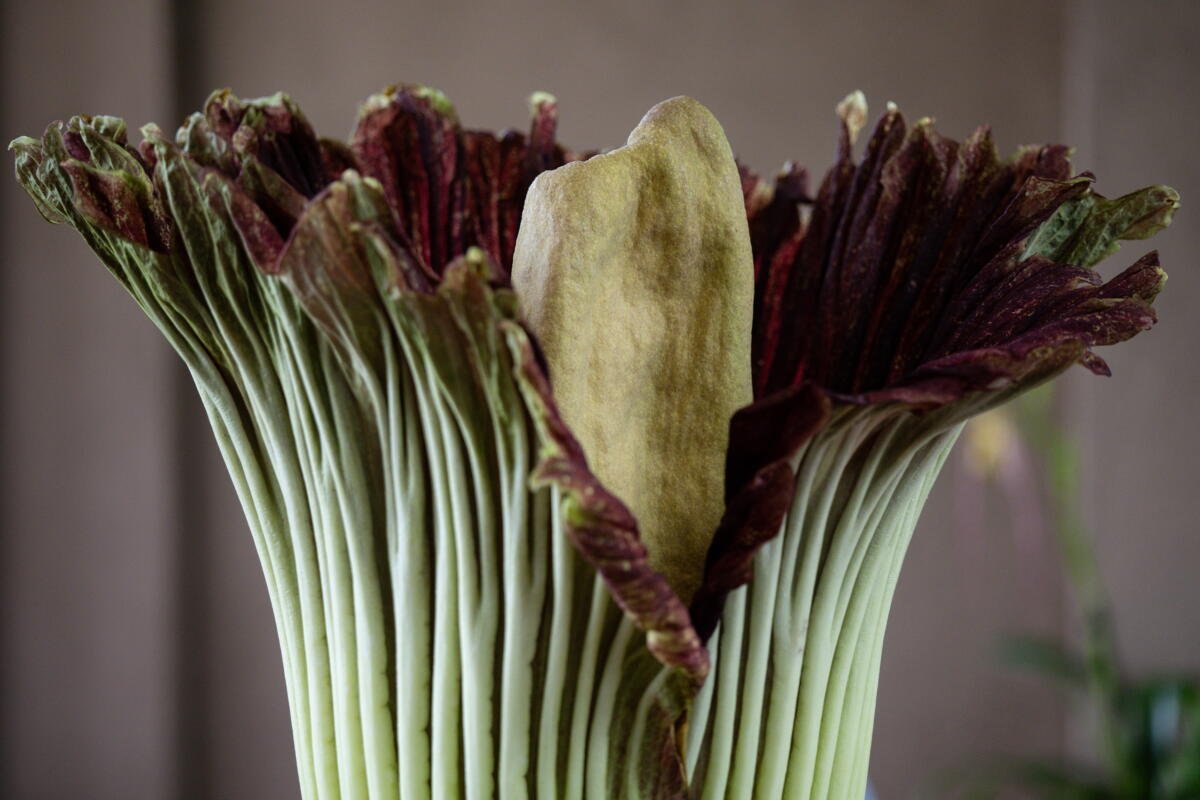
During the opening, staff noticed that Odora’s central spike, or spadix, had caved inward instead of standing fully upright. Tam clarified that the unusual appearance did not indicate a structural health problem. He expects the plant to return to its standard bloom cycle in three to four years without long-term anatomical impact.

Native exclusively to the steep tropical rainforests of Sumatra, Indonesia, *Amorphophallus titanum* is listed as Endangered on the Red List of the International Union for Conservation of Nature (IUCN). Habitat destruction, deforestation, and the expansion of oil palm plantations pose severe threats to the species in the wild.
The plant is not a single flower. It produces the largest unbranched inflorescence in the plant kingdom, with hundreds of tiny male and female flowers concealed at the base of the spadix inside a leaf-like sheath called a spathe. In the wild, it staggers activation of its reproductive organs to minimize self-pollination.
To draw carrion beetles and flesh flies through dense rainforest canopies, the plant uses thermogenesis, heating its central spadix to more than 90 degrees Fahrenheit. That temperature spike volatilizes sulfur-based chemical compounds, including dimethyl disulfide, dimethyl trisulfide, and trimethylamine, creating a smell comparable to decaying animal tissue or rotting garbage.

According to Tam, the two active plants increased the concentration of volatile compounds inside the glass conservatory. He described the combined odor as among the three most potent recorded in his career.
The Huntington began cultivating the species in August 1999, when it displayed its first blooming corpse flower, named “Little Stinker.” The event was only the 11th recorded titan arum bloom in U.S. history and the first ever recorded in California. Over the subsequent 25 years, The Huntington developed a specialized conservation and propagation program around the species.
Odorysseus and Odora had drawn the public because individual specimens bloom unpredictably once every several years and lose their distinct scent and structure soon after opening. As the 24-to-48-hour blooming window closes, both inflorescences will lose their scent, close back up, and ultimately collapse, returning the plants to a dormant vegetative state until their next bloom cycle.