Slow Cookers Become Thanksgiving Lifeline as Home Cooks Solve Oven Space Crisis
Why the 1970s Crock-Pot remains the smartest tool for the modern holiday kitchen
With Thanksgiving a week away, home cooks across the country are confronting the annual bottleneck: a single oven and too many dishes that need it. The solution increasingly favored by recipe developers and kitchen strategists isn’t a second oven — it’s the countertop slow cooker gathering dust in the pantry.
Sales data from the NPD Group shows slow cooker purchases spike 35% in November, a pattern that has held for five consecutive years. But the appliance’s role has shifted from set-it-and-forget-it weekday dinners to strategic holiday infrastructure. “The oven is the critical path on Thanksgiving,” said Lisa McManus, executive tasting and testing editor at America’s Test Kitchen. “Every dish you move to a slow cooker buys you 45 minutes of oven time for something that actually requires dry heat — the turkey, the pies, the stuffing that needs a crisp top.”
The capacity constraint is real. Most 6- to 7-quart slow cookers hold a 5-pound turkey breast or a 7-pound bone-in ham, but not a whole bird. That limitation has spawned a sub-category of holiday cooking: the intentional non-turkey main. Red wine-braised short ribs, coconut milk-braised chicken thighs, and beef stew now appear regularly in Thanksgiving menu plans from major food publishers, not as compromises but as deliberate choices for smaller gatherings.

Food safety experts at the USDA emphasize a critical rule often ignored in holiday rush: slow cookers must reach 140°F within two hours to prevent bacterial growth. That means starting on high for the first hour, especially with refrigerated ingredients. The “warm” setting is not a cooking setting — it holds food at roughly 145°F, safe for serving but insufficient for bringing cold food up to temperature.
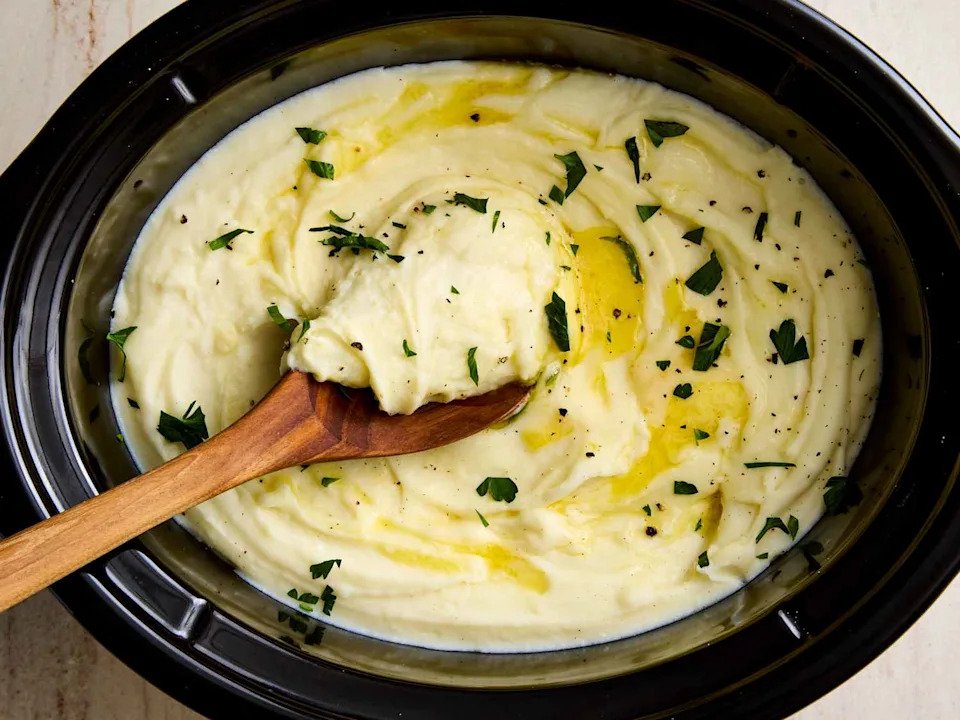
Beyond mains, the appliance excels at the dishes that tie up burners: mashed potatoes held at serving temperature for two hours without scorching, cranberry sauce that reduces without splatter, stuffing that stays moist without occupying a 9×13 pan. Dessert applications — bread pudding, lava cake, spiced cider — exploit the same principle: gentle, even heat that doesn’t demand attention while the turkey rests.
The technical gap between slow cookers and multicookers like the Instant Pot matters for Thanksgiving. Pressure cooking reduces braise times from eight hours to 90 minutes, but the slow cooker’s unpressurized lid allows evaporation, concentrating flavors in a way sealed pressure cooking cannot. For dishes where reduction is the goal — short rib braising liquid, cranberry compote — the slow cooker remains superior.
Historically, the Thanksgiving oven crunch is a mid-20th century phenomenon. Pre-1950s, many rural households cooked the bird in a wood-fired range or outdoor pit, while sides simmered on the stove top. The electric oven’s dominance created the single-point-of-failure problem that countertop appliances now solve.
This year, programmable models with WiFi connectivity allow remote temperature adjustments — a feature manufacturers report as the most requested holiday upgrade. But the core technology hasn’t changed since the 1971 Rival Crock-Pot patent: a heating element wrapped around a ceramic insert, controlled by a bimetallic thermostat. The simplicity is the point.
As of this week, the USDA’s Meat and Poultry Hotline (1-888-674-6854) has extended hours through Thanksgiving Day for real-time food safety questions, including slow cooker-specific guidance.