

Rodríguez Meets Trump in New York as Maduro Awaits Trial
Venezuela’s acting president pledges elections without a date after meeting Trump
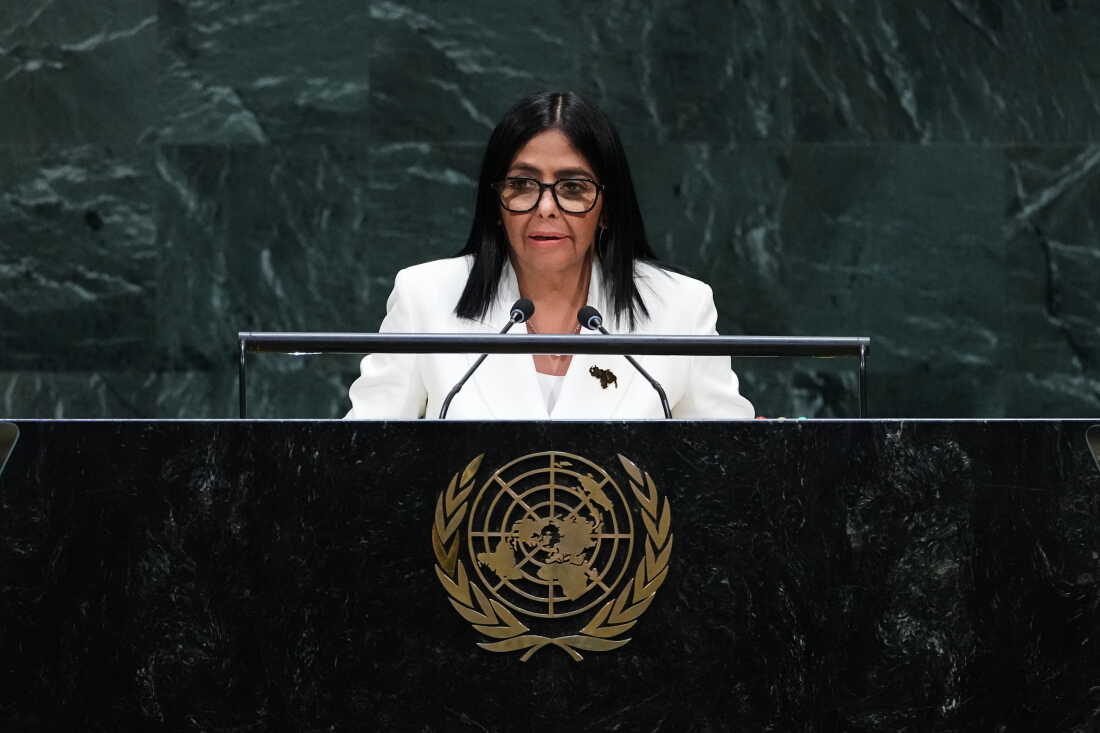
Venezuela’s acting President Delcy Rodríguez told the 81st session of the U.N. General Assembly on Wednesday, Sept. 23, 2026, that her country would hold national elections, but gave no date. The Venezuelan people would decide the “right moment,” she said. Her administration, she added, had begun a “political dialogue with opposition sectors” toward a vote “based on equal conditions for all.” The address was part of her effort to secure international legitimacy for her government.
The previous evening, Rodríguez met U.S. President Donald Trump face to face in a “pull-aside” encounter at a reception he hosted. It was their first in-person meeting since she assumed the acting presidency after a unilateral U.S. military raid captured her predecessor, Nicolás Maduro, in January 2026. Maduro remains in a federal holding facility awaiting trial on drug trafficking charges, a few miles from U.N. headquarters.
Rodríguez later said on social media that she and Trump had discussed stronger bilateral relations and cooperation on mining, security and energy. Their meeting followed a major agreement signed last month giving the United States a direct stake in Venezuela’s state-controlled oil reserves. Those reserves are the world’s largest proven crude holdings, estimated at more than 300 billion barrels.
Her trip is the first to the United States by a Venezuelan head of state since Maduro traveled to New York to address the U.N. in 2018. Speaking this week, Rodríguez recalled that the last formal meeting between the countries’ presidents was at the 2009 Summit of the Americas, where the late President Hugo Chávez and Barack Obama shook hands. The current diplomatic thaw follows nearly two decades of hostility.
The oil agreement reverses decades of resource nationalism in Venezuela that began in earnest when Chávez nationalized major foreign oil assets in the mid-2000s. The emerging U.S.-Venezuela alliance, centered on energy security and economic pragmatism, is a rapid shift from the raid that removed Maduro.
The economic partnership became increasingly vital to Rodríguez’s government after two catastrophic earthquakes struck north-central Venezuela on June 24, 2026. The back-to-back quakes measured 7.2 and 7.5 in magnitude, killed more than 6,500 people, left thousands missing and severely damaged infrastructure that was already fragile.
In her U.N. address, Rodríguez referred to those “setbacks” and said a prolonged “crisis of political coexistence” had also deeply disrupted national life. Recovery would take time and would not be easy, she cautioned Venezuelans; “rebuilding the national soul” remained her administration’s chief priority. While calling for dialogue and energy cooperation to resolve differences with Washington, she said Venezuela wished to “breathe freely and exercise its rights as a sovereign nation without any kind of interference.”
Washington lifted individual sanctions against Rodríguez in April 2026, formally recognizing her as Venezuela’s de facto authority. Members of Trump’s foreign policy team, including Secretary of State Marco Rubio, historically a vocal proponent of regime change in Caracas, and U.N. Ambassador Mike Waltz, have pivoted toward stabilizing Venezuelan energy output and securing cooperation on regional security and transnational crime.




One Comment