Oracle executive stock options lose all intrinsic value after 53% share-price fall
AI data center spending drove free cash flow to negative $23.7 billion despite rapid cloud revenue growth.
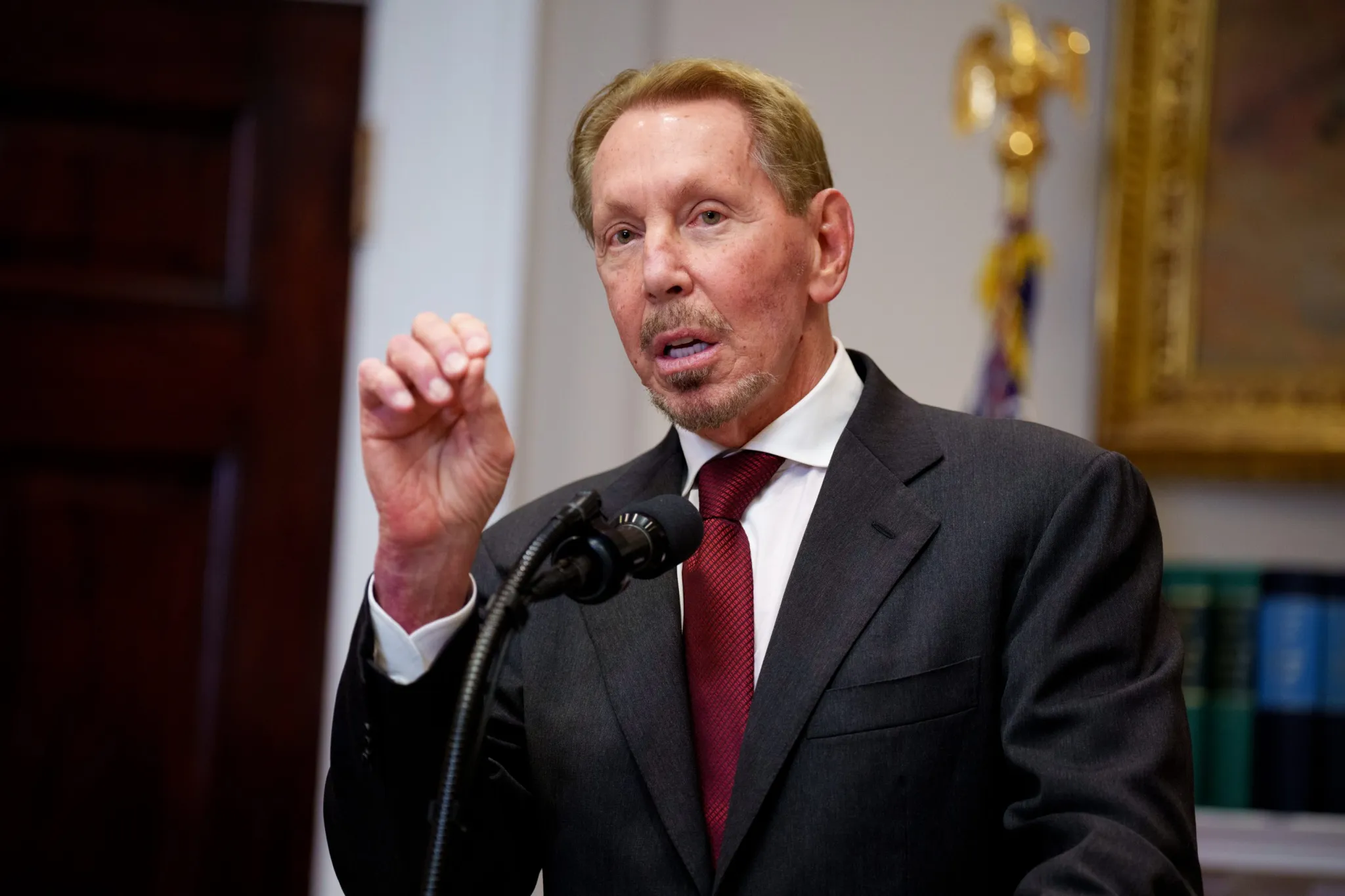
Stock options granted to Oracle Corp. co-founder Larry Ellison and its two co-chief executives ended fiscal 2026 with no intrinsic value after a 53% fall in the company’s shares over the past 12 months. Oracle’s stock closed Friday at $137, leaving the awards underwater even as the company reported sharp growth in cloud revenue and contracted future business.
Oracle assigned the executive option packages a combined grant-date value of $988 million during the fiscal year ended May 31, according to its annual proxy statement filed with the U.S. Securities and Exchange Commission. The options were priced during stock rallies near market peaks. Under an internal reporting method that treats four option awards as equivalent to one full share, Oracle assigned a combined value of $400 million to the grants for Ellison and co-CEOs Clay Magouyrk and Mike Sicilia.
The share-price decline comes as Oracle undertakes a $55.7 billion capital expenditure push to expand artificial intelligence data center infrastructure and challenge Amazon Web Services, Microsoft Azure and Google Cloud Platform in hosting resource-intensive AI workloads. Construction and hardware purchases, including high-density graphics processing unit (GPU) server clusters, helped drive free cash flow to negative $23.7 billion in fiscal 2026, according to Oracle’s Form 10-K annual report.

Magouyrk and Sicilia became co-CEOs in September 2025, succeeding Safra Catz, who moved to executive vice chair. Days after their promotions, Magouyrk received options valued at $621.7 million on the grant date, while Sicilia received an award valued at $248.7 million. Both have an exercise strike price of $308 a share, requiring Oracle’s stock to rise more than 124% from Friday’s $137 close before either can realize cash value from the awards.
Oracle raised capital in both debt and equity markets to fund its expansion, issuing $43 billion in senior notes and selling $20 billion in common stock during the summer at $141 a share. The cost of insuring its debt against default reached record highs after Oracle invoked a force majeure clause on a major data center development project in New Mexico, underscoring supply-chain and utility power-grid bottlenecks facing mega-cap technology firms. Credit markets have reacted sharply to the company’s increased leverage and operational execution risks.
Ellison, Oracle’s co-founder and chief technology officer, received options valued at $117.8 million at their October grant date, with a strike price of $280 a share. The board said in the proxy filing that the awards’ lack of intrinsic value showed the pay structure was working as intended: stock options require sustained share appreciation to pay out. Major Fortune 500 corporations have largely moved away from options in favor of restricted stock units (RSUs) and performance-based equity. Oracle’s compensation committee said it had neither reset the strike prices nor issued compensatory awards to offset executives’ paper losses.
Oracle’s annual revenue nevertheless rose 17% to $67.4 billion. Overall cloud revenue increased 39% to $34 billion, including a 77% surge to $18.1 billion at Oracle Cloud Infrastructure (OCI), which provides core compute and storage capacity. Remaining performance obligations (RPO), or contracted future revenue not yet recognized, reached $638 billion at the end of fiscal 2026, compared with $138 billion a year earlier, reflecting long-term enterprise commitments for cloud infrastructure and database services.
While their options lost intrinsic value, Ellison, Magouyrk and Sicilia each received $4.9 million in annual cash bonuses for fiscal 2026. Ellison also received his first base-salary increase in years, from $1 annually to $950,000, bringing his fixed pay into line with the two co-CEOs.
During the executive restructuring, Oracle introduced an “Equity Choice Program” to retain talent. It lets executives take their time-based equity entirely as options, entirely as RSUs or as a 50-50 split. For a given grant allocation, Oracle awards four times as many options as RSUs to account for market risk. Catz, Chief Legal Officer Stuart Levey and Chief Operations Officer Douglas Kehring chose RSU allocations; Mark Hura, president of global field operations, chose options.
Chief Financial Officer Hilary Maxson joined in April 2026 with a $30 million total pay package, including $26 million in equity. She chose to receive $10.4 million of her award in RSUs. That portion was worth $12.7 million at the fiscal year-end but had fallen to $7.7 million by Friday’s close. The rest of her equity award consists of options with a $185-a-share strike price, which also remain underwater.
The majority of stock options held by Oracle employees across the company are underwater after the year-long share decline. Oracle carried out multiple rounds of workforce reductions during the fiscal year to streamline operations, while median annual compensation for its global workforce fell from $98,899 in fiscal 2025 to $94,740 in fiscal 2026, according to the filing. Shareholders are scheduled to vote on executive compensation packages and governance policies at Oracle’s annual general meeting on Nov. 18.