Minus33 Revives a Century-Old New Hampshire Wool Mill
Debt-free operations, Amazon marketplace restructuring, and deep inventory reserves fueled the outdoor apparel maker's post-pandemic growth.
ASHLAND, N.H. — A family-owned textile mill in central New Hampshire that nearly collapsed during the early 2000s offshoring wave has restructured itself into a debt-free outdoor apparel company, leveraging direct-to-consumer e-commerce and strict inventory controls to quadruple its profits over the past six years.
Minus33, which manufactures merino wool base layers, socks, and underwear, operates out of the same Ashland building where the L.W. Packard Mill began producing wool broadcloth in 1916. The privately held company is owned by 72 shareholders, predominantly family members, and refuses to take on outside venture capital or bank debt to fund expansion.
The operation represents a rare survival story in an industry decimated by globalization. U.S. textile mills employed roughly 500,000 workers in 1990, according to Bureau of Labor Statistics data. That figure plummeted to under 80,000 by early 2026 as apparel production migrated overseas. Minus33’s predecessor business felt the full weight of that shift. After peaking as a $50 million cashmere processing operation with about 300 employees in the 1990s, the mill was reduced to three people and zero revenue by 2002 when its New York garment-maker clients moved manufacturing abroad.


The pivot from industrial B2B supplier to consumer brand began when Lawson Glidden’s father, a textile engineer, partnered with an overseas supplier capable of spinning machine-washable merino wool. He initially produced base layers for hunting companions before word-of-mouth demand forced commercialization. Merino wool, unlike traditional coarse wool or the cashmere the family previously processed, offers natural temperature regulation, moisture wicking, and odor resistance without requiring dry cleaning—properties that fueled the explosive growth of the outdoor recreation market throughout the 2010s.
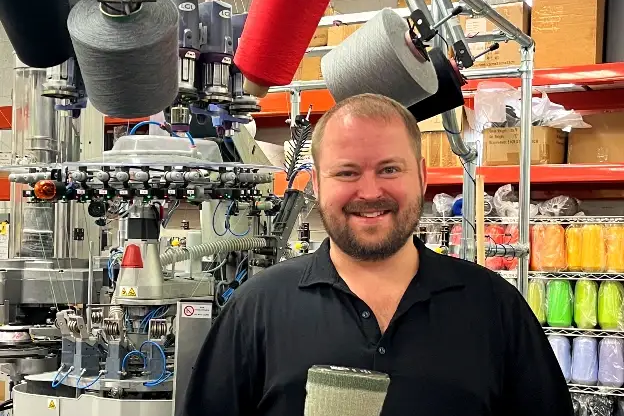
Lawson Glidden, now 39 and serving as company president, left a career in regulatory software consulting to join the business in 2018. His first operational move was purchasing sock-knitting machines and learning to program them directly. Minus33 launched domestic sock manufacturing in 2019.
Rather than engineering socks for retail shelf appeal—a common industry practice where manufacturers add bulk and synthetic fillers to make products look larger and more substantial—Glidden optimized the knit structure for anatomical fit. Tighter construction reduces friction against the skin, allowing the company to minimize nylon reinforcement and maximize the wool content. The tradeoff is a visually smaller, plainer product that defies conventional retail merchandising logic but addresses the primary complaint of long-distance hikers: blistering.
Scaling the business required dismantling the company’s legacy distribution model. Prior to 2019, Minus33 functioned almost entirely as a wholesale network with minimal public visibility. Glidden systematically built a digital sales infrastructure, starting with pay-per-click advertising, followed by a website overhaul in 2020, and eventually expanding onto third-party marketplaces.
A critical margin improvement came from restructuring the company’s relationship with Amazon. Minus33 exited Amazon’s Vendor Central program—where the platform purchases inventory wholesale and dictates pricing—and shifted to Seller Central, retaining ownership of the stock and control over retail pricing. This transition insulated the company from the margin compression typical of wholesale relationships with major retailers like Walmart and Target.
While the brand distributes through approximately 700 independent brick-and-mortar retailers, Glidden enforces a strict prohibition preventing those partners from selling Minus33 products on their own websites. All online orders route through the company’s centralized platform, ensuring uniform customer service and capturing direct consumer data, a strategy increasingly adopted by heritage brands attempting to protect margins against digital discounting.
Financial discipline remains anchored in the trauma of the 2002 collapse. The company funds all initiatives through operating cash flow. Glidden caps experimental marketing spends at amounts small enough that a total failure would never trigger layoffs, accepting a high rate of failed tests in exchange for verified data. One such experiment testing magazine advertising cost $20,000 and yielded no return, but provided definitive proof to abandon the channel.
This conservative capital approach intersected with aggressive supply chain planning just before the global economy locked down. In 2019, Glidden instituted a policy requiring two years’ worth of inventory on hand before authorizing any doubling of company size. When pandemic-era supply chain disruptions left competitors unable to fulfill orders in 2020, Minus33 had the warehouse depth to absorb the demand surge, effectively doubling its revenue while rivals faced stockouts.
Revenue has since grown between 2.5 and three times its 2018 levels, with returning customers increasing annually by roughly 30 percent. Because the company is private, these figures cannot be independently audited, though the 72 shareholders receive annual dividends based on their stakes. Glidden holds approximately 5 percent of the company after incrementally increasing his share.
Unlike outdoor industry giants such as Smartwool, which is owned by VF Corporation, or Icebreaker, acquired by Columbia Sportswear, Minus33 remains entirely independent. The board of directors is nominated annually by the shareholders, who then elect the president, maintaining a governance structure unchanged in its fundamental mechanics for over a century.
Marketing remains the company’s most active development frontier. Having conquered search advertising and marketplace logistics, Minus33 is currently engaging external agencies to build a social media presence, attempting to translate highly technical, utilitarian garments into compelling digital content without resorting to the stylized graphics common among outdoor lifestyle brands.
Glidden continues to live in Ashland, a town of fewer than 2,000 residents situated five minutes from Squam Lake in New Hampshire’s Lakes Region, personally testing prototype garments on local trails and verifying quality control metrics on the factory floor after every hike.