Marshall sought water earmark near his Kansas ranch
Watchdogs flag a conflict of interest as the Republican senator faces a tightening reelection race against Democrat Adam Hamilton.
U.S. Sen. Roger Marshall secured $4.2 million in federal funding to pump water into a Kansas wildlife refuge through a pipeline running adjacent to a commercial ranch he co-owns, a move government watchdogs say creates a conflict of interest for the Republican lawmaker as he faces an unexpectedly competitive reelection campaign.
The appropriation directs water from a separate watershed through Rattlesnake Creek — which borders Marshall’s Rattlesnake Ranch — and into the Quivira National Wildlife Refuge. The project aims to resolve a decades-long dispute between agricultural irrigation demands and conservation needs that has steadily depleted water levels at the 22,000-acre refuge since the 1970s.
Marshall holds a 20% ownership stake in Rattlesnake Ranch and serves as a director of the business entity registered in Kansas. Senate financial disclosures show the property generates income through building rentals and oil and gas leases. He co-owns the land with hunting associates who are also documented campaign donors. After previously holding or co-holding more than 1,000 acres near Quivira, Marshall reduced his holdings after winning his Senate seat in 2020 but retained the ranch.


Burke Griggs, a Washburn University law professor and former state water rights attorney, said stabilizing the water supply at Quivira directly elevates surrounding land values because the region supports a massive waterfowl hunting economy. Hundreds of thousands of ducks and geese migrate through central Kansas each fall, drawing hunters whose spending sustains local businesses and property markets. A reliable water source means consistent bird populations, which translates into higher valuations for nearby recreational and commercial parcels.
Craig Holman, a lobbyist for the nonprofit Public Citizen, argued Marshall should have recused himself from legislative efforts tied to the project. Senate rules prohibit members from requesting earmarks when the principal purpose is personal financial gain. Because the Quivira initiative broadly benefits regional agriculture and the U.S. Fish and Wildlife Service, Holman assessed that the request likely does not technically violate the letter of the rule, even as it breaches its spirit.
A spokesperson for Marshall, Payton Fuller, stated all water from the project flows exclusively into the refuge and that Rattlesnake Ranch would not benefit. She described the infrastructure as essential to saving farms and supplying water during drought years. Fuller added that the ranch is not used for waterfowl hunting, though she did not address questions regarding its commercial operations or rental activities. Marshall’s office declined interview requests and did not answer detailed inquiries about the property.
The senator’s pursuit of the funding contradicts his established legislative record on congressional appropriations. Marshall voted four times to eliminate earmarks, publicly vowing in 2021 to “blow up the process” so no lawmaker could use them. He previously mocked Democratic spending bills as dripping with grease. Yet in January, months after securing the Quivira funding through broader spending legislation, he cast another vote attempting to strip earmarks from a separate appropriations package.
The water dispute escalated in 2023 when the Biden administration’s Fish and Wildlife Service formally requested Kansas guarantee adequate water delivery to Quivira. Under the state’s prior appropriation doctrine — where senior water rights holders can legally curtail junior users during shortages — the federal demand threatened to force farmers to reduce irrigation. Kansas lawmakers, including Marshall, successfully pressured the administration to withdraw the request, pledging instead to find a compromise that protected both growers and the ecosystem. The resulting $4.2 million pipeline bypassed the need to curtail agricultural water rights entirely by importing water from outside the stressed basin.
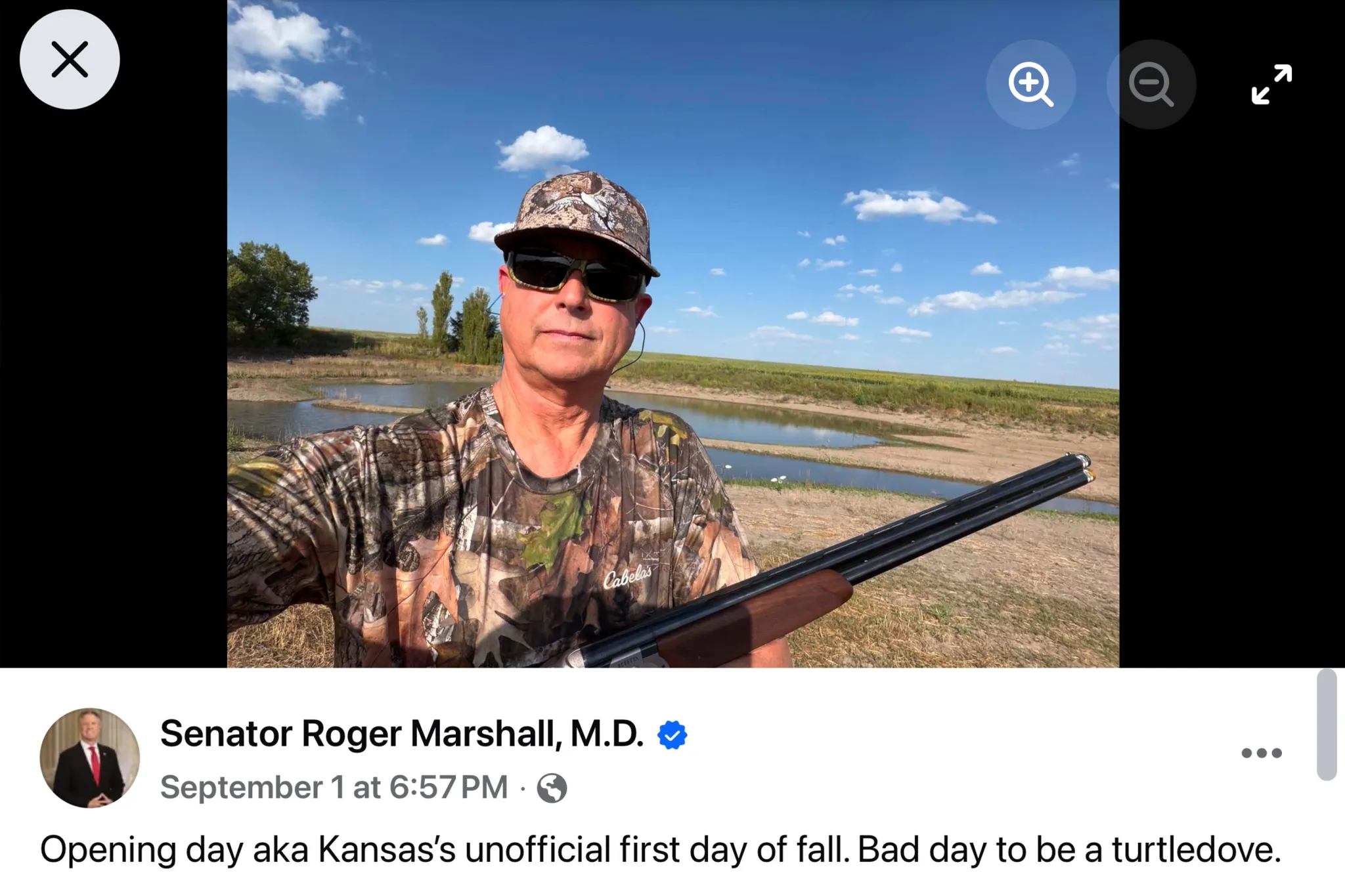
Marshall’s public identity is deeply intertwined with the region’s outdoor culture. He frequently posts photographs of harvested game online, and his official Senate website highlights his sandhill crane hunts near Quivira. In a 2022 interview with Lone Star Outdoor News republished by his office, he stated he hunts “as often as I can.” When announcing the water compromise, he explicitly cited his three-decade history as a property owner along Rattlesnake Creek.
The controversy emerges as Marshall defends his seat against Democrat Adam Hamilton, a former Republican who leads the nation’s largest United Methodist church. Trump carried Kansas by 16 points in the most recent presidential election, and the state has not sent a Democrat to the Senate since 1932. Despite those structural advantages, Republican political organizations have committed millions of dollars in emergency advertising to protect Marshall’s lead heading into November.