

Lukashenko Balances Moscow’s War Machine With Openings to Washington
Belarus keeps Russia close while testing limited ties with Washington

WASHINGTON — Three decades after taking power in Minsk, Belarusian President Alexander Lukashenko is using his country’s strategic military alignment with Moscow while pursuing rare diplomatic openings with Washington. Belarus remains tied to Russia’s military logistics and operational planning even as Minsk tests limited economic engagement with the West.
The United States recently lifted specific sanctions on Belarusian potash, a key component in agricultural fertilizers, after a deal secured the release of political prisoners. Lukashenko confirmed on Sept. 11 that Belarus had resumed potash shipments to the U.S. market. State-owned Belaruskali had historically produced nearly one-fifth of global potash output, but Western restrictions imposed after Minsk’s post-2020 election crackdown and its later support for Moscow’s war effort had crippled the company.
That targeted sanctions relief contrasts with the position of neighboring European Union member states along NATO’s eastern flank. European nations continue to maintain a rigid economic embargo against Minsk for its complicity in Russia’s invasion of Ukraine. Lithuanian Foreign Minister Kęstutis Budrys said Vilnius opposes any broader rollback of punitive measures against the regime. “We do not see any reasons why our position on Belarus should soften as Belarus is not changing its behaviour,” Budrys said, emphasizing that international pressure on Minsk must remain firm.

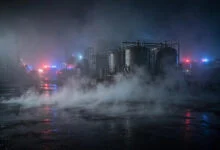
Belarusian armed forces have not directly committed ground troops to combat in Ukraine, but Belarus served as a primary staging ground for Russian forces invading toward Kyiv in February 2022. Minsk also continues to supply critical components to the Russian defense sector and permits Russian forces to use Belarusian airspace and ground territory for strike operations against Ukrainian infrastructure.

Construction recently began in Gomel Oblast, along Belarus’s southern border with Ukraine, on a specialized railway network designed specifically to handle heavy military transport trains. The two countries also maintain routine joint operational readiness through large-scale maneuvers such as the periodic “Zapad” (West) exercises, which simulate high-intensity conflict along the borders of Poland and the Baltic states.
Moscow’s transfer of tactical nuclear weapons to Belarusian territory further solidified the defense relationship. It was the first such deployment outside Russian borders since the 1991 dissolution of the Soviet Union. The partnership’s structural backbone is the 1999 Union State treaty, a bilateral framework intended to integrate the economies, defense policies and political structures of Russia and Belarus.
Lukashenko, a former Soviet collective farm manager who became president of Belarus in July 1994, is Europe’s longest-serving head of state. Russian President Vladimir Putin has led Russia continuously as president or prime minister since late 1999, serving presidential terms from 2000 to 2008 and from 2012 to the present.

At a youth forum titled “Youth. Belarus. Future.” in Minsk on Sept. 17, Lukashenko discussed his long tenure and his personal relationship with Putin. “They say I’m the last dictator, the last dictator in Europe,” Lukashenko told the audience. “Dictator—so be it. Well, Vladimir Vladimirovich Putin and I often argue, jokingly, about which of us is the bigger dictator.”
Lukashenko said international perceptions of his governance arose from his decision to “stand up against the entire ‘civilized world’.” Constitutional amendments in Belarus removed presidential term limits, and while addressing political succession, he argued that no potential successor is prepared to take control of the state apparatus.
“Never believe those who say that Lukashenko is ‘clinging to power with blue-knuckled hands’,” he said, adding that he had “had my fill of this power.” He then told the audience: “The only question is whether you are capable today of taking over the country and holding on to it. If you are, start tomorrow. To be frank, I cannot yet answer that question positively.”
Bilateral summits and public endorsements continue to reinforce Lukashenko’s diplomatic ties with Moscow. After meeting Putin in person in Moscow on Aug. 27, Lukashenko issued a formal message on Sept. 21 congratulating the Russian president on recent election outcomes. He praised high voter turnout and the performance of the ruling United Russia party, characterising the political outcome as a necessary defense against external attempts to discredit the Russian government and foster internal division.

One Comment