

Jensen Huang Sees Nvidia Chip Sales Doubling as Nations Build Sovereign AI
Nvidia’s chip boom collides with the global debate over AI rules and energy
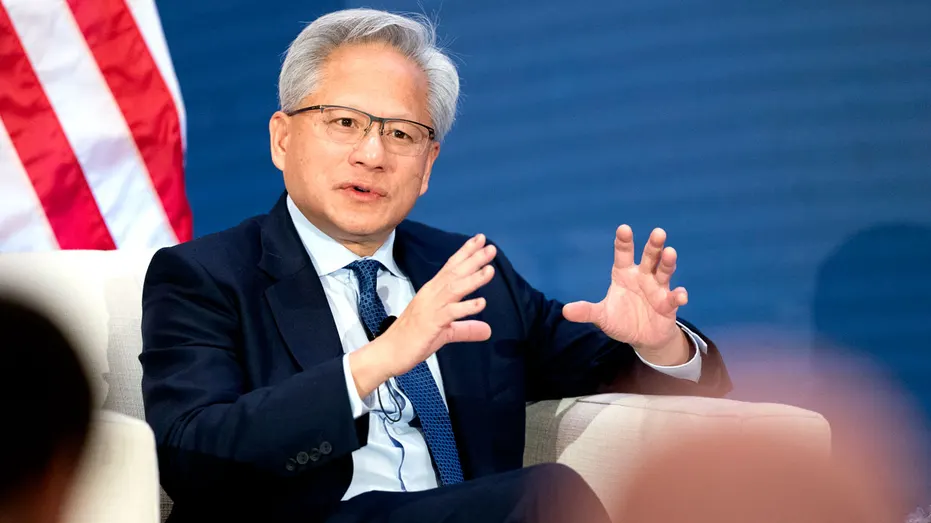
Nvidia Corp. Chief Executive Jensen Huang projected that his company’s chip sales will double over the coming year as sovereign nations invest in domestic artificial intelligence infrastructure. He revealed the forecast during high-level meetings in Scotland, where governments and enterprise cloud providers were rushing to secure high-performance graphics processing units (GPUs).
The push for “sovereign AI” involves countries building their own computing facilities to train models with local data, infrastructure, and languages. Nations seeking digital autonomy have accelerated that trend, while Nvidia, headquartered in Santa Clara, California, has moved from its Hopper GPU architecture to next-generation Blackwell chips for hyperscale data facilities around the world.



The hardware expansion was also discussed at an international gathering convened by King Charles III at Dumfries House in Cumnock, Scotland. Executives and research leaders from Google DeepMind, OpenAI, Anthropic, and Nvidia met there to evaluate safety standards and the environmental footprint of large-scale compute infrastructure.
High-density data centers, often described as “AI factories,” require continuous, multi-gigawatt power supplies. Their growth has exposed limits in global electrical grids, created localized transmission bottlenecks, and raised long-term energy concerns.
Huang said the rising energy requirements of data centers would accelerate investment in clean energy generation. Reliable, baseload power for computing facilities is drawing more capital toward nuclear fission, fusion research, hydroelectric projects, and utility-scale solar and wind power. Major compute operators have also begun signing direct power purchase agreements with energy producers and exploring small modular reactors (SMRs) for dedicated, low-carbon power at next-generation data centers.

The expansion of localized compute capacity has unfolded alongside a policy rift over AI governance in Washington and European capitals. OpenAI and Anthropic have advocated formal safety standards, licensing regimes, and regulatory guardrails to prevent systemic risks. Meta Platforms Inc. and Nvidia, by contrast, maintain that heavy-handed rules could entrench incumbents, restrict competition, and impede open-source development.
U.S. economic and technology policy officials have increasingly identified open-source AI models as important to international competition. Economic leaders supporting open-weights technology argue that accessible software architecture is necessary for American technological leadership and for countering state-subsidized AI advances from China. They contend that broad open-source availability lets global developer ecosystems build on Western frameworks, while strict regulatory barriers could restrict domestic innovation.
Huang urged software engineers and AI developers to conduct rigorous internal testing before releasing commercial tools. “It is the responsibility of the AI companies ourselves to develop the technology safely and to properly test it,” Huang said, adding that recent industry deployment errors should warn developers. “If it’s not ready, just hold it back. You should go as fast as you can, but no faster than that.”
He rejected comparisons between artificial intelligence and the early rise of social media platforms, which expanded with minimal industry-specific regulation. Huang instead compared AI with complex industrial components, including commercial aviation engines, that require contained testing environments and strict quality controls before public deployment.
Huang argued against creating novel statutory frameworks specifically for artificial intelligence and advocated adapting existing legal structures across specialized sectors. Healthcare, transportation, automotive safety, and financial-services regulations already establish legal boundaries for technology deployment, he said, with enforcement focused on how AI is applied within those domains.
While technology companies must remain accountable for operational mishaps, Huang said regulatory approaches should avoid curtailing technological advancement, which he described as essential for broader economic and industrial development.










One Comment