

Reflection AI Launches Beam to Challenge China’s Open-Source Lead
Backed by $7.3 billion in compute agreements, the New York startup targets enterprise efficiency to counter Chinese dominance in open-weight architectures.
New York startup Reflection has released Beam, an open-source artificial intelligence model engineered to run complex reasoning tasks at a fraction of the computational cost required by current industry standards. The launch marks the first product from a company that has rapidly assembled one of the largest infrastructure war chests in the generative AI sector.
Beam targets enterprises and government agencies seeking high-performance coding and agentic capabilities without relying on proprietary, closed-system APIs. Through high-compute reinforcement learning—a training methodology that rewards models for generating correct step-by-step logic—Reflection claims Beam operates three to four times more efficiently than competing Western open models. Internal benchmark testing places its performance on par with GLM-5.2, an open-weight model released in July by Beijing-based Z.ai.
The efficiency metric addresses the primary bottleneck in deploying large language models at scale: inference cost. While proprietary systems from Anthropic, OpenAI, and Google DeepMind dominate general-purpose benchmarks, they require users to route data through external servers via API calls. Open-source alternatives allow organizations to download entire model weights, host them on private infrastructure, and fine-tune them for specific operational needs. This architecture is increasingly mandatory for defense contractors, healthcare networks, and financial institutions bound by strict data sovereignty regulations.


Reflection secured access to those regulated environments early. In May, the company finalized partnerships to supply its models to the U.S. Department of Energy and the U.S. Department of War.
To sustain the compute demands of training frontier open models, the company locked in $7.3 billion in hardware agreements over two months. A $6.3 billion deal signed in June secures access to Nvidia GB300 chips housed at SpaceX’s Colossus 2 data center, according to CNBC. Nebius, a cloud infrastructure provider, added another $1 billion in compute capacity in July, Bloomberg reported.
The capital deployment reflects the physical reality of modern AI development. Training competitive open models requires clusters of tens of thousands of advanced GPUs running continuously for weeks. The Nvidia GB300 architecture, designed specifically for massive-scale transformer training, represents the current ceiling for commercially available AI silicon. Securing priority allocation for these chips effectively determines which companies can compete at the frontier.
Founded in March 2024 by Misha Laskin and Ioannis Antonoglou, both former researchers at Google DeepMind, Reflection reached a $25 billion valuation by April, backed by Nvidia. Laskin serves as CEO, while Antonoglou holds the roles of president and chief technology officer.
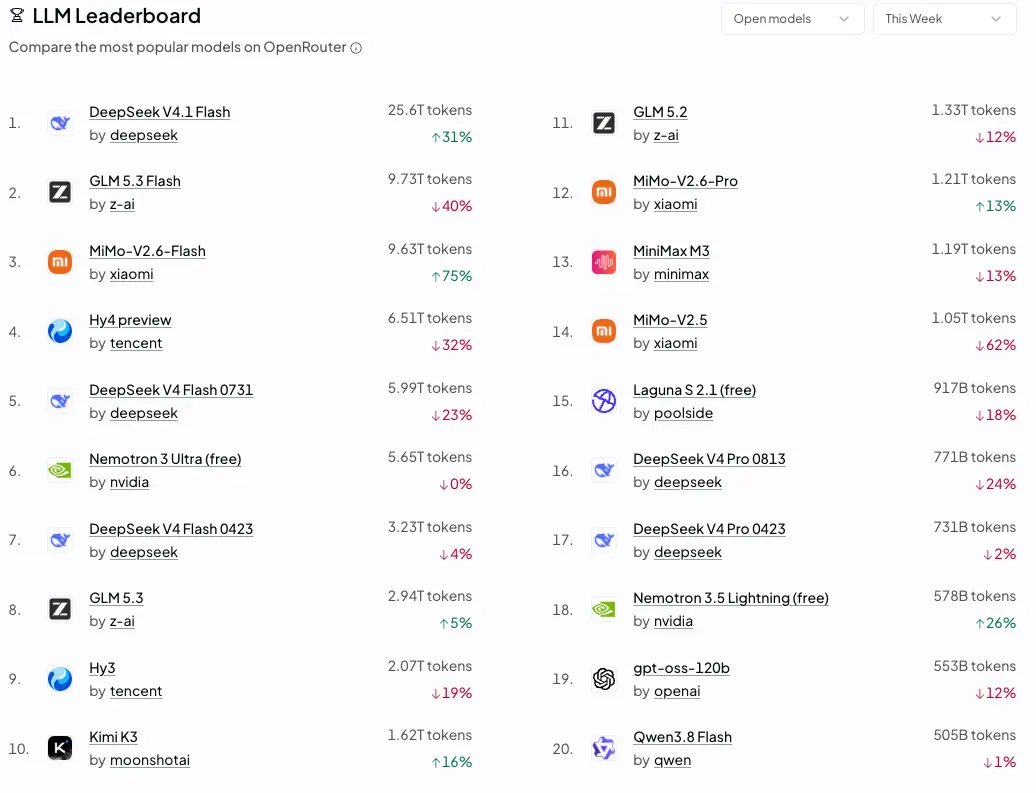
The broader leaderboard illustrates the challenge facing American developers. On OpenRouter, a widely used gateway that tracks real-world model utilization across multiple providers, filtering for open architectures reveals Chinese dominance. Models produced by DeepSeek, Z.ai, Xiamo, and Tencent occupy the top positions. Nvidia’s Nemotron currently stands as the highest-ranked U.S.-based open model at number six overall. OpenAI’s gpt-oss trails significantly at nineteenth place. Thinking Machines Lab, founded by former OpenAI CTO Mira Murati, introduced its Inkling model in July as another domestic attempt to close the gap.
Western tech giants have historically treated open releases as secondary to their flagship proprietary products. Meta’s Llama series remains the most widely adopted American open-weight family, yet it frequently trades peak benchmark scores for broader accessibility. Reflection’s approach attempts to invert that tradeoff by optimizing specifically for inference speed and token economy rather than raw parameter count.
The company confirmed it is already training the next, larger model on its roadmap.









