

Inside the U.S. Open’s New AI Serve Score
Hawk-Eye cameras and IBM AI turn players’ service motion into a public U.S. Open metric
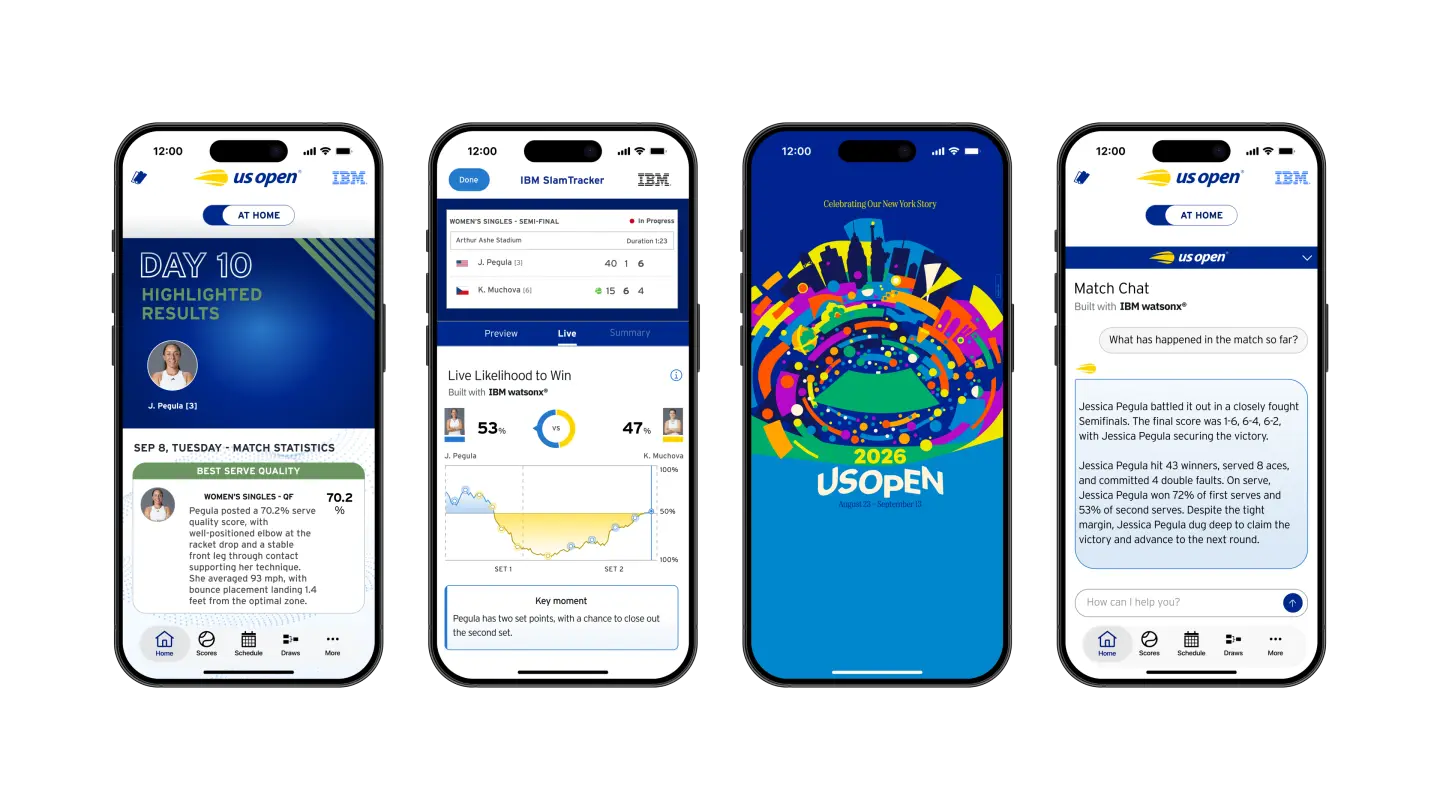
FLUSHING, N.Y. — Fans at the U.S. Open can now access advanced biomechanical analytics through the tournament’s official mobile application, which provides post-match evaluations of service motion. The expansion marks the first time a Grand Slam tournament has integrated optical skeletal tracking into its public digital platforms.
The metric, called “serve quality,” rates a player’s service motion on a 100-point scale. It was developed through a long-running collaboration between the United States Tennis Association (USTA) and technology partner IBM, and is powered by IBM’s watsonx artificial intelligence platform.
Serve quality metrics become available immediately after each singles match through an interactive chat and recap interface. Spectators can use it to query specific technical factors that influenced the outcome, while the system’s motion data also evaluates physical execution, ball trajectory, and the spatial precision of every serve.


The technology was demonstrated during the women’s semifinals matchup between world No. 3 Jessica Pegula and Aryna Sabalenka. Sabalenka secured the victory on the court, but the post-match algorithmic breakdown highlighted how kinematic efficiency and target accuracy factored into the contest.
According to data generated through the app’s AI-assisted match recap feature, Pegula registered a higher overall serve quality score of 72.32 percent compared to Sabalenka’s 71.95 percent. Pegula landed 75.95 percent of her 79 total serves inside the service box, hitting targets at an average distance of 1.555 feet from the calculated optimal serve zone.
At Arthur Ashe Stadium, 12 specialized Hawk-Eye cameras capture the real-time movement of 21 distinct anatomical points and joints on each singles player, including the wrists, elbows, knees, and hips. The cameras were originally deployed for automated electronic line-calling and form part of the multi-camera optical networks installed across the USTA Billie Jean King National Tennis Center.
Across the two-week tournament, IBM estimates that the system processes more than 1.2 billion skeletal joint data points. That produces roughly 7 million individual serve quality insights for the men’s and women’s singles draws.
“It all starts with the camera,” said Tyler Sidell, technology program director of sports and entertainment partnerships at IBM. “The Hawk-Eye cameras began to capture the limbs, and so we’re analyzing 21 limbs and joints from every single singles player, and then we’re feeding that into our platform that we built. That really helped speed up innovation.”
The motion data is fed into proprietary algorithms trained on academic biomechanics research, historical player movement, and match tracking datasets. Sidell noted that developers weighted the underlying scoring engine using peer-reviewed sports science literature to ensure the algorithm rewarded proper kinetic sequencing.
The serve was selected as the foundational metric because it represents the only closed-loop shot in tennis entirely under the player’s physical control. “There is so much data that now comes out of a tennis match,” said Brian Ryerson, senior director for digital strategy at the USTA. “Skeletal data is fairly new to us at the U.S. Open. We’ve had it the last few years, and it’s also a very rich and heavy data set.”
Ryerson said the primary challenge was translating dense spatial coordinates into an intuitive format for general audiences without compromising analytical precision. “One is really ensuring that it was understood by fans because it is a pretty technical data set, and we’re trying to distill that down,” he said. “And then I think what we were really looking for is how it can help enhance our day-over-day storytelling, and really making sure we’re as accurate as possible.”
The consumer rollout follows a multi-year engineering initiative. Markerless skeletal tracking made its competitive tennis debut through Hawk-Eye’s “SkeleTRACK” system at the 2024 Laver Cup, but the technology had previously been confined to internal officiating, performance analysis, and broadcast enhancements.
IBM and the USTA conducted private testing of the tracking framework over consecutive tournament cycles. They used data collected during the 2025 U.S. Open to train and refine the scoring models before deploying the system to the public in 2026.
The introduction of serve tracking is the initial phase of a broader expansion of optical motion analytics across professional sports. IBM and USTA officials confirmed that future iterations are exploring models to evaluate groundstrokes, including forehands and backhands, as well as racket kinematics and multi-year comparative player performance profiles.
IBM is also evaluating plans to introduce limb-tracking analytics across its other major sports properties, including potential deployments at the Wimbledon Championships and in professional golf at the Masters Tournament, where optical tracking could be applied to full swing mechanics.