How Ritchie Valens Made a 400-Year-Old Song Rock History
La Bamba’s roots and Ritchie Valens’ lasting place in American music

At 17, Pacoima high school student Richard Valenzuela was recording under the name Ritchie Valens and claiming space in an American music industry largely closed to Mexican Americans. From the working-class community in Los Angeles’ San Fernando Valley, he transformed a centuries-old Mexican folk style into a driving force of early rock ‘n’ roll and bridged the cultural divide of segregated America. Nearly seven decades after his life was cut short, his fusion is being celebrated as a critical cornerstone of American cultural history rather than simply a nostalgia act.
Valens was discovered in May 1958 by Bob Keane, owner of the independent Los Angeles label Del-Fi Records. At Gold Star Studios and Del-Fi’s Silver Lake studio, he combined traditional acoustic rhythms with electric guitars and simplified, energetic rock chords, creating a blueprint for the emerging West Coast “Eastside Sound.”
His music also moved through Southern California venues where segregation shaped entertainment. Valens frequently performed at the historic El Monte Legion Hall, an iconic San Gabriel Valley gathering place where Black, white, and Latino youths danced together. Legendary local figures such as radio DJ Art Laboe promoted the multicultural dance halls, which became early testing grounds for desegregation in the region.


“What really mattered to me was to emphasize that he was revolutionary,” said Hector Flores, artistic director of “Ritchie Forever” and a founding member of the Los Angeles-based Chicano band Las Cafeteras. “Singing about interracial love, singing in Spanish on the radio, playing at desegregated dance halls like El Monte Legion Hall here in L.A. He played music to unite people.”
The song most closely associated with Valens, his 1958 hit “La Bamba,” began more than 400 years earlier in Veracruz, Mexico. It existed as a *son jarocho*, a traditional folk style blending African, Spanish, and Indigenous musical elements, and survived centuries of colonialism and slavery before being reinterpreted in Southern California.
Flores spent years researching those roots. “Most people don’t know that La Bamba is a 400-year-old Afro-Mexican song… this song that survived colonialism and slavery,” he said. Valens was born into a highly segregated era, Flores noted, yet recorded a track that crossed racial and geographic borders. To understand modern-day cultural divisions in America, Flores looked back at trailblazers who had navigated those dynamics decades earlier.
Rafael Gonzalez, CEO of Grand Performances, had spent years conceptualizing a tribute to Valens. “As a kid, I was always fascinated by the way Ritchie claimed space at a time when Mexican Americans were not represented,” Gonzalez said. Valens’ cross-genre experimentation paved the way for later generations of rock artists. “You can’t deny Ritchie’s influence,” Gonzalez said.
That influence runs through mid-century Chicano rock groups such as Cannibal & the Headhunters and The Premiers, and into Carlos Santana’s Latin-infused psychedelic rock in the late 1960s. British rock group Led Zeppelin also drew directly from Valens: its 1975 track “Boogie with Stu” was heavily inspired by Valens’ “Ooh! My Head,” eventually leading to a legal settlement that credited Valens’ mother, Connie Valenzuela, for royalties.
On Saturday, Aug. 22, the downtown Los Angeles arts organization Grand Performances will present “Ritchie Forever: An Ode to an American Dreamer” at California Plaza. The free tribute will recontextualize Valens’ brief but explosive career and examine how a Chicano teenager entered a mainstream music industry that was largely closed to Mexican Americans.
The event will connect Valens’ generation with contemporary Southern California musicians through live reinterpretations of his catalog by Chicano and vintage-soul artists including Thee Sinseers, The Altons, Shannon and the Clams, and The McCharmlys.
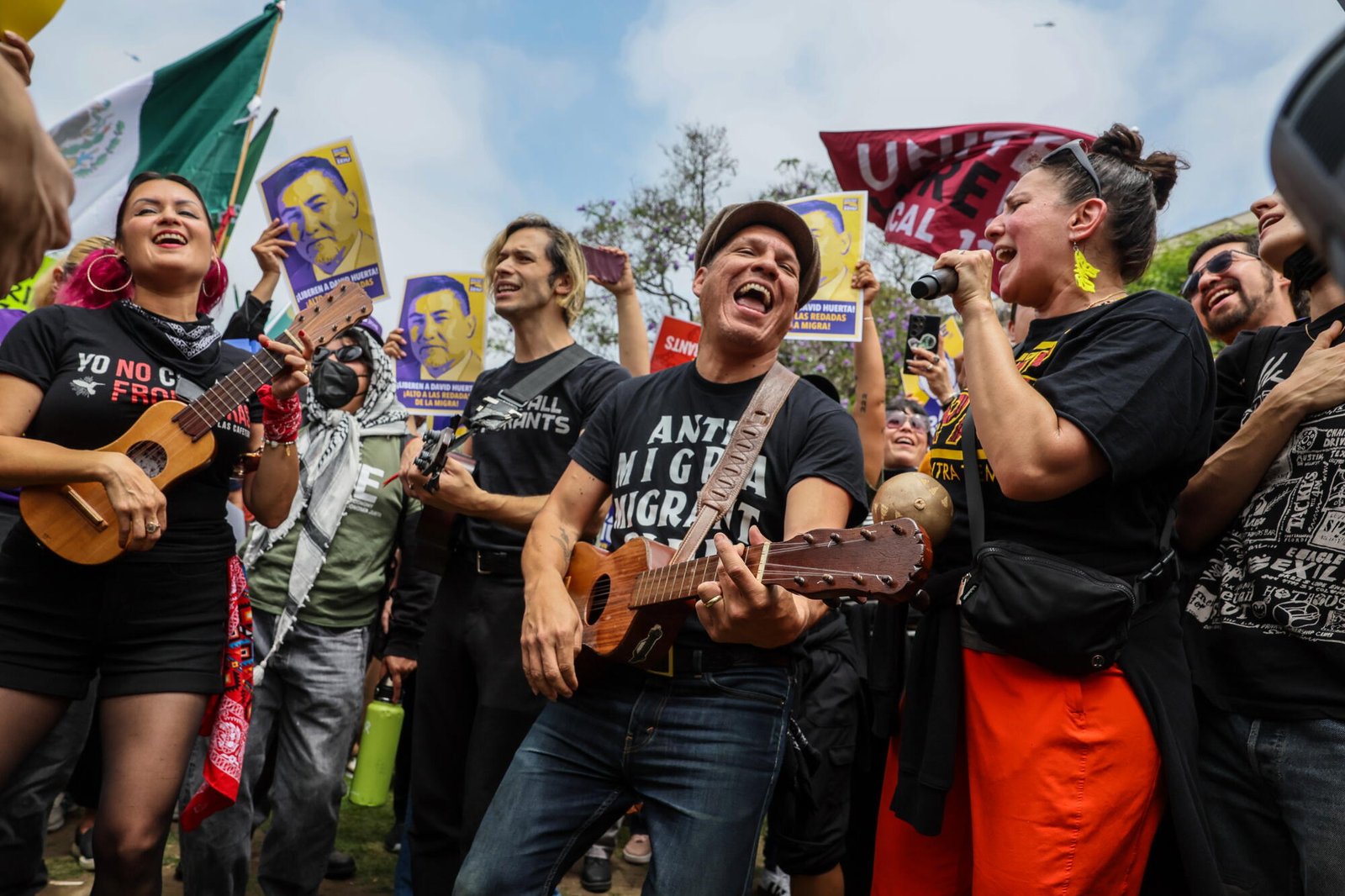
For Angie Monroy, a vocalist with the Santa Ana-based romantic rock ‘n’ roll band The McCharmlys, the performance is personal. “For Ritchie to come from nothing and become such a big figure, that we still play his music today inspires me so much,” Monroy said. “He made music that made people want to come together and dance. I’m excited to continue that.”
Organizing the tribute required building trust with Valens’ surviving family. His siblings Irma, Connie, and Mario each took their brother’s professional stage name to preserve his memory.
Flores first presented the concept during the 2024 Winter Dance Party, an annual festival at the Surf Ballroom in Clear Lake, Iowa. The festival commemorates the final concert played by Valens, Buddy Holly, and J.P. Richardson, “The Big Bopper,” on February 2, 1959. Flores traveled to Iowa specifically to pitch “Ritchie Forever” to Irma Valens.
The family receives a large volume of tribute proposals, and Irma and Connie were initially skeptical. “I didn’t want to move forward without her blessing,” Flores recalled. He returned to Iowa the following year with a locked-in date, venue, and promotional materials to demonstrate his commitment. After Irma approved the project, it developed into a multimedia experience featuring archival footage, family conversations, and live narration by Flores mapping Valens’ historical journey.
Valens’ career lasted only eight months. On February 3, 1959, a chartered Beechcraft Bonanza crashed in a snowstorm shortly after taking off from Mason City, Iowa. The accident killed Holly, Richardson, pilot Roger Peterson, and the 17-year-old Valens in what became known as “The Day the Music Died.”
Irma Valens was only nearly seven years old when her brother died, but she still vividly remembers the radio broadcast in their Pacoima home. “They listed off the names from the crash, and when they said Ritchie, she just broke down,” Irma said. “She couldn’t stop saying, ‘My hijo is dead.’ Even as much as people think of Ritchie as a rock ‘n’ roll star, at the end of the day, he was my mother’s son. He was only 17 years old. He was my older brother.”
The Valens family continues to view the downtown Los Angeles celebration through the permanence of his music. “We can’t say the music died. It never did,” Irma said. “It just keeps getting better as long as people keep remembering his story in different ways.”