CXMT Surges 466% in Shanghai Debut as China’s Largest Memory Chipmaker Reaches $487B Valuation
China's leading DRAM manufacturer raises $8.6B on the STAR Market amid tight U.S. trade restrictions and booming AI demand.
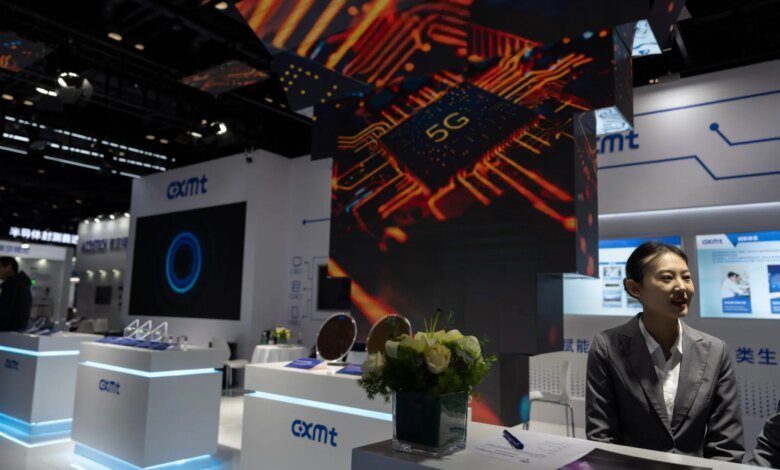
ChangXin Memory Technologies made a dramatic market debut on the Shanghai Stock Exchange’s STAR Market, with its shares skyrocketing 466% on the opening day. The listing raised at least $8.6 billion, positioning the Hefei-based DRAM manufacturer as mainland China’s most valuable publicly listed enterprise, carrying a market capitalization of approximately 3.3 trillion yuan ($487 billion).
The public offering stands as mainland China’s second-largest on record, surpassed only by the Agricultural Bank of China’s $22.1 billion dual listing in 2010. Offered at 8.66 yuan ($1.30) per share, the stock issuance reflects an aggressive domestic appetite for state-aligned technology firms capable of shielding China’s hardware ecosystem from external disruptions.
The market enthusiasm follows an unprecedented financial surge for CXMT. In the first three months of 2026, the chipmaker generated 50.8 billion yuan ($7.5 billion) in revenue—a greater than sevenfold increase year-over-year. Demand for dynamic random-access memory (DRAM) chips, essential components in mobile devices, automotive computing, and high-performance Artificial Intelligence servers, has outstripped global production capacity, escalating prices across consumer electronics.
Dynamic random-access memory serves as the primary volatile storage architecture in modern electronic systems, retaining data needed for immediate execution by processors. In advanced artificial intelligence workloads, stacked DRAM variants known as high-bandwidth memory (HBM) are critical to avoiding compute bottlenecks. However, sweeping U.S. trade restrictions on advanced equipment have blocked Chinese technology firms from acquiring foreign-made HBM units, turning CXMT into Beijing’s primary candidate to develop native HBM capabilities.
Despite its local dominance and massive market valuation, CXMT’s capital market worth remains below the combined scale of established global memory leaders. According to figures from Counterpoint Research, CXMT held approximately 8% of the global DRAM shipment market in 2025, climbing to roughly 9% in early 2026. South Korea’s Samsung Electronics dominated the landscape with a 36% market share in 2025, followed by SK Hynix at 29% and Idaho-based Micron Technology at 24%.
Counterpoint projects CXMT’s market share to reach 11% by 2028. However, industry analysts indicate that memory chipmakers typically require a minimum global market share of 15% to maintain long-term cost competitiveness against legacy incumbents.
Expanding manufacturing capacity remains a significant hurdle for CXMT due to restricted access to advanced lithography tools produced by foreign equipment vendors. MS Hwang, research director at Counterpoint Research specializing in memory semiconductors, highlighted that trade limits on manufacturing tools remain the principal operational bottleneck facing the company. Consequently, CXMT has been forced to increasingly rely on domestic toolmakers to scale up production runs.
Beyond tool access, the company faces growing geopolitical hostility from Washington. Listed by the U.S. Department of Defense as an entity with alleged links to China’s military—a designation Beijing strongly disputes—CXMT faces renewed pushback from American lawmakers urging President Donald Trump‘s administration to ban U.S. corporations from purchasing CXMT memory hardware.