Tokenized Real-World Assets Dominate Over 50% of Hyperliquid’s Weekly Volume in Landmark Market Shift
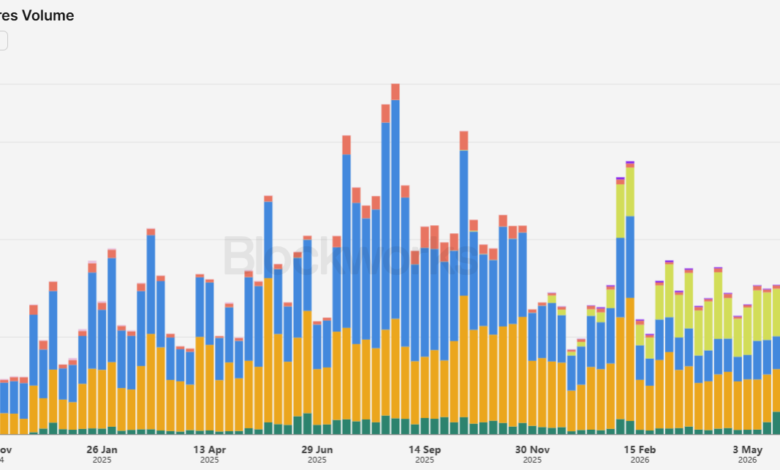
In a milestone for decentralized finance, trading in tokenized real-world assets (RWAs) accounted for the majority of weekly volume on perpetual futures exchange Hyperliquid for the first time, overtaking standard cryptocurrency derivatives.
Between July 13 and July 19, RWA-linked contracts generated $25.1 billion in trading volume, representing 52% of Hyperliquid’s $48.2 billion total weekly throughput, according to metrics compiled by Blockworks. Lorenzo Valente, research director for digital assets at ARK Invest, noted that Hyperliquid’s RWA perpetual market alone surpassed the combined crypto perpetual trading volume across every other decentralized exchange.
Unlike traditional futures contracts that require settlement at specified expiration dates, perpetual swaps allow traders to hold leveraged positions indefinitely through a continuous funding rate mechanism. Originally designed for digital tokens like Bitcoin and Ether, these instruments are increasingly being applied to offchain assets, including equity indices, commodities, and foreign exchange rates.
The shift coincides with expanding broader adoption of tokenized instruments. Data from analytics platform RWA.xyz shows the global count of RWA holders rose 32% over the past month to 1.25 million, while the aggregate value of tokenized real-world assets expanded to $36.7 billion—a 3.5% increase.
Hyperliquid’s surge in activity translated into $7.6 million in weekly fee protocol revenue, based on tracking from DefiLlama. That performance placed the platform third among all crypto applications by weekly earnings, positioned directly behind leading fiat-backed stablecoin issuers Tether and Circle, which captured $112 million and $45 million respectively. While stablecoin firms primarily monetize interest yield on reserve assets like U.S. Treasuries, decentralized trading venues derive income directly from transaction fee slices.
Circle co-founder and chief executive officer Jeremy Allaire characterized the rising prominence of RWA trading on Hyperliquid as a “major structural shift” for digital asset markets, marking a pivot away from speculation limited to native crypto assets toward global macroeconomic exposure onchain.
Venture firm Pantera Capital previously highlighted the structural advantages driving perpetual contracts beyond traditional crypto boundaries. By offering uninterrupted 24/7 continuous price discovery, dynamic margin management, and eliminating roll costs associated with expiring contracts, onchain perpetuals provide an alternative framework to conventional derivatives venues.
The rapid growth of onchain perpetual venues has caught the attention of mainstream financial institutions. Jeffrey Sprecher, chief executive officer of Intercontinental Exchange (ICE)—the parent company of the New York Stock Exchange—recently urged regulatory bodies to establish a standardized framework for 24/7 onchain derivatives. Traditional financial institutions are simultaneously building out their own infrastructure; in March, the NYSE partnered with tokenization infrastructure firm Securitize to explore round-the-clock stock trading and settlement on public blockchains.