SEC Commissioner Warns Crypto Vaults and On-Chain Lending May Trigger Federal Securities Oversight
Commissioner Hester Peirce clarifies that moving DeFi activities on-chain does not exempt them from federal oversight.
Hester Peirce, a commissioner at the U.S. Securities and Exchange Commission (SEC), has issued a cautionary statement regarding the regulatory status of decentralized finance (DeFi) products. In a public address on Wednesday, Peirce clarified that crypto vaults and on-chain lending protocols often mirror traditional financial instruments and may fall under the agency’s jurisdiction depending on their operational structure.
The warning centers on products that involve discretionary management. According to Peirce, when a platform or protocol makes active decisions—such as allocating assets, selecting specific yield-generating activities, or establishing lending terms and liquidation thresholds—it may be crossing the line into regulated territory. These activities could classify the products as securities offerings or the entities managing them as investment companies or advisers.
Peirce, often referred to as “Crypto Mom” for her generally favorable stance toward digital asset innovation, emphasized that the underlying technology does not grant legal immunity. She noted that moving financial activities onto a blockchain does not inherently remove them from the scope of the federal securities laws administered by the Commission.
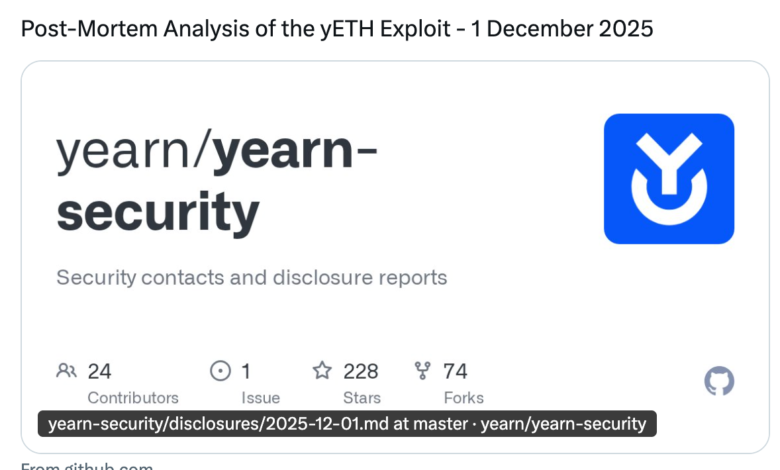
This regulatory scrutiny comes as the DeFi sector increasingly packages complex strategies into user-friendly “vaults.” These products pool investor assets to automate returns through staking, liquidity provision, or lending. While these offer convenience, they also introduce risks that have caught the attention of regulators. For instance, the decentralized finance protocol Yearn Finance experienced a roughly $9 million exploit in late 2023, highlighting the technical vulnerabilities inherent in automated yield strategies.
The SEC has historically used the Howey Test—a legal standard originating from a 1946 Supreme Court case—to determine whether a transaction qualifies as an investment contract. If a product involves an investment of money in a common enterprise with a reasonable expectation of profits derived from the efforts of others, it is typically deemed a security. Peirce’s comments suggest that the “efforts of others” in the context of DeFi may include the developers or DAO members who set the parameters for vault strategies.
The market for these products has expanded significantly this year. Major industry players have launched various iterations of on-chain yield tools. In May, the exchange Kraken introduced a Bitcoin vault that utilizes decentralized lending protocols like Aave to generate variable returns. Similarly, Wallet in Telegram recently integrated self-custodial vaults for major assets like Bitcoin and Ether, aimed at simplifying yield generation for retail users. Sentora also recently opened a platform designed to help users navigate and compare different DeFi vault strategies based on risk and reward metrics.
Peirce encouraged developers and operators of these platforms to engage with the SEC to determine if their products require registration or qualify for specific exemptions. The commissioner also invited feedback on how existing regulatory frameworks might be adapted to better suit the unique nature of on-chain finance, acknowledging the tension between traditional compliance and decentralized architecture.
If the SEC moves to enforce these standards, operators could face mandatory registration requirements and be forced to provide the same level of disclosure as traditional investment firms. This follows a broader trend of U.S. regulators targeting crypto lending; previously, firms like BlockFi reached multi-million dollar settlements with the SEC over the sale of unregistered interest-bearing accounts.