BC Prepares Fairy Creek Deferral Extension as Old-Growth Logging Clash Intensifies
British Columbia faces economic and environmental trade-offs as old-growth deferrals near expiration amid rising industry tariffs.
British Columbia Forests Minister Ravi Parmar will seek an extension to old-growth logging deferrals at Fairy Creek if a long-term agreement with the Pacheedaht First Nation is not reached before existing protections expire in September, even as Premier David Eby’s administration pledges to increase timber harvests across the province.
The impending deadline reopens a central policy friction for Canada’s westernmost province: balancing an industrial forestry sector supporting roughly 100,000 direct and indirect jobs—now facing U.S. softwood lumber tariffs exceeding 45%—against mounting pressure from environmental groups and First Nations elders to preserve Vancouver Island’s remaining ancient temperate rainforests.
BC officials argue that an immediate halt to old-growth logging would destabilize the regional economy. Although the province has deferred or protected 2.4 million hectares of old growth since 2021, government plans call for higher timber harvests to revitalize forest companies struggling with market headwinds.
“Forestry is the foundation of our economy. It provides good paying, family supporting jobs — about 100,000 direct and indirect,” said Parmar, who emphasized that investments are being made in second-growth hemlock milling to ease reliance on ancient timber. “If we were to shut down harvesting of all old forests here in British Columbia, it would shut down our sector completely on day one.”
While the provincial government reports that more than 11 million hectares of old growth remain across British Columbia, independent forest ecologists and conservation groups estimate that only about 415,000 hectares of high-productivity old growth—stands capable of growing the largest, thousand-year-old trees—are intact. On Vancouver Island, where temperate rainforests store more carbon per hectare than almost any ecosystem on Earth, roughly 20% of productive old growth remains, much of it still open to logging.
“Once an old-growth forest is logged, it will require millennia before it has the structure, composition and function of the forest that was logged — if in fact it can ever recover in times of changing climate,” said Andy MacKinnon, a forest ecologist in British Columbia.
Commercial activities in high-value stands of old-growth western red cedar—a highly durable species fetching premium prices in construction and export markets—continue to draw opposition. In the Walbran Valley on Pacheedaht territory, logging operated by Tsawak-qin Forestry, a joint venture co-owned by the Huu-ay-aht First Nation and Western Forest Products, has highlighted division over whether traditional lands should be prioritized for revenue generation or ecosystem preservation.
The policy uncertainty has brought land defenders and activists back to logging roads on southwest Vancouver Island, mirroring the 1993 Clayoquot Sound protests that led to over 850 arrests and the 2021 Fairy Creek blockades where more than 1,100 people were detained.
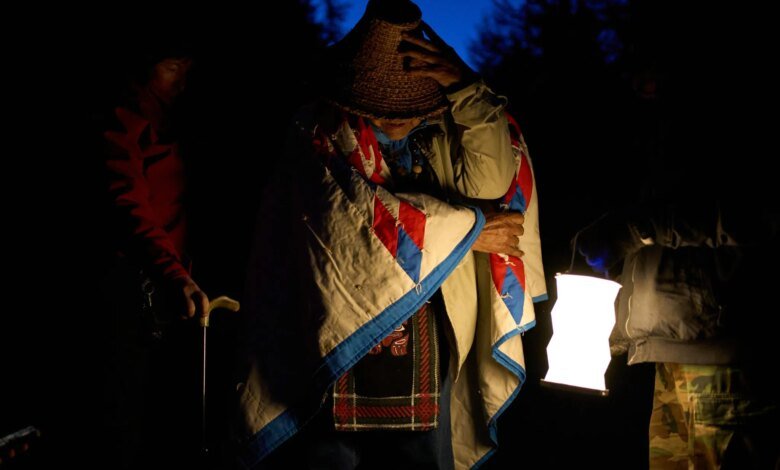
“There is no dispute about what happened to our land,” said Bill Jones, an 86-year-old Pacheedaht First Nation elder who began logging at age 18 before advocating for conservation. Sitting on a logging road during a blockade that turned back a timber truck, Jones pointed to decades of clear-cutting across traditional territory.
“There’s nothing left — it’s practically naked, bare,” he said. “There’s few remnants here and there, and so we have to save what we can.”
Jones added that the conflict reflects a broader breakdown in how communities relate to natural landscapes. “We’re just fighting over the leftovers.”
Blockaders have recently tracked expanding timber operations toward Ditidaht First Nation territory and north into the Prince of Wales range.
“This is our ivory trade,” said Steven “Shambu” Daniluk, a blockader who spent nearly two years on the front lines at Fairy Creek, drawing a parallel to global wildlife protection efforts. “People feel unheard,” he said. “Being engaged in this way, risking that arrest, is the only way.”
Outdoor enthusiast Veronika Sitar, who surveys ancient trees in northern Vancouver Island, recently identified surveyor flagging tape near General Buxton, one of British Columbia’s largest yellow cedars, marking the path of a proposed logging road.
“I don’t want to get too attached knowing what will be logged,” she said.